Monster
Typhon
Greatest and most fearsome monster in Greek mythology, last challenge to Zeus's rule.
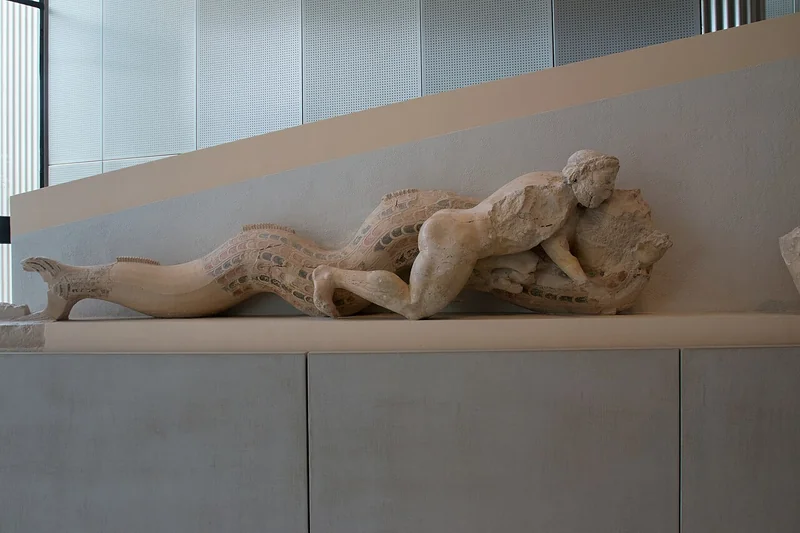
Typhon is the most powerful and fearsome monster in Greek mythology, described by Hesiod as the last great challenge to Zeus's rule. He is the son of Gaia (Earth) and Tartarus, with a hundred serpent heads that breathed fire and could produce the voices of all animals. He battled Zeus for control of the cosmos; Zeus defeated him with thunderbolts and buried him beneath Mount Etna (or Tartarus in other versions). The volcanic eruptions of Mount Etna were attributed to his continued struggles beneath the mountain. Typhon fathered many of the great monsters of Greek mythology with Echidna.
Quick facts
- Pantheon
- Greek
- Figure type
- Monster
- Period
- Attested from Hesiod (c. 700 BCE)
- Primary sources
- Hesiod Theogony 820–880; Apollodorus Bibliotheca 1.6.3; Pindar Pythian Odes 1.15–28
- Related figures
- zeus, echidna, cerberus, hydra, chimera, sphinx
Battle with Zeus
Hesiod's Theogony (820–868) narrates the battle between Typhon and Zeus as the final conflict for cosmic supremacy after the defeat of the Titans. Typhon arose from Tartarus, a creature of terrifying aspect: from his shoulders grew a hundred serpent heads, each breathing fire, with voices that sounded like every animal known. The battle shook the earth and sky; Zeus struck Typhon repeatedly with his thunderbolts and then crushed him beneath a mountain — Hesiod says 'a great part of the sprawling earth was scorched by the tremendous blast.' Pindar (Pythian Odes 1.15–28) identifies the mountain as Mount Etna in Sicily.
Typhon as progenitor of monsters
With the half-serpent, half-woman Echidna, Typhon fathered the canonical monsters of Greek mythology (Hesiod Theogony 306–325): Cerberus (the dog of Hades), the Lernaean Hydra, Orthus (the two-headed dog), the Sphinx, the Nemean Lion, the Colchian dragon that guarded the Golden Fleece, and others. Typhon and Echidna thus form the progenitor pair of the monstrous in the Greek mythological world. The word 'typhoon' (a powerful tropical cyclone) derives ultimately from Typhon's name, reflecting his association with violent elemental forces.
Sources & further reading (2)
- primary-source — accessed 2026-05-06
- encyclopedia — accessed 2026-05-06
Frequently asked questions
What is the connection between Typhon and Mount Etna?
Ancient Greek and Roman writers identified Mount Etna in Sicily as the volcanic mountain under which Zeus buried the defeated Typhon. Pindar (Pythian Odes 1.15–28, c. 470 BCE) describes 'the snowy mountain' as the prison of Typhon, attributing its volcanic eruptions to his continued fire-breathing. Aeschylus (Prometheus Bound 363–369) and later sources repeat the tradition. The myth provided an aetiological explanation for volcanic activity: the imprisoned monster's fire and struggling caused the eruptions observed at the real Mount Etna.
What monsters were children of Typhon?
According to Hesiod's Theogony (306–325), Typhon and Echidna were parents of Cerberus (three-headed dog of Hades), the Lernaean Hydra (multi-headed water serpent), the Chimera (fire-breathing composite beast), Orthus (two-headed dog of Geryon), and the Sphinx (riddle-asking monster of Thebes). Some sources also include the Nemean Lion, the Colchian dragon (guardian of the Golden Fleece), and the eagle that devoured Prometheus's liver among Typhon's offspring. Typhon and Echidna thus form the root of the Greek monstrous genealogy.