God
Tsukuyomi
The moon god of Japanese mythology, whose killing of Ukemochi caused the separation of day and night.
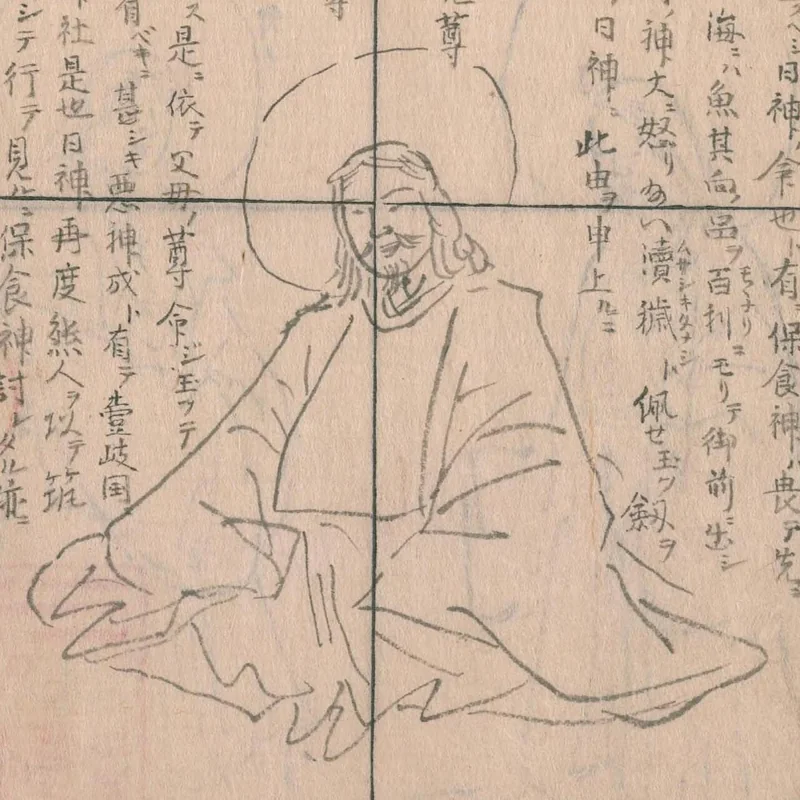
Tsukuyomi-no-Mikoto (月読命, 'Moon Reader' or 'Moon Counter') is the god of the moon in Japanese mythology, born from the right eye of Izanagi during his purification ritual. Izanagi assigned Tsukuyomi to rule the realms of the night alongside his sister Amaterasu. The defining myth of Tsukuyomi is his killing of the food goddess Ukemochi, whose method of producing food from her orifices he found repulsive. When Amaterasu learned of this, she declared Tsukuyomi wicked and vowed never to look upon him again — which is the mythological explanation for why the sun and moon are never in the sky at the same time. Described in the Kojiki (712 CE, trans. Chamberlain 1882) and Nihon Shoki (720 CE, trans. Aston 1896).
Quick facts
- Pantheon
- Japanese
- Figure type
- God
- Period
- Recorded in the Kojiki (712 CE) and Nihon Shoki (720 CE)
- Primary sources
- Kojiki (712 CE), trans. Chamberlain 1882: Book I, section 5; Nihon Shoki (720 CE), trans. Aston 1896: Vol. I, pp. 26–29
- Related figures
- amaterasu, susanoo, izanagi, ukemochi
Birth and separation from Amaterasu
The Kojiki (Book I, section 5, trans. Chamberlain 1882) records Tsukuyomi's birth from Izanagi's right eye during the purification ritual after returning from Yomi. Izanagi assigned him to rule the night in partnership with Amaterasu. The Nihon Shoki (trans. Aston 1896: Vol. I, pp. 26–29) provides a more elaborate account: Amaterasu sent Tsukuyomi to attend the food goddess Ukemochi on her behalf. Ukemochi produced food from her nose, mouth, and rectum — meat and rice and other provisions. Tsukuyomi was offended by the manner of production and killed her. From Ukemochi's corpse, food plants grew: silkworms from her head, rice from her eyes, millet from her ears, wheat from her genitals, soya beans from her anus. Amaterasu, upon hearing of Tsukuyomi's action, declared him evil and refused ever to look upon him again — explaining the perpetual separation of day and night.
Role and relative obscurity
Despite being one of the three great children of Izanagi — alongside Amaterasu (sun) and Susanoo (storm) — Tsukuyomi is the least developed of the three in the surviving texts. The Kojiki gives him almost no independent mythology beyond his birth; the Nihon Shoki's Ukemochi episode is his primary narrative. Scholars have noted this relative absence and proposed several explanations: the moon may have been associated with death or pollution in early Japanese culture (because of its connection to the underworld Yomi and menstrual cycles), making its god less publicly venerated. Shrines to Tsukuyomi are comparatively rare in the Shinto landscape, and his iconography is not well established in classical sources.
Sources & further reading (2)
- primary-source — accessed 2026-05-06
- encyclopedia — accessed 2026-05-06
Frequently asked questions
Why are the sun and moon never in the sky at the same time?
The Nihon Shoki (720 CE, trans. Aston 1896: Vol. I, pp. 28–29) explains this through the Ukemochi episode. When Tsukuyomi killed Ukemochi for producing food in a way he found disgusting, Amaterasu was furious. She declared: 'Tsukuyomi is a wicked deity. I must not look upon him face to face.' From that point, Amaterasu and Tsukuyomi lived separately, alternating between day and night but never appearing at the same time. The myth is a Japanese etiological narrative explaining the astronomical observation that the sun and the full moon are never simultaneously visible in the sky (one rises as the other sets), cast in terms of divine estrangement.
What is Tsukuyomi's role in Shinto practice?
Tsukuyomi is a relatively minor figure in Shinto practice compared to Amaterasu or Susanoo, partly because his mythology is thin in the canonical sources (Kojiki and Nihon Shoki). A handful of shrines are dedicated to him — notably Tsukuyomi-no-Miya within the Ise Jingū complex and the Tsukiyomi Shrine in Kyoto. In classical Japanese literature and poetry, the moon is frequently personified or invoked, but this tradition draws more on continental (Chinese) astronomical and literary convention than specifically on the myth of Tsukuyomi. As a deity of time-reckoning and the lunar calendar, he had practical relevance in an agricultural society, but his mythology was not as elaborately developed as that of his siblings.