Hero
Theseus
Hero-king of Athens who slew the Minotaur in the Cretan Labyrinth.
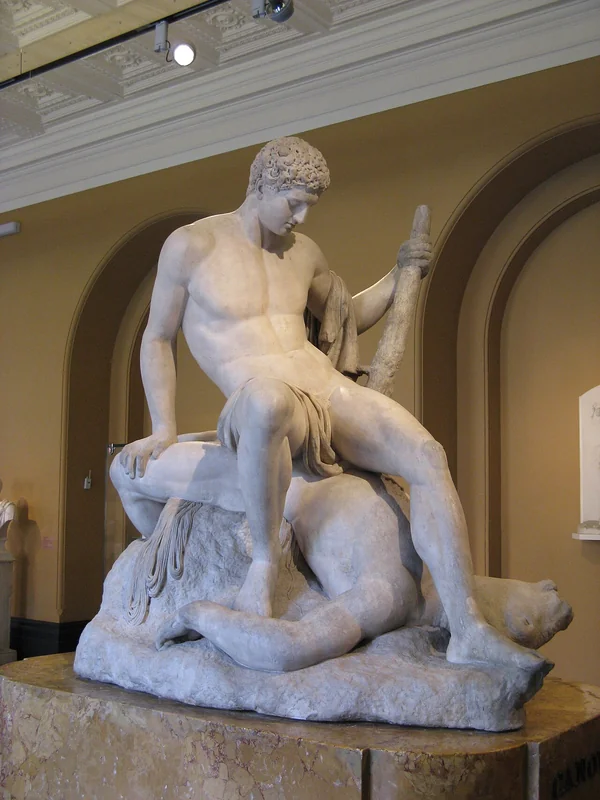
Theseus is the legendary hero-king of Athens and the most important hero in Athenian tradition. Son of King Aegeus of Athens (or of Poseidon, in some accounts) and Aethra of Troezen, he is best known for slaying the Minotaur in the Labyrinth of Crete. On his way to Athens he performed six labours clearing the road of dangerous bandits and monsters. Like Heracles, he became a civilising force in Greek mythology. Theseus was also credited with unifying Attica under Athenian leadership (synoikismos). His story is narrated by Apollodorus (Bibliotheca 3.15.6–16.2, Epitome 1).
Quick facts
- Pantheon
- Greek
- Figure type
- Hero
- Period
- Mythological hero; traditions place him in the generation before the Trojan War
- Primary sources
- Apollodorus Bibliotheca 3.15.6–3.16.2; Apollodorus Epitome 1.1–24; Plutarch Life of Theseus (Greek text, but drawing on earlier PD sources); Bacchylides Dithyramb 17
- Related figures
- minotaur, poseidon, heracles, ariadne, aegeus
Slaying the Minotaur
The myth of Theseus and the Minotaur is narrated in Apollodorus Epitome 1.7–9. Athens was required to pay a tribute to King Minos of Crete every nine years: fourteen young men and women to be fed to the Minotaur, a monster with a human body and bull's head, confined in the Labyrinth built by Daedalus. Theseus volunteered to go as one of the tribute-youths. In Crete, Princess Ariadne fell in love with him and gave him a ball of thread (the 'clew of Ariadne') to guide himself out of the Labyrinth. Theseus killed the Minotaur and led the other Athenians out using the thread.
The road to Athens
Before reaching Athens, Theseus cleared the road from Troezen by killing six dangerous bandits and monsters (Apollodorus Epitome 1.1–4): Periphetes (who clubbed travellers), Sinis (who tore victims apart by bending pine trees), the Crommyonian Sow, Sciron (who kicked travellers off a cliff into the sea), Cercyon (who challenged passers-by to wrestling matches), and Procrustes (who fitted guests to an iron bed by cutting or stretching them). These labours mirror the Twelve Labours of Heracles in structure and reflect Theseus's role as the civilising hero of Athens.
Sources & further reading (2)
- primary-source — accessed 2026-05-06
- encyclopedia — accessed 2026-05-06
Frequently asked questions
Who was Ariadne and what was her role in the Theseus myth?
Ariadne was the daughter of King Minos of Crete. When Theseus arrived in Crete as part of the Athenian tribute, Ariadne fell in love with him and helped him navigate the Labyrinth by giving him a ball of thread to unwind as he entered, enabling him to retrace his path after killing the Minotaur (Apollodorus Epitome 1.8–9). Theseus promised to take her back to Athens and marry her. However, he abandoned her on the island of Naxos; she was found there by Dionysus, who made her his consort.
What is the myth of Theseus and the black sails?
Before departing for Crete, Theseus promised his father King Aegeus that he would change his ship's black sails to white if he returned safely. On the return voyage, Theseus forgot to change the sails. Aegeus, watching from Cape Sounion and seeing the black sails, believed his son was dead and threw himself into the sea. The body of water became known as the Aegean Sea. This is recorded in Apollodorus Epitome 1.10 and in the Life of Theseus by Plutarch (drawing on earlier sources).