God
Takemikazuchi
The god of thunder and swords in Japanese mythology, who pacified the earthly realm for heaven.
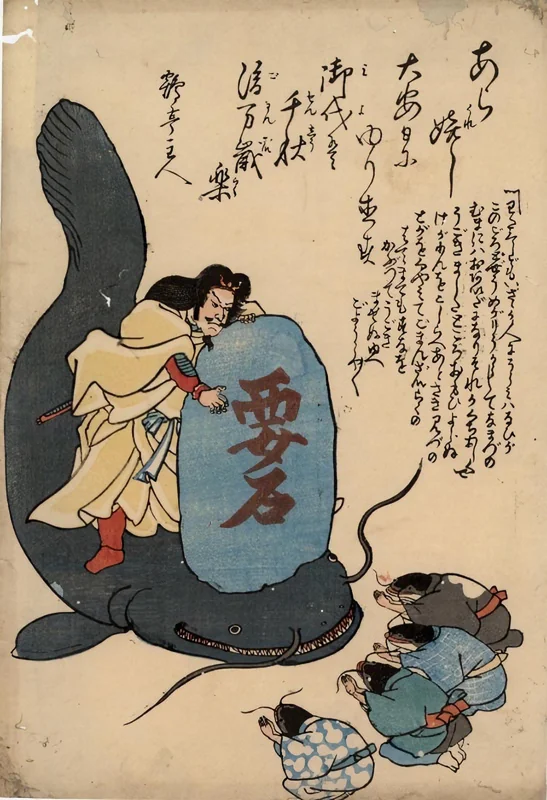
Takemikazuchi-no-Kami (建御雷之男神, 'Brave Thunder Male Deity') is the god of thunder and lightning and the patron deity of martial arts in Japanese mythology. He was born from the blood that dripped from the sword Izanagi used to slay the fire deity Kagutsuchi. He was sent by Amaterasu to negotiate the transfer of the land of Japan from Ōkuninushi to the heavenly gods. After Ōkuninushi's agreement, Takemikazuchi descended with the second messenger Futsunushi to formally complete the pacification. He was later asked by the gods to send down his sacred sword to Japan to assist the first emperor Jimmu's campaign, rather than descend himself. Takemikazuchi is enshrined at Kashima Shrine in Ibaraki Prefecture. Described in the Kojiki (712 CE, trans. Chamberlain 1882) Book I, sections 8, 32–35.
Quick facts
- Pantheon
- Japanese
- Figure type
- God
- Period
- Recorded in the Kojiki (712 CE) and Nihon Shoki (720 CE)
- Primary sources
- Kojiki (712 CE), trans. Chamberlain 1882: Book I, sections 8, 32–35; Nihon Shoki (720 CE), trans. Aston 1896: Vol. I, pp. 80–90
- Related figures
- amaterasu, okuninushi, izanagi, futsunushi
Birth and nature
The Kojiki (Book I, section 8, trans. Chamberlain 1882) describes Takemikazuchi's birth from the blood that fell when Izanagi cut off the head of the fire deity Kagutsuchi with the sword Totsuka-no-Tsurugi — specifically from the blood that collected on the rocks at the riverbed. His nature is therefore intrinsically tied to the sword and to the violent power of lightning. His name, containing the root kaminari (thunder/lightning), marks him as one of the kami of atmospheric phenomena. In the Nihon Shoki (trans. Aston 1896), he is described as born from the sparks when the sword struck the rock — an even more explicitly fire-and-strike origin. His martial character made him the patron deity of the warrior families of eastern Japan, particularly the Fujiwara clan.
Pacification of the land
Amaterasu's primary messenger Ame-no-Hohi had been sent to negotiate with Ōkuninushi first, but he was seduced by the land and failed to return for three years (Kojiki Book I, section 31, trans. Chamberlain 1882). The next messenger, Ame-no-Wakahiko, shot an arrow that struck and killed a pheasant-messenger and then, deflected back by divine power, killed him too. Finally Amaterasu sent Takemikazuchi and Futsunushi. Takemikazuchi thrust his sword into the sea-foam and sat upon its hilt, demanding Ōkuninushi's answer. After negotiations — Ōkuninushi's son Kotoshironushi agreed immediately; his other son Takeminakata wrestled Takemikazuchi and lost, fleeing to the tip of the Suwa peninsula — the land was peacefully transferred to the heavenly lineage.
Sources & further reading (2)
- primary-source — accessed 2026-05-06
- encyclopedia — accessed 2026-05-06
Frequently asked questions
What is the sacred sword associated with Takemikazuchi?
Takemikazuchi is associated with the sword Futsunomitama (or Futsu-no-Mitama-no-Tsurugi) in the Kojiki (Book II, section 37, trans. Chamberlain 1882) and Nihon Shoki. When Amaterasu's descendant Jimmu was struggling in his eastern campaign to pacify Japan, Takemikazuchi offered to send his sword to assist rather than descend himself. The deity Takakuraji received the sword in a dream — in his storehouse — and brought it to Jimmu. As soon as Jimmu received it, his enemies became confused and he was able to advance. The sword is enshrined at Isonokami Jingu (Stone-Up Shrine) in Nara Prefecture, considered one of Japan's oldest shrines, housing legendary divine weapons.
Why is Takemikazuchi important to Japanese martial arts?
Takemikazuchi's birth from sword-struck lightning and his role as the deity who physically subdued the earthly kami (notably his wrestling victory over Takeminakata, Kojiki Book I, section 34) made him a patron of martial power in general and swordsmanship and sumo wrestling in particular. Kashima Shrine (Ibaraki Prefecture), one of his principal shrines, is the origin of the Kashima Shinto-ryu, one of the oldest schools of Japanese swordsmanship (kenjutsu). The Kashima-Shinto-ryu tradition held that the deity Takemikazuchi directly transmitted sword techniques to the founders of the school, giving the school divine authority. Many later martial arts lineages traced their spiritual foundation through Kashima Shrine's tradition.