Place
Takamagahara
The Plain of High Heaven — the celestial realm of the kami in Japanese mythology.
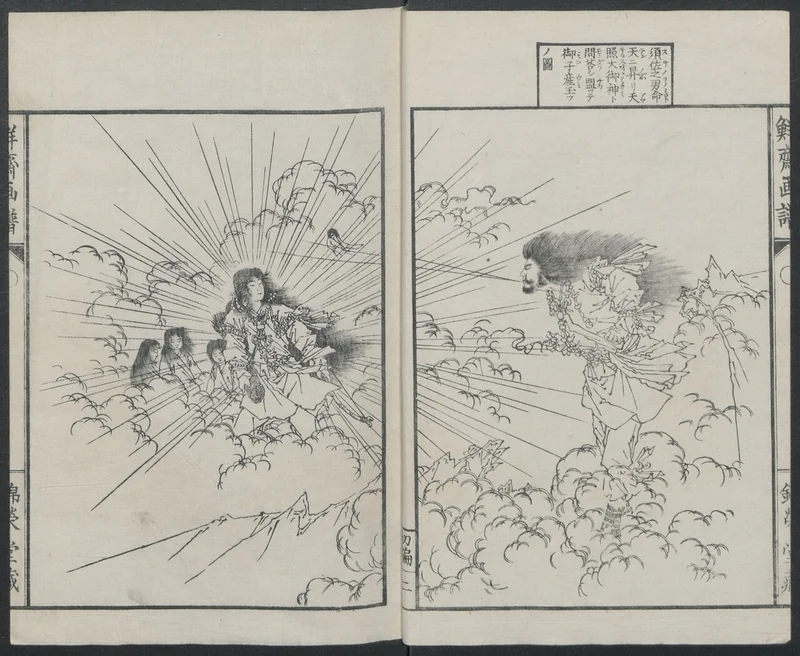
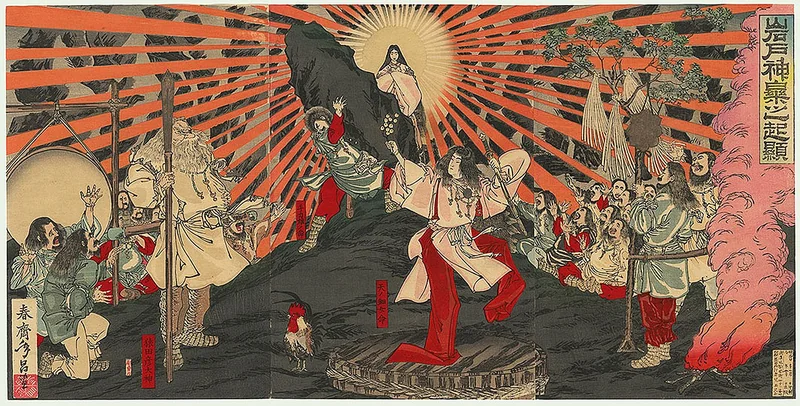
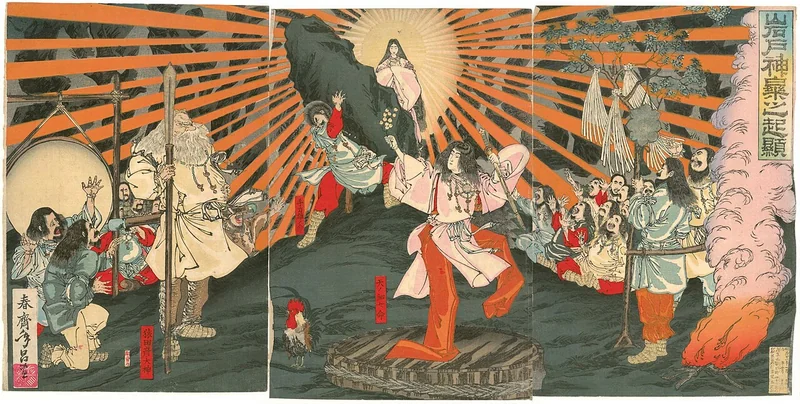
Takamagahara (高天原, 'Plain of High Heaven') is the celestial realm of the kami (gods) in Japanese mythology, the highest of the three-tiered cosmos (heaven, earth, and underworld). It is the dwelling place of the heavenly deities (amatsukami), ruled by Amaterasu. The first deities came into existence spontaneously in Takamagahara at the beginning of the world; the creator couple Izanagi and Izanami were commanded from Takamagahara to create and consolidate the earth. Susanoo was banished from Takamagahara for his destructive behaviour; Amaterasu withdrew into the rock cave within Takamagahara. It is described as a luminous, ordered realm — the source of divine legitimacy and authority for earthly rule. The descents of gods from Takamagahara to earth (kami-kudari) are the mythological foundation of Japan's divine imperial lineage. Described throughout the Kojiki (712 CE, trans. Chamberlain 1882) and Nihon Shoki (720 CE, trans. Aston 1896).
Quick facts
- Pantheon
- Japanese
- Figure type
- Place
- Period
- Described in the Kojiki (712 CE) and Nihon Shoki (720 CE)
- Primary sources
- Kojiki (712 CE), trans. Chamberlain 1882: Book I, sections 1–40 (throughout); Nihon Shoki (720 CE), trans. Aston 1896: Vol. I, pp. 1–110 (throughout)
- Related figures
- amaterasu, susanoo, tsukuyomi, izanagi, izanami, amenouzume
Cosmological structure
The Kojiki (Book I, sections 1–2, trans. Chamberlain 1882) opens with the spontaneous generation of the first deities in Takamagahara before the creation of the earth. The heavenly realm (Takamagahara), the earthly realm (Nakatsukuni or Miðgarðr-equivalent), and the underworld (Yomi or Ne-no-Kuni) form a three-tier cosmos. Takamagahara is the source of divine authority: when Izanagi and Izanami were commanded to 'make, consolidate, and give birth to' the drifting earth, the commission came from the heavenly assembly in Takamagahara. The bridge between Takamagahara and the earthly realm is the Ama-no-Ukihashi ('Floating Bridge of Heaven'), the axis mundi from which the creation of Japan proceeded. All legitimate descent to earth originates from Takamagahara — including the descent of Ninigi (Amaterasu's grandson) with the imperial regalia.
Divine assembly and crisis
Takamagahara functions in the Kojiki narratives as both a dwelling place of gods and a political assembly (Kojiki Book I, sections 13–17, trans. Chamberlain 1882). When Susanoo's destructive behaviour in heaven prompted Amaterasu's withdrawal into the rock cave, Takamagahara fell into darkness and disorder. The eight million deities assembled on the Ame-no-Yasu-kaha (Tranquil Heaven River) to deliberate and plan the response. This assembly — deliberating, performing divination, crafting sacred objects — operates like a divine council. The resolution required ritual, dance, laughter, and finally force (pulling the door open). The crisis and its resolution establish the pattern by which divine order is restored through collective action, ritual, and communication — a pattern reflected in Shinto religious practice.
Sources & further reading (2)
- primary-source — accessed 2026-05-06
- encyclopedia — accessed 2026-05-06
Frequently asked questions
Where exactly is Takamagahara and how is it reached?
The Kojiki (712 CE, trans. Chamberlain 1882) and Nihon Shoki (720 CE, trans. Aston 1896) describe Takamagahara as the high heaven above the earth, separated by the Floating Bridge of Heaven (Ama-no-Ukihashi). The sources do not specify a physical location or direction — it is a mythological realm above the world, accessed by celestial beings. The concept belongs to the common cosmological pattern of a 'high heaven' realm found across world mythologies (the Norse Ásgarðr, the Greek Olympus, the Mesopotamian An). In Shinto theological interpretation, Takamagahara is sometimes understood as a transcendent spiritual realm rather than a physical place, but the texts treat it as a real location where the kami live, assemble, and make decisions that affect the earthly world.
How does Takamagahara connect to Japan's imperial legitimacy?
The political function of Takamagahara in the Kojiki (712 CE, trans. Chamberlain 1882) is to provide divine legitimacy for Japan's imperial institution. The Kojiki was compiled under Emperor Genmei's command to preserve and legitimise the ruling dynasty's sacred origins. The narrative establishes that Amaterasu, the supreme deity of Takamagahara, commanded her grandson Ninigi to descend from heaven with the three imperial regalia (mirror, sword, jewel) and rule Japan in her name (Kojiki Book II, section 33). Ninigi's descendant became Emperor Jimmu, the legendary first emperor. This chain — Amaterasu → Takamagahara → Ninigi's descent → Jimmu → historical emperors — makes Takamagahara the ultimate source of imperial authority in classical Japanese political theology.