God
Susanoo
The storm god of Japanese mythology, slayer of the eight-headed serpent Yamata no Orochi.
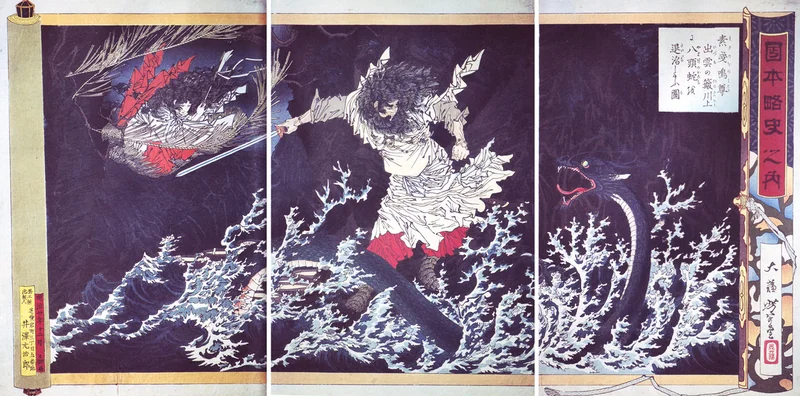
Susanoo-no-Mikoto (建速須佐之男命, 'Brave Swift Impetuous Male Deity') is the god of storms and the sea in Japanese mythology. Born from the nose of Izanagi during his purification ritual, he was assigned rule over the seas. His turbulent weeping for his mother Izanami caused natural disasters; when he visited Takamagahara, his sister Amaterasu feared an attack and he was eventually expelled. Exiled to Izumo Province, he slew the eight-headed serpent Yamata no Orochi and found the legendary sword Kusanagi within one of its tails. He then married the mortal woman Kushinadahime and became the ancestor of many Japanese deities. Described in the Kojiki (712 CE, trans. Chamberlain 1882) and Nihon Shoki (720 CE, trans. Aston 1896).
Quick facts
- Pantheon
- Japanese
- Figure type
- God
- Period
- Recorded in the Kojiki (712 CE) and Nihon Shoki (720 CE)
- Primary sources
- Kojiki (712 CE), trans. Chamberlain 1882: Book I, sections 7–18; Nihon Shoki (720 CE), trans. Aston 1896: Vol. I, pp. 48–65
- Related figures
- amaterasu, tsukuyomi, izanagi, yamata-no-orochi, kushinadahime
Expulsion from heaven
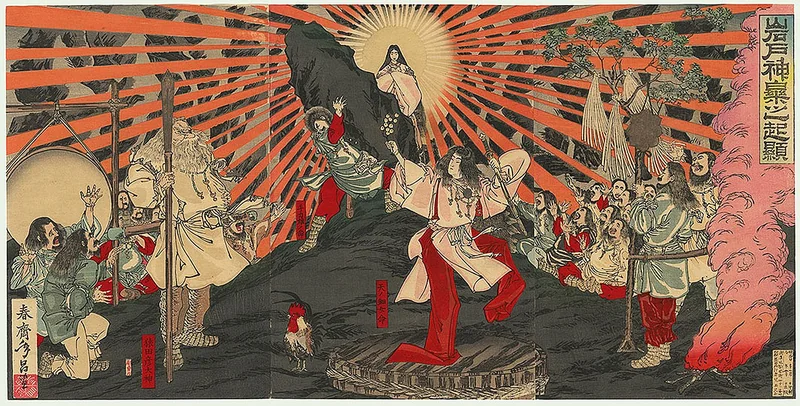
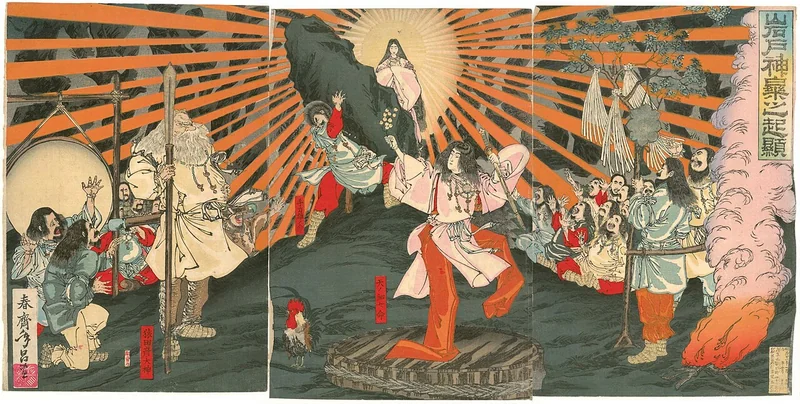
The Kojiki (Book I, sections 7–12, trans. Chamberlain 1882) narrates that Susanoo mourned ceaselessly for his dead mother Izanami, causing mountains to wail and seas to dry up. When his father Izanagi ordered him to rule the seas, Susanoo refused. Izanagi banished him. Before departing, Susanoo went to Takamagahara to bid farewell to his sister Amaterasu, but his approach was so violent that she armed herself, fearing conquest. Though the two performed a ritual together (the Ukei divination) to establish goodwill, Susanoo then proceeded to destroy rice paddies, fill in irrigation ditches, and defile Amaterasu's weaving hall, causing one of her weavers to die of fright. These acts prompted Amaterasu's retreat into the rock cave. Susanoo was expelled from heaven and stripped of his possessions.
Slaying of Yamata no Orochi
Cast out of heaven, Susanoo descended to the province of Izumo (Kojiki Book I, sections 18–20, trans. Chamberlain 1882). He found an elderly couple weeping; they had been forced to sacrifice seven daughters to the eight-headed, eight-tailed serpent Yamata no Orochi ('Great Eight-Forked Serpent'), and only one daughter, Kushinadahime, remained. Susanoo transformed Kushinadahime into a comb (to keep her safe in his hair), brewed strong sake in eight vats, and set them out as a trap. The eight heads of Orochi drank from the eight vats and fell into a stupor. Susanoo slew the serpent, cutting it into pieces. In the middle tail he found a sword of exceptional quality — later named Kusanagi-no-Tsurugi, which he presented to Amaterasu and which became one of Japan's three imperial regalia.
Sources & further reading (2)
- primary-source — accessed 2026-05-06
- encyclopedia — accessed 2026-05-06
Frequently asked questions
What is the sword Kusanagi?
Kusanagi-no-Tsurugi ('Grass-Cutting Sword') is the legendary sword found by Susanoo inside the middle tail of the Yamata no Orochi serpent (Kojiki Book I, section 20, trans. Chamberlain 1882). Susanoo presented it to his sister Amaterasu as a gesture of reconciliation. It later came to the hero Yamato Takeru, who used it to escape a fire trap by cutting the surrounding grass. Kusanagi is one of Japan's three imperial regalia — the Sanshu no Jingi (along with the mirror Yata no Kagami and the jewel Yasakani no Magatama). It is traditionally held at Atsuta Shrine in Nagoya. Its exact whereabouts are not confirmed by any public inspection.
Is Susanoo a villain in Japanese mythology?
Susanoo's character in the Kojiki and Nihon Shoki is complex: he is simultaneously destructive and heroic. His grief-driven rampage, destruction of Amaterasu's rice paddies, and pollution of her weaving hall make him a disruptive figure who causes the goddess to retreat into the cave (Kojiki Book I, sections 12–16). Yet after his expulsion and descent to Izumo, he becomes the culture hero who slays the monstrous Yamata no Orochi, rescues Kushinadahime, and discovers Kusanagi. Japanese mythology does not frame him as simply good or evil; he embodies the ambivalent power of storms — destructive but also necessary and ultimately generative.