Monster
Sphinx
Riddle-asking monster of Greek mythology who challenged travelers at Thebes.
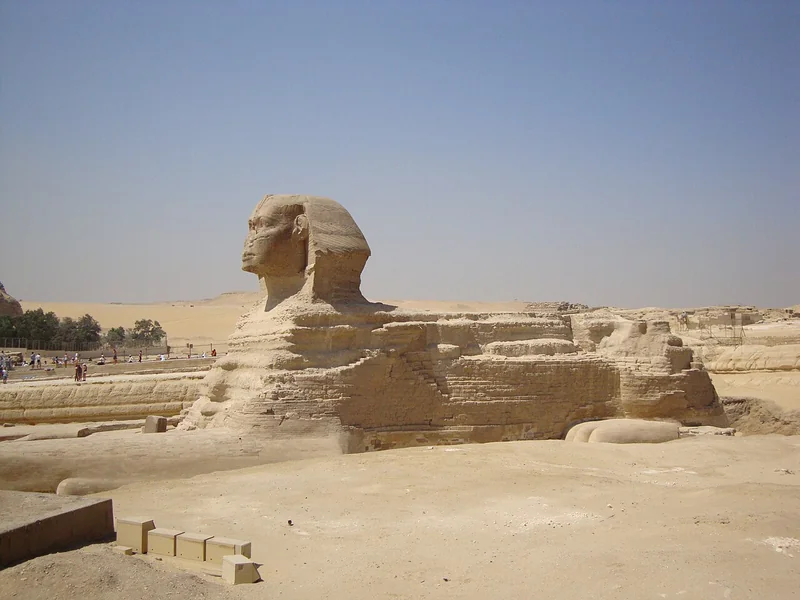
The Sphinx of Greek mythology is a monster with the head of a woman, the body of a lion, and the wings of an eagle, who haunted the road to Thebes. She posed a famous riddle to all travelers; those who could not answer were killed. Oedipus answered her riddle — 'What goes on four legs at dawn, two at noon, and three in the evening?' — correctly ('Man'), and the Sphinx killed herself in defeat. This encounter allowed Oedipus to enter Thebes and become king, setting in motion the events of Sophocles's Oedipus Rex. The myth is narrated by Apollodorus (Bibliotheca 3.5.8).
Quick facts
- Pantheon
- Greek
- Figure type
- Monster
- Period
- Greek literary tradition from at least 5th century BCE; iconographic precedent in Egyptian sphinx much earlier
- Primary sources
- Apollodorus Bibliotheca 3.5.8; Sophocles Oedipus Rex 391–398 (alludes to riddle); Hesiod Theogony 326–327
- Related figures
- typhon, chimera, cerberus, hydra
The Riddle of the Sphinx
Apollodorus (Bibliotheca 3.5.8) narrates that the Sphinx was sent to Thebes by Hera as a curse upon the city after the Theban king Laius carried off Chrysippus. The Sphinx sat on a rock outside Thebes and posed her riddle to all who passed: 'What being, with only one voice, has sometimes two feet, sometimes three, sometimes four, and is weakest when it has the most?' All who failed to answer were devoured. Oedipus, arriving in Thebes after unknowingly killing his own father on the road, answered: 'Man — who crawls on four limbs as an infant, walks on two as an adult, and uses a staff as a third foot in old age.' The Sphinx immediately threw herself from her rock and died.
Origins and cultural context
The Greek sphinx is distinct from the Egyptian sphinx (which has a male human head and a male lion's body, and is typically benevolent). The Greek sphinx has a female head, a lion's body, and eagle's wings. She is the daughter of the monster Echidna and Typhon in Hesiod (Theogony 326–327) or of the dog Orthus and Echidna in some sources. Her role as a riddle-poser and devourer connects her to broader Near Eastern traditions of hybrid guardian creatures at city gates. The Sphinx became a widespread motif in Greek art, especially in votive offerings and funerary contexts.
Sources & further reading (2)
- primary-source — accessed 2026-05-06
- encyclopedia — accessed 2026-05-06
Frequently asked questions
What is the famous riddle of the Sphinx?
The Sphinx posed the riddle: 'What goes on four legs in the morning, two legs at noon, and three legs in the evening?' (Apollodorus Bibliotheca 3.5.8 gives this as the standard version). The answer is 'Man' (or 'a human being'): an infant crawls on all fours, an adult walks upright on two legs, and an old person walks with a staff as a third leg. The 'morning, noon, and evening' represent the stages of human life. Oedipus solved it; the Sphinx killed herself in defeat.
Is the Greek Sphinx the same as the Egyptian Sphinx?
No. The Great Sphinx of Giza is a colossal ancient Egyptian monument with a male human head and a male lion's body, dating to c. 2500 BCE. It is a royal guardian statue, not a monster. The Greek sphinx, by contrast, is a composite female monster (woman's head, lion's body, eagle's wings) who poses riddles and devours those who fail to answer. The Greek term sphinx may derive from the Egyptian word 'shesep ankh' (living image), but the two traditions developed independently.