God
Ryūjin
The dragon king of the sea in Japanese mythology, master of the tide jewels.
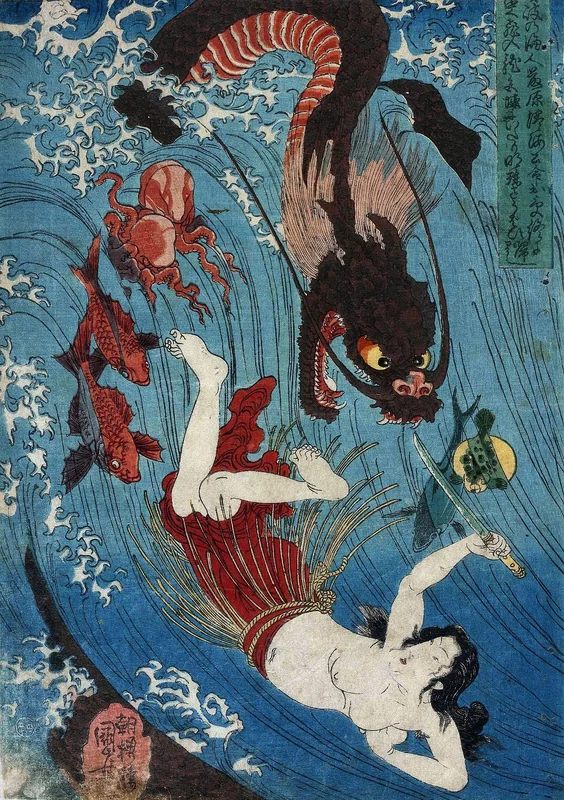
Ryūjin (竜神, 'Dragon God') is the ruler of the sea in Japanese mythology, dwelling in his magnificent underwater palace Ryūgū-jō ('Dragon Palace'). He controls the tides through two magical jewels — the kanju (tide-coming jewel) and the manju (tide-receding jewel). Ryūjin is often depicted as a dragon capable of taking human form. He is the father of the sea goddess Toyotama-hime, who married the hunter Hoori (Yamasachi-hiko). When Hoori came to Ryūjin's palace seeking his brother's lost fishhook, Ryūjin hosted him and gave him the tide jewels to defeat his rival brother. He is also the father of Empress Jingū's companion deity in some traditions. Described in the Kojiki (712 CE, trans. Chamberlain 1882) Book I, sections 40–44, and Nihon Shoki (720 CE, trans. Aston 1896).
Quick facts
- Pantheon
- Japanese
- Figure type
- God
- Period
- Recorded in the Kojiki (712 CE) and Nihon Shoki (720 CE)
- Primary sources
- Kojiki (712 CE), trans. Chamberlain 1882: Book I, sections 40–44; Nihon Shoki (720 CE), trans. Aston 1896: Vol. I, pp. 110–125
- Related figures
- toyotama-hime, hoori, susanoo, amaterasu
Hoori at the Dragon Palace
The Kojiki (Book I, sections 40–44, trans. Chamberlain 1882) tells of the brothers Hoderi (Umisachi-hiko, the fisher) and Hoori (Yamasachi-hiko, the hunter), who exchanged their tools — the fishhook and the hunting bow. Hoori lost his brother's fishhook in the sea and could not recover it. An old man (the sea god Watatsumi) advised him to go to Ryūjin's palace. Hoori descended to Ryūgū-jō, where Ryūjin's daughter Toyotama-hime saw him at the well and fell in love. Ryūjin welcomed Hoori and had his court assembled the fishhook from the sea creatures — it was found in the throat of a fish. Ryūjin also gave Hoori the two tide jewels. Hoori married Toyotama-hime, lived in the palace for three years, and returned to the surface world. He used the tide jewels to overcome his jealous brother Hoderi.
Ryūjin and the tide jewels
The two tide jewels — kanju (ebb tide jewel) and manju (flood tide jewel) — are Ryūjin's most powerful possessions in the Kojiki narrative (Book I, sections 43–44, trans. Chamberlain 1882). When Hoori raised the flood-tide jewel, the sea rose and Hoderi was submerged; when Hoderi submitted, Hoori used the ebb-tide jewel to lower the waters. In later Japanese legend and history, these jewels appear in connection with Empress Jingū's legendary military campaigns: the Nihon Shoki (trans. Aston 1896: Vol. I, pp. 222–228) narrates that Ryūjin provided the tide jewels to aid her invasion of the Korean kingdoms (3rd century CE in legendary chronology). The jewels thus appear as instruments of both personal and national power.
Sources & further reading (2)
- primary-source — accessed 2026-05-06
- encyclopedia — accessed 2026-05-06
Frequently asked questions
What is Ryūgū-jō and how is it described in the sources?
Ryūgū-jō ('Dragon Palace') is Ryūjin's magnificent underwater palace, described in the Kojiki (Book I, section 40, trans. Chamberlain 1882) as a great hall beside the well at the seafloor. The description in the classical sources is relatively sparse — a palace, a well, a great assembly of sea-creatures. In medieval and Edo-period literary and artistic elaborations, Ryūgū-jō became a fantastic coral palace with halls and gardens, surrounded by sea creatures serving as attendants, where time moves differently than on the surface (one day in the palace equals many years above). This expanded description appears in the Urashima Tarō tale tradition, where the fisherman Urashima Tarō visits Ryūgū-jō and returns to find hundreds of years have passed.
What is Ryūjin's relationship to Japanese dragon mythology?
Ryūjin belongs to the broader East Asian dragon (ryū or tatsu) tradition, which differs significantly from European dragons. The Japanese/Chinese dragon is typically a serpentine creature associated with water, rain, and benevolent cosmic power rather than evil. Ryūjin as the king of sea-dragons is the Japanese instantiation of the aquatic dragon-palace motif found across East Asian mythology. His ability to control tides connects him to the primordial power of the ocean. In the Nihon Shoki (trans. Aston 1896) he is also called Watatsumi-no-Kami (sea-god), sometimes treated as a distinct figure. By the late Heian and medieval periods, Ryūjin had been syncretised with Buddhist nāga (serpent deities) traditions from India, enriching his mythology further.