God
Raijin
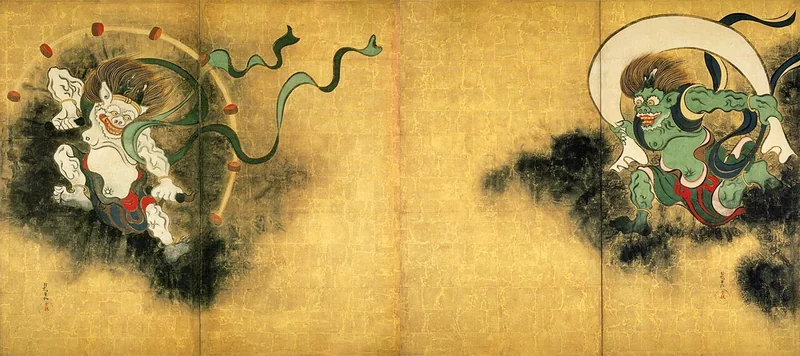
The Japanese god of thunder and lightning, depicted beating a ring of drums in the storm clouds.
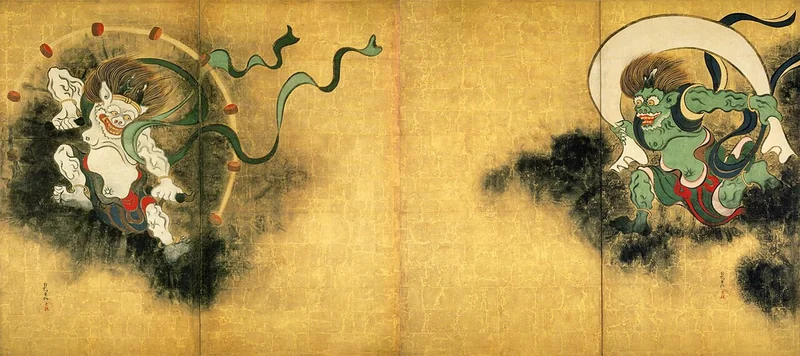
Raijin (雷神, 'Thunder God') is the deity of thunder, lightning, and storms in Japanese mythology, born from the body of Izanami in Yomi. He is depicted as a fierce, muscular, demon-like figure surrounded by a ring of drums (taiko), which he beats to produce thunder. Raijin almost invariably appears paired with Fūjin (the wind god), and the two serve as guardian deities in Buddhist-Shinto syncretic iconography. He is sometimes identified with Takemikazuchi (the thunder-and-sword deity) but is typically treated as a separate deity in the classical sources. Raijin is believed to drop lightning bolts that fertilise the earth — hence rice planted in fields struck by lightning was considered particularly fertile. Described in the Kojiki (712 CE, trans. Chamberlain 1882) as the thunder deities born from Izanami's body in Yomi.
Quick facts
- Pantheon
- Japanese
- Figure type
- God
- Period
- Thunder deities attested in Kojiki (712 CE); Raijin iconography developed under Buddhist influence from the Nara period (710–794 CE)
- Primary sources
- Kojiki (712 CE), trans. Chamberlain 1882: Book I, section 9 (thunder deities in Yomi); Nihon Shoki (720 CE), trans. Aston 1896: Vol. I, pp. 22–24
- Related figures
- fujin, izanami, susanoo, takemikazuchi
Birth from Izanami
The Kojiki (Book I, section 9, trans. Chamberlain 1882) provides the origin of Raijin in the underworld narrative. When Izanagi entered Yomi and lit a torch to see his dead wife Izanami, he found her body writhing with eight different kinds of thunder deity (Great Thunder, Fire Thunder, Earth Thunder, Young Thunder, Black Thunder, Mountain Thunder, Rending Thunder, Couchant Thunder). These thunder deities were born from or inhabiting the various parts of Izanami's decomposing body. The sight horrified Izanagi and caused him to flee. This origin — from the rotting body of a creator goddess in the underworld — marks the Japanese thunder deities as ambivalent forces: terrifying and associated with death and pollution, yet ultimately connected to the creative power of storms and fertilising rain.
Iconography and the drum ring
The distinctive iconography of Raijin — a muscular, fierce-looking deity surrounded by a ring of drums — developed during the Nara and Heian periods under Chinese Buddhist influence, drawing on the imagery of Chinese thunder deities (Lei Gong) and the general tradition of fierce Buddhist guardian figures. The drums (taiko) produce the sound of thunder when struck; his lightning appears as jagged bolts in his hands or at his feet. The famous Sanjūsangen-dō statues (Kyoto, 1254 CE) and the Fūjin-Raijin-zu screens (attributed to Sōtatsu, c. 1600 CE) established the paired Fūjin-Raijin iconography that became definitive. Children in Japan were traditionally told to hide their navels during thunderstorms because Raijin was said to eat navels — a piece of playful folk religion that helped explain his destructive power to the young.
Sources & further reading (2)
- primary-source — accessed 2026-05-06
- encyclopedia — accessed 2026-05-06
Frequently asked questions
Why was lightning associated with rice fertility in Japan?
Japanese agricultural tradition held that fields struck by lightning produced particularly abundant rice harvests. This belief has a basis in agricultural science: lightning fixes atmospheric nitrogen into the soil through the conversion of N₂ to nitric oxide, which becomes dissolved in rainwater as nitrate — a natural fertiliser. The word for lightning in classical Japanese (inabikari or ina-zuma, 'rice-wife') contains the root ina (rice), reflecting this cultural observation. Raijin as a deity of thunder and lightning was thus not only a god of terrifying storms but also a deity of agricultural fertility. Shrines to Raijin in agricultural communities were maintained as prayers for productive storms as much as protection from destructive ones.
How is Raijin different from Takemikazuchi?
Both Raijin and Takemikazuchi are thunder-associated deities in the Japanese mythological tradition, but they differ in origin, function, and narrative role. Takemikazuchi (建御雷之男神) was born from the blood of the sword used to kill Kagutsuchi (Kojiki Book I, section 8, trans. Chamberlain 1882) — he is a sword-and-thunder deity associated with martial power, explicitly a warrior and the one who pacified the earthly realm for Amaterasu. He is enshrined at Kashima Shrine. Raijin (雷神) is the thunder deity born from Izanami's body in Yomi — a more elemental, atmospheric power. The two represent different conceptual aspects of thunder: Takemikazuchi as the sharp, cutting power of the lightning bolt; Raijin as the rumbling, percussive force of the thunderclap.