Titan
Prometheus
Titan who stole fire from the gods and gave it to humanity in Greek mythology.
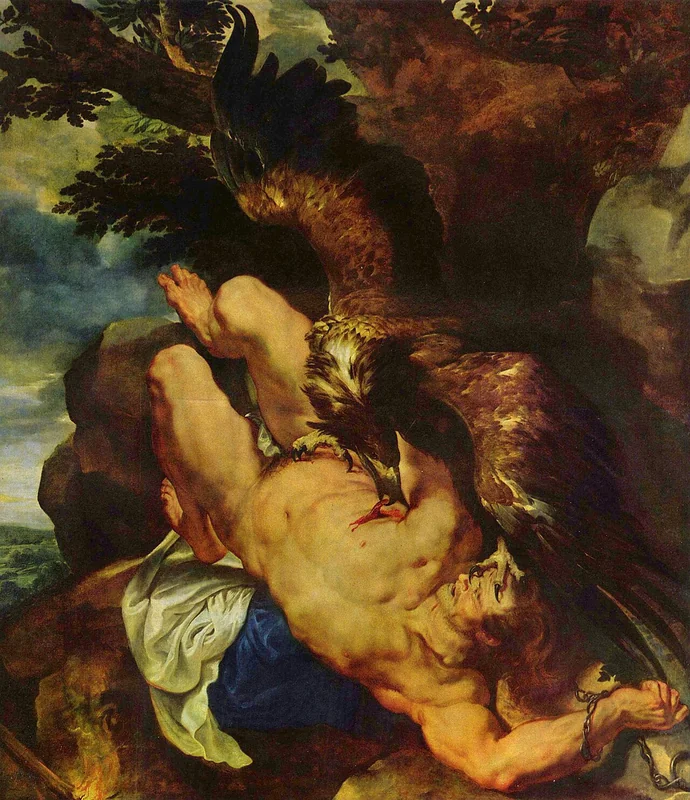
Prometheus is a Titan in Greek mythology, son of the Titan Iapetus and the Oceanid Clymene (or Asia). His name means 'Forethought.' He is celebrated as the benefactor of humanity — he stole fire from the hearth of the gods on Mount Olympus and gave it to mortals, enabling civilisation. Zeus punished him by chaining him to a cliff where an eagle devoured his regenerating liver each day, until he was eventually freed by Heracles. Prometheus also modelled the first humans from clay in some versions of his myth. His story is central to Hesiod's Theogony and Works and Days.
Quick facts
- Pantheon
- Greek
- Figure type
- Titan
- Period
- Attested from Hesiod (c. 700 BCE)
- Primary sources
- Hesiod Theogony 507–616; Hesiod Works and Days 42–105; Apollodorus Bibliotheca 1.7.1; Aeschylus Prometheus Bound (5th c. BCE)
- Related figures
- zeus, heracles, pandora, atlas, epimetheus
Theft of fire
Hesiod's Theogony (561–570) narrates that Zeus, angered by Prometheus's earlier trickery over sacrificial portions, withheld fire from humanity. Prometheus stole it from the gods — hiding a spark of fire in a fennel stalk — and carried it down to mortals. Zeus punished both Prometheus and humanity: Prometheus was chained to a cliff (or pillar) in the Caucasus mountains, where an eagle (or in some versions a vulture) tore out his liver each day; the liver regenerated overnight. Hesiod's Works and Days (42–105) adds that Zeus created Pandora as humanity's punishment, introducing toil, disease, and hardship.
Freeing of Prometheus
Prometheus's suffering eventually ended when Heracles, passing through the Caucasus during the Labour of the cattle of Geryon, shot the eagle and freed him (Apollodorus Bibliotheca 2.5.11). Zeus consented because he wished to glorify his son Heracles, and also because Prometheus had revealed a crucial prophecy: that a son of Thetis (the sea-nymph whom Zeus had coveted) would surpass his father in greatness — a secret knowledge that had given Prometheus leverage with Zeus. By revealing this prophecy and consenting to his release, Prometheus's long ordeal ended.
Sources & further reading (2)
- primary-source — accessed 2026-05-06
- encyclopedia — accessed 2026-05-06
Frequently asked questions
What did Prometheus create besides fire?
Prometheus is credited in various ancient sources with more than just the gift of fire. Apollodorus (Bibliotheca 1.7.1) records that he fashioned the first humans from clay and water. Aeschylus's Prometheus Bound (5th century BCE) credits him with giving humanity all the skills of civilisation: blind hope (to sustain them through misfortune), fire, skilled crafts, agriculture, reason, and knowledge of the seasons and stars. In this tradition, Prometheus is not merely a fire-thief but the founding benefactor of human civilisation.
What is the myth of Prometheus and Pandora?
In Hesiod's Works and Days (42–105), Zeus created Pandora — the first woman — as punishment for Prometheus's theft of fire. Hephaestus fashioned her from earth; each god gave her a gift (hence 'Pandora' — 'all-gifted'). Hermes gave her a deceitful character and she was sent to Prometheus's brother Epimetheus ('Afterthought'), who accepted her despite Prometheus's warning not to accept any gift from Zeus. Pandora opened a jar (pithos) she had been given, releasing all the evils, diseases, and troubles into the world; only Hope (Elpis) remained inside.