Hero
Perseus
Greek hero who slew Medusa and rescued Andromeda from the sea monster.
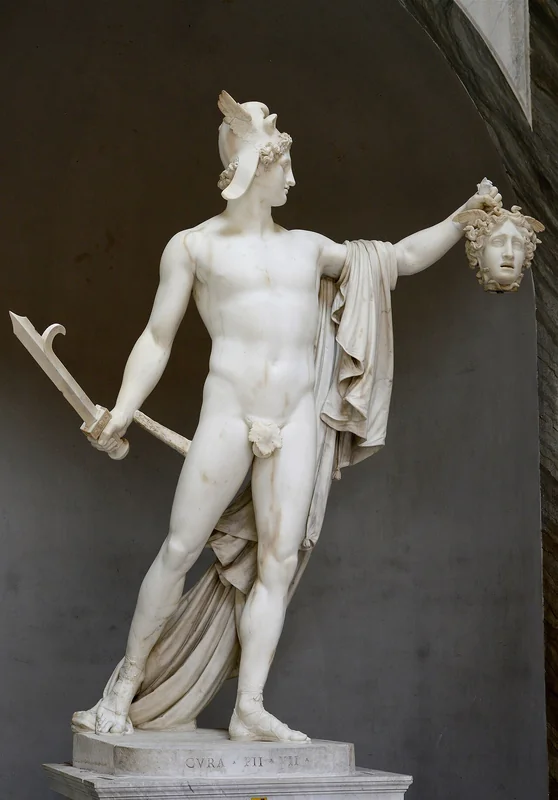
Perseus is a celebrated hero of Greek mythology, son of Zeus and the mortal Danae. Sent on a seemingly impossible quest by King Polydectes to obtain the head of the Gorgon Medusa, Perseus received divine aid from Athena and Hermes. He killed Medusa and used her severed head — which turned anyone who gazed at it to stone — as a weapon on his journey home. En route he rescued the princess Andromeda from the sea monster Cetus. The myth is narrated by Apollodorus in the Bibliotheca (2.4.1–5) and alluded to throughout ancient literature.
Quick facts
- Pantheon
- Greek
- Figure type
- Hero
- Period
- Mythological hero; traditions set in the generation before Heracles
- Primary sources
- Apollodorus Bibliotheca 2.4.1–5; Hesiod Theogony 270–286; Ovid Metamorphoses 4.604–803; Pindar Pythian Odes 10.31–48
- Related figures
- zeus, medusa, andromeda, cassiopeia, athena, hermes
- Constellation link
- Perseus Constellation (Perseus)
Quest for Medusa's head
Apollodorus (Bibliotheca 2.4.2–3) narrates how Perseus was aided by Athena and Hermes to accomplish his quest. He obtained winged sandals, the cap of invisibility (from the nymphs), a kibisis (a special bag to hold the head), and the adamantine sickle of Hermes. He located the Gorgons at the edge of the world, used his reflective shield to look at Medusa indirectly rather than meeting her petrifying gaze directly, and beheaded her while she slept. From Medusa's severed neck sprang Pegasus the winged horse and the giant Chrysaor. Perseus stored the head in the kibisis and escaped using the cap of invisibility.
Perseus and Andromeda
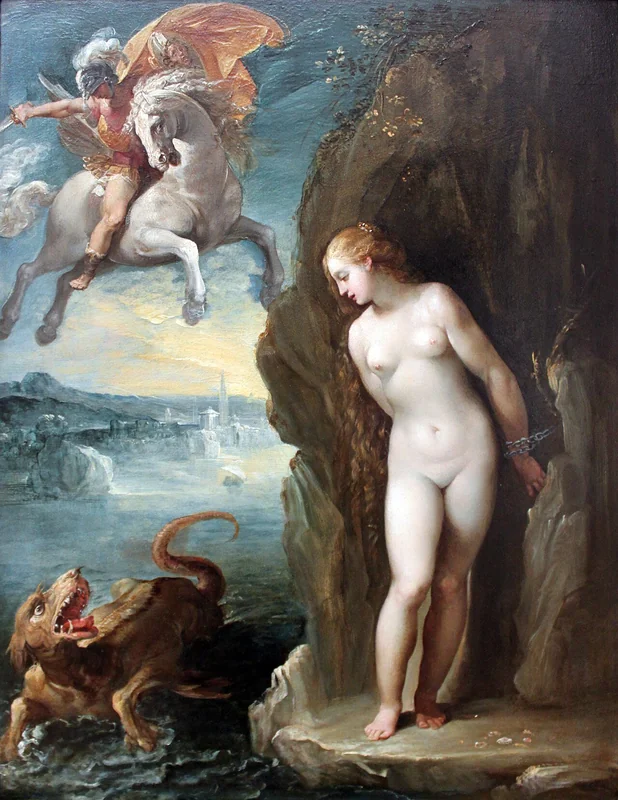
On his return from the Gorgons, Perseus encountered the princess Andromeda chained to a sea-cliff as a sacrifice to the sea monster Cetus (Apollodorus 2.4.3). Her mother Queen Cassiopeia had boasted that Andromeda's beauty surpassed that of the Nereids (sea-nymphs), and Poseidon had sent Cetus to ravage the kingdom of Aethiopia in punishment. Perseus slew Cetus and freed Andromeda, whom he took as his wife. After their deaths, Andromeda, Perseus, Cassiopeia, Cepheus (her father), and Cetus were all placed among the stars as constellations, forming a mythological family group visible in the autumn sky.
Sources & further reading (2)
- primary-source — accessed 2026-05-06
- encyclopedia — accessed 2026-05-06
Frequently asked questions
How did Perseus kill Medusa?
Perseus killed Medusa by avoiding her petrifying gaze, using the reflective surface of his polished shield to see her image without directly meeting her eyes. Armed with an adamantine sickle given by Hermes and guided by Athena, he beheaded her while she slept. He then stored the head in a special bag called the kibisis, keeping it covered to prevent its petrifying effect. This is narrated by Apollodorus (Bibliotheca 2.4.2–3) and by Pindar (Pythian Odes 10.44–48).
What constellations are named after the myth of Perseus?
The Perseus mythological cycle is commemorated by a group of constellations in the autumn sky: Perseus himself, Andromeda (his wife), Cassiopeia (her mother), Cepheus (her father), Cetus (the sea monster he slew), and Auriga (sometimes connected with Perseus). The connections were described by Aratus (Phaenomena 198–224, 353–357) and by Eratosthenes (Catasterismi 16, 17, 36). This family group spans a large region of the northern sky.