Hero
Pandora
First mortal woman of Greek mythology, fashioned by the gods and bearer of a fateful jar.
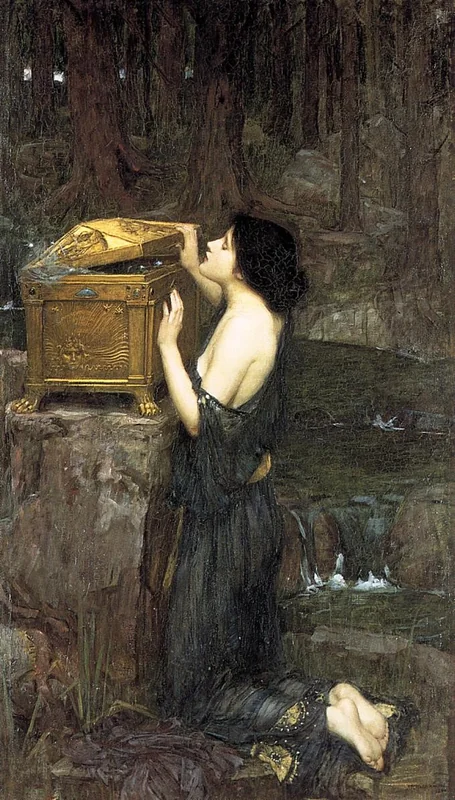
Pandora is the first mortal woman in Greek mythology, created by Hephaestus from earth and water on the orders of Zeus. Her name means 'all-gifted,' as each of the gods gave her a quality: Aphrodite gave beauty, Hermes gave a deceptive character, Athena gave skill in weaving. She was sent to Epimetheus (brother of Prometheus) as part of Zeus's punishment for Prometheus's theft of fire. She opened a large jar (pithos) — often mistranslated as a 'box' — releasing all the evils, diseases, and troubles into the world. Only Hope (Elpis) remained inside. This myth is narrated by Hesiod in the Theogony and Works and Days.
Quick facts
- Pantheon
- Greek
- Figure type
- Hero
- Period
- Attested from Hesiod (c. 700 BCE)
- Primary sources
- Hesiod Works and Days 60–105; Hesiod Theogony 570–616
- Related figures
- prometheus, epimetheus, hephaestus, zeus, hermes
Creation of Pandora
Hesiod's Works and Days (60–105) narrates Pandora's creation in detail. Hephaestus fashioned her likeness from earth and water; Athena clothed her and taught her weaving; Aphrodite shed grace and painful longing about her head; Hermes gave her a dog's mind and a thievish character, and the gift of speech. Her name Pandora ('all-gifted') reflects this collective creation by all the gods. Hermes was sent with her to Epimetheus, who accepted her despite his brother Prometheus's warning never to accept a gift from Zeus. She brought with her a great storage jar.
Pandora's jar
The famous 'Pandora's box' is more accurately a large storage jar (pithos) in Hesiod's text — the mistranslation to 'box' (pyxis) originated with Erasmus of Rotterdam in the 16th century CE. Hesiod (Works and Days 94–100) records that before Pandora opened the jar, mankind lived free from sorrow, disease, and toil. When she opened it (either from curiosity or as part of Zeus's plan), all the evils were released into the world and scattered among humanity. Hope alone remained inside, under the jar's rim, when she replaced the lid. The myth explains the origin of human hardship.
Sources & further reading (2)
- primary-source — accessed 2026-05-06
- encyclopedia — accessed 2026-05-06
Frequently asked questions
Is it a box or a jar?
Hesiod's original text uses the word 'pithos' — a large clay storage jar, not a box. The familiar 'Pandora's box' phrase originated with a mistranslation by the Renaissance scholar Erasmus of Rotterdam, who used 'pyxis' (a small box or casket) rather than 'pithos' in his Latin rendering of the myth. Despite centuries of the 'box' tradition in Western culture, the original Greek myth clearly describes a large storage jar. The distinction matters for understanding the scale and domestic context of the original myth.
Why did Hope remain in Pandora's jar?
Hesiod's Works and Days (94–100) states that Hope (Elpis) remained inside the jar when Pandora replaced the lid, trapped under the rim. The significance of Hope's retention has been debated since antiquity. One interpretation: Hope is a benefit for humanity, preserved as a counterweight to all the evils released. Another: Hope is itself a deception — a dangerous illusion that prevents humans from accepting their fate. Hesiod's ambiguous phrasing 'Hope alone remained inside' does not clearly indicate whether this is good or bad, leaving the question deliberately open.