Hero
Orion
Giant hunter of Greek mythology whose image was placed among the stars.
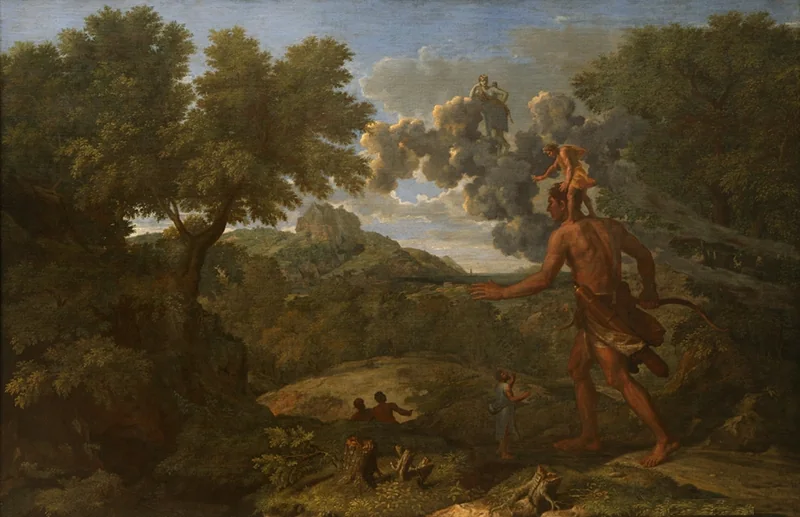
Orion is a giant hunter in Greek mythology, son of Poseidon and Euryale in the most common tradition, or born from a bull's hide buried in the earth in another. He was a companion of Artemis and the greatest hunter in the world. He was killed — by a scorpion sent by Gaia, by Artemis's arrow, or by Apollo's trickery in various ancient accounts — and placed among the stars as the constellation Orion. The constellation has been identified with him since at least Hesiod's Works and Days (619), making it one of the oldest identified star-figures in the Western tradition.
Quick facts
- Pantheon
- Greek
- Figure type
- Hero
- Period
- Constellation identified with the figure from at least the 8th century BCE (Hesiod, Homer)
- Primary sources
- Hesiod Works and Days 619; Homer Odyssey 5.121–124; Apollodorus Bibliotheca 1.4.3–5; Aratus Phaenomena 322–325
- Related figures
- artemis, poseidon, apollo, scorpius, sirius
- Constellation link
- Orion Constellation (Orion)
The myths of Orion
Multiple ancient accounts survive for Orion's origin and death, reflecting different regional traditions. For his origin: the most common account (Apollodorus Bibliotheca 1.4.3) makes him the son of Poseidon and Euryale, able to walk on the sea. For his death: Apollodorus (1.4.3–5) records two versions. In one, Artemis killed him accidentally, tricked by her brother Apollo who pointed out a distant figure in the sea and challenged her archery — not knowing it was Orion she would hit. In another, Gaia sent a giant scorpion to kill Orion after he boasted he would kill all the animals of the earth. Homer's Odyssey (5.121–124) alludes to Orion as a beautiful giant hunter slain by Artemis.
Constellation
Orion is one of the most conspicuous and recognisable constellations in the sky. Hesiod's Works and Days (619) and Homer's Odyssey (5.274) both reference it as a known star-figure, confirming it was identified with the mythological Orion by at least the 8th century BCE. Aratus's Phaenomena (322–325) describes Orion rising as the Pleiades set. The IAU constellation Orion covers 594 square degrees and contains the distinctive three-star belt and several bright stars including Rigel and Betelgeuse. The nearby Scorpius constellation — diametrically opposite in the sky — reflects the myth that Orion and the Scorpion never appear in the sky together.
Sources & further reading (2)
- primary-source — accessed 2026-05-06
- encyclopedia — accessed 2026-05-06
Frequently asked questions
What is the Orion constellation?
Orion is one of the 88 IAU constellations, covering 594 square degrees in the equatorial sky. It is among the most recognisable constellations worldwide, identified by its three-star belt (Alnitak, Alnilam, Mintaka) and the bright stars Rigel (blue supergiant, 0.13 magnitude) and Betelgeuse (red supergiant, variable). It is one of Ptolemy's original 48 constellations (Almagest, c. 150 CE). The Orion Nebula (Messier 42), one of the brightest nebulae in the sky, is visible to the naked eye as a fuzzy star in Orion's sword.
Why are Orion and Scorpius never in the sky at the same time?
Orion and Scorpius are on opposite sides of the celestial sphere, so that when one rises, the other sets — they never appear simultaneously above the horizon. Ancient Greek and Roman writers connected this astronomical fact to the myth: Orion was killed by a scorpion (Gaia's scorpion or the Scorpio sent to punish him), and the gods placed both in the sky but arranged them so they would never meet. Aratus's Phaenomena and Ovid's Fasti allude to this mythological explanation for an observable astronomical fact.