Hero
Onjo
The legendary founder of Baekje, son of Jumong who crossed into the south to build a new kingdom.
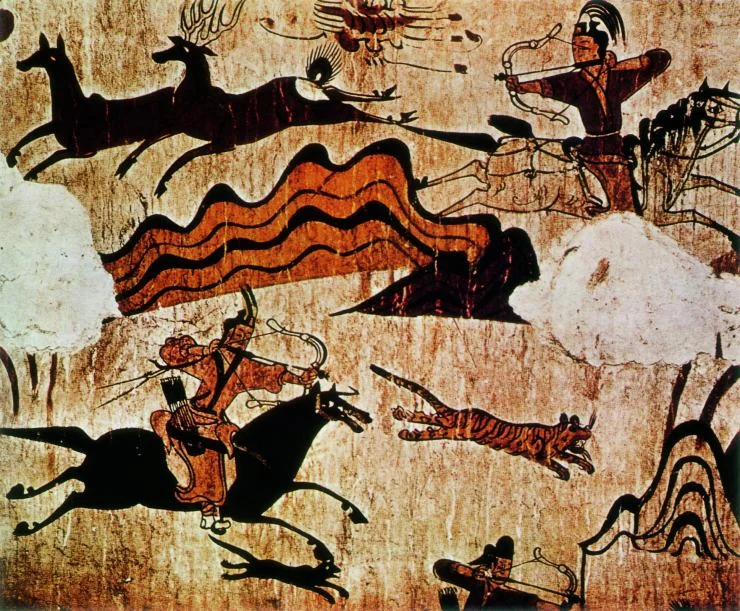
Onjo (온조, 溫祚) is the legendary founder of the kingdom of Baekje (백제, 18 BCE – 660 CE), one of the Three Kingdoms of Korea. The son of Jumong (the founder of Goguryeo) by his second wife Soseono, Onjo and his elder brother Biryu were displaced when Jumong's son from a previous marriage arrived to become crown prince. With their followers and mother Soseono, the two brothers left Goguryeo and went south. Biryu chose to settle at Michuhol (near modern Incheon) but found the land marshy and salty and unfit for agriculture; his people starved and he died of shame. Onjo settled at Wiryeseong (near modern Seoul), where the land was fertile; his kingdom thrived and the people of Biryu's failed settlement joined him. He named his kingdom Sipje ('Ten Subjects', after his ten loyal followers), later changed to Baekje ('Hundred Subjects', when more joined). Recorded in the Samguk Sagi (1145 CE) and Samguk Yusa (1281 CE).
Quick facts
- Pantheon
- Korean
- Figure type
- Hero
- Period
- Legendary founding of Baekje: 18 BCE; recorded in Samguk Sagi (1145 CE) and Samguk Yusa (1281 CE)
- Primary sources
- Samguk Sagi (1145 CE), Book 23: Baekje annals, by Kim Busik; Samguk Yusa (1281 CE), Book 1: 'Baekje' references, by Iryeon
- Related figures
- jumong, soseono, biryu
Origins and southern migration
The Samguk Sagi (1145 CE, Book 23) gives two alternative accounts of Onjo's parentage. In the first (the more mythologically elaborate account), Onjo's mother is Soseono, a widow who had helped Jumong (the future founder of Goguryeo) escape from Buyeo and supported the building of Goguryeo. When Jumong's son from his earlier Buyeo marriage, Yuri, arrived and was made crown prince, Soseono persuaded her sons Biryu and Onjo to seek their own kingdom in the south. She accompanied them with ten loyal ministers. The alternative Samguk Sagi account identifies Onjo's father as Wutae, a Buyeo king, and his mother as Soseono — making him not Jumong's son but Jumong's stepson. The Samguk Sagi itself notes the uncertainty and records both versions. The mythological importance of the first version (Onjo as Jumong's son) is that it connects Baekje to the divine solar lineage of Goguryeo, lending the Baekje royal family the same divine descent credentials.
Founding and naming of Baekje
After parting from his brother Biryu (who chose the coastal settlement of Michuhol), Onjo settled at Wiryeseong on the south side of the Han River — the site of modern Seoul — where he found fertile land and established his capital (Samguk Sagi 1145 CE, Book 23). He named his kingdom Sipje (十濟, 'Ten Crossings' or 'Ten Subjects') in honour of his ten loyal ministers who followed him south. When Biryu's settlement failed and his people migrated to Onjo's thriving kingdom, the larger population prompted a renaming to Baekje (百濟, 'Hundred Crossings' or 'Hundred Subjects') — a name reflecting the growing number of people who had made the journey of loyalty to Onjo. The Han River basin site of Wiryeseong (modern Mongchontoseong or the Pungnap Earthen Wall area in Seoul) has been investigated by Korean archaeologists as a candidate for Baekje's original capital.
Sources & further reading (2)
- encyclopedia — accessed 2026-05-06
- primary-source — accessed 2026-05-06
Frequently asked questions
Who was Soseono and what was her role in Korean founding mythology?
Soseono (소서노, 召西奴) is one of the most remarkable figures in Korean founding mythology — a woman who played a key role in the founding of not one but two Korean kingdoms. According to the Samguk Sagi (1145 CE, Book 13), Soseono was a wealthy widow who provided crucial financial and logistical support to Jumong when he fled from Buyeo and established Goguryeo. She became his queen. When Jumong's son from his first marriage (Yuri) arrived and displaced her sons, she organised the southern migration that led to the founding of Baekje. Her sons Biryu and Onjo followed her leadership in the founding enterprise. Soseono is thus the connecting figure between the founding of Goguryeo (through Jumong, whom she supported) and the founding of Baekje (through her sons). She represents the capable, politically active woman behind two of Korea's Three Kingdoms.
What is the significance of Baekje in Korean history?
Baekje (백제, 18 BCE – 660 CE) was one of the Three Kingdoms of Korea (alongside Goguryeo and Silla) and occupied the southwestern Korean peninsula. Historically, Baekje was a significant mediator of Chinese and Korean culture to Japan: many elements of Japanese Yamato-period culture, including Buddhist scripture and iconography, writing, administrative systems, and arts, were transmitted via Baekje. The monk Norisachigye (or Wangin, traditional account) brought the Analects of Confucius and the Thousand Character Classic to Japan from Baekje in the late 4th or early 5th century CE. Baekje aristocrats and craftspeople contributed significantly to the development of Japanese court culture. Baekje was conquered by a Tang China – Silla alliance in 660 CE, ending the Three Kingdoms period and beginning the Unified Silla era.