God
Ōkuninushi
The great earthly deity of Japanese mythology who built the land before ceding it to the heavenly gods.
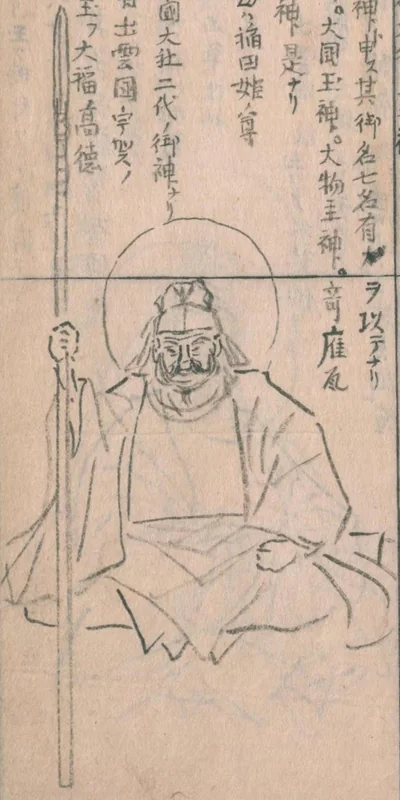
Ōkuninushi-no-Mikoto (大国主命, 'Great Lord of the Land') is the deity of nation-building, agriculture, medicine, and magic in Japanese mythology, a descendant of Susanoo. Despite being murdered twice by his eighty brothers (who resented his beauty and took his intended bride), he was restored to life twice by divine intervention. He built the land of Japan in partnership with the dwarf god Sukunabikona and created a hidden world of spirits (the kakuriyo). When the heavenly deities (Amaterasu's descendants) descended to rule the earth, Ōkuninushi peacefully ceded the visible world to them in exchange for the building of a great shrine — later identified as the Grand Shrine of Izumo. Described in the Kojiki (712 CE, trans. Chamberlain 1882) Book I, sections 20–32.
Quick facts
- Pantheon
- Japanese
- Figure type
- God
- Period
- Recorded in the Kojiki (712 CE) and Nihon Shoki (720 CE)
- Primary sources
- Kojiki (712 CE), trans. Chamberlain 1882: Book I, sections 20–32; Nihon Shoki (720 CE), trans. Aston 1896: Vol. I, pp. 65–80
- Related figures
- susanoo, amaterasu, sukunabikona, takemikazuchi
Murder and resurrection
The Kojiki (Book I, sections 20–24, trans. Chamberlain 1882) narrates how the eighty brothers of Ōkuninushi (called the eighty deities) repeatedly tried to kill him out of jealousy. First they crushed him with a great heated boulder rolled down a mountain; his mother appealed to the heavenly deities, who revived him. Then they killed him again by wedging him into a tree. Again his mother appealed and had him revived. These repeated deaths and resurrections suggest Ōkuninushi as a dying-and-rising god associated with seeds and cultivation. He then fled to Susanoo's realm in the underworld (Ne-no-Kuni), where he performed tasks set by Susanoo, won the hand of Susanoo's daughter Suseribime, stole Susanoo's weapons and harp, and escaped to become the master of the land.
Ceding the land
Ōkuninushi built and consolidated the land of Japan with the help of the dwarf deity Sukunabikona, who arrived on the sea in a tiny boat and worked with him to develop agriculture, medicine, and sericulture (Kojiki Book I, sections 27–28, trans. Chamberlain 1882). When Sukunabikona departed to the far land of Ne-no-Kuni, Ōkuninushi was disheartened, but a radiant deity appeared in the sea and commanded him to enshrine it in Yamato. The heavenly messenger Takemikazuchi eventually arrived and demanded that Ōkuninushi cede the land to Amaterasu's grandson Ninigi. After consulting with his sons, Ōkuninushi agreed, saying: 'I will remove myself to the unseen world... let there be built for my dwelling a great palace of eight fathoms in height.' This great palace is identified with Izumo Taisha, one of Japan's most ancient shrines.
Sources & further reading (2)
- primary-source — accessed 2026-05-06
- encyclopedia — accessed 2026-05-06
Frequently asked questions
Why is Ōkuninushi associated with Izumo Taisha?
The Kojiki (Book I, section 32, trans. Chamberlain 1882) records that when Ōkuninushi agreed to cede the visible world to the heavenly deities, his condition was the construction of a great shrine where he could rule the hidden world of spirits (the kakuriyo). The great shrine demanded by Ōkuninushi is identified with Izumo Taisha (Grand Shrine of Izumo) in Shimane Prefecture, one of Japan's oldest and most important shrines. Ōkuninushi's association with medicine, agriculture, and matchmaking (en-musubi — the tying of fate-threads between people) made Izumo Taisha one of the principal sites in Japan for prayers about relationships and marriage. Every October (called Kannazuki, 'Month Without Gods') by the traditional Japanese calendar, the kami of all Japan are said to gather at Izumo.
What is the story of the White Rabbit of Inaba?
The White Rabbit of Inaba (Inaba no Shirousagi) is told in the Kojiki (Book I, section 22, trans. Chamberlain 1882) as an episode that reveals Ōkuninushi's character. A white rabbit, having tricked sharks into forming a bridge (by claiming to count them), was then flayed by the sharks in revenge. The eighty arrogant brothers, when the rabbit asked for help, told it to bathe in salt water — which worsened the pain. Ōkuninushi, following behind and carrying the brothers' baggage, took pity on the rabbit, told it to wash in fresh water and roll in cattail pollen, and it was healed. The rabbit then prophesied that Ōkuninushi, not the eighty brothers, would win the beautiful princess Yagamihime. The story establishes his character as compassionate and just, traits that explain his eventual role as patron of medicine.