Hero
Odysseus
Cunning hero of Homer's Odyssey, king of Ithaca and mastermind of the Trojan War.
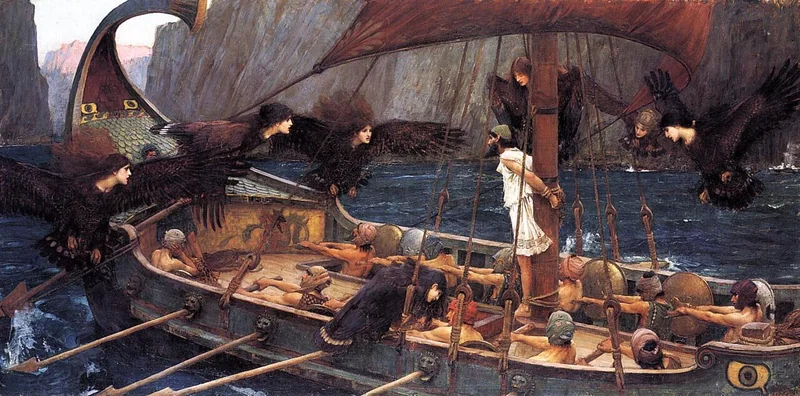
Odysseus (Ulysses in Latin) is the protagonist of Homer's Odyssey and a prominent figure in the Iliad. King of Ithaca and son of Laertes, he is characterised by exceptional intelligence and cunning rather than brute strength. He devised the stratagem of the Trojan Horse that ended the Trojan War. The Odyssey narrates his ten-year voyage home after Troy, including encounters with Cyclopes, the witch Circe, the Sirens, Scylla and Charybdis, and his descent to the underworld. He is aided throughout by Athena.
Quick facts
- Pantheon
- Greek
- Figure type
- Hero
- Period
- Mythological hero; Trojan War tradition, Mycenaean period in ancient reckoning
- Primary sources
- Homer Odyssey 1.1–10 (proem); Homer Iliad 2.169–210; Apollodorus Epitome 7.1–36; Homer Odyssey 11.1–640 (Nekyia, descent to underworld)
- Related figures
- athena, achilles, hermes, circe, poseidon, penelope
The ten-year voyage
Homer's Odyssey begins after the fall of Troy with Odysseus stranded on the island of the nymph Calypso, unable to return home. The poem then narrates his earlier adventures in retrospect, including his blinding of the Cyclops Polyphemus (son of Poseidon), who curses him to suffer at sea. Odysseus also visits the witch Circe, who transforms his men into pigs before Odysseus, protected by the herb moly given by Hermes, compels her to restore them. In Book 11, Odysseus performs the Nekyia — a rite to summon the shades of the dead — to receive prophecy from the seer Tiresias about his voyage home.
The Trojan Horse
The stratagem of the Trojan Horse — a large wooden horse filled with Greek soldiers, offered as a supposed divine gift, and dragged inside Troy's walls — is attributed to Odysseus in post-Homeric tradition (Homer Odyssey 8.492–495 alludes to it; Apollodorus Epitome 5.14 gives details). After ten years of fruitless siege, the Greeks feigned departure, leaving the horse behind. A Greek spy named Sinon persuaded the Trojans to accept it. Greek soldiers emerged at night and opened the city gates, allowing the Greek army to sack Troy. The stratagem exemplifies Odysseus's characteristic trait of winning by intelligence rather than strength.
Sources & further reading (2)
- primary-source — accessed 2026-05-06
- encyclopedia — accessed 2026-05-06
Frequently asked questions
What is the main theme of Homer's Odyssey?
Homer's Odyssey narrates Odysseus's ten-year voyage from Troy back to his home of Ithaca, and his reunion with his wife Penelope and son Telemachus. The central themes are homecoming (nostos), loyalty, cunning versus brute force, and the relationship between mortals and gods. The poem opens with Odysseus stranded on the island of Calypso and proceeds through a series of fantastical adventures (Cyclops, Sirens, Circe, Scylla) before the hero's return and his slaughter of the suitors who had invaded his palace.
Why is Odysseus called Ulysses?
Ulysses is the Latin form of Odysseus's name, used in Roman literature and tradition. The Romans translated or adapted many Greek heroes' names into Latin; Ulysses is the Latinised version that appears in Virgil's Aeneid (where he is depicted negatively as a treacherous Greek from the Trojan perspective) and in Cicero, Ovid, and Horace. The name Ulysses has been widely used in Western literature ever since, most famously in Alfred, Lord Tennyson's poem 'Ulysses' (1842) and James Joyce's novel Ulysses (1922).