Hero
Narcissus
Beautiful youth of Greek mythology who fell in love with his own reflection.
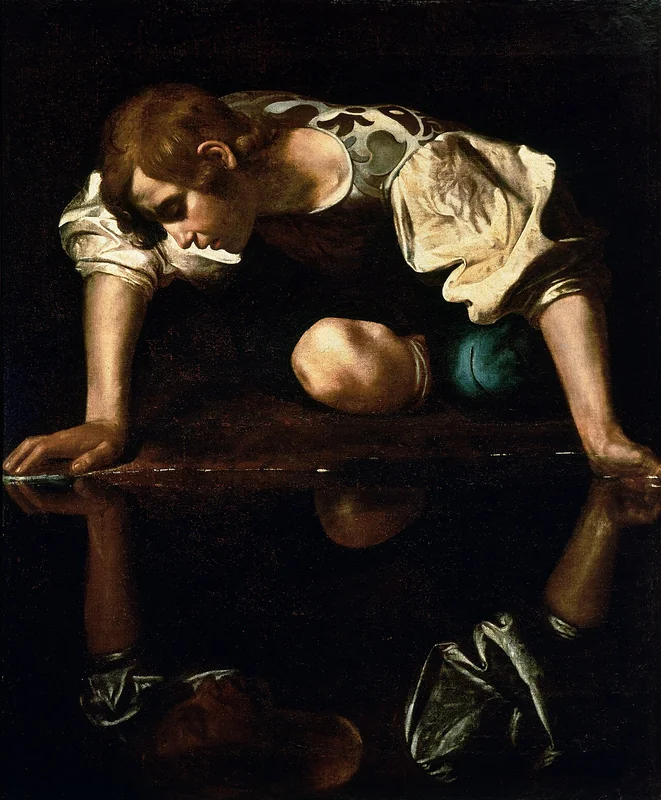
Narcissus is a youth in Greek mythology celebrated for his extraordinary beauty. The son of the river-god Cephissus and the nymph Liriope, he was prophesied at birth to live a long life only if he never knew himself. He scorned all who loved him, including the nymph Echo, who wasted away until only her voice remained. As punishment, Nemesis (or Aphrodite in some accounts) made Narcissus fall in love with his own reflection in a pool of water. Unable to leave the image, he pined away and died. The narcissus flower sprang from the spot where he died. The myth is told in full by Ovid (Metamorphoses 3.339–510).
Quick facts
- Pantheon
- Greek
- Figure type
- Hero
- Period
- Mythological tradition; the myth is attested fully in Ovid (1st c. BCE–1st c. CE) but earlier Greek versions existed
- Primary sources
- Ovid Metamorphoses 3.339–510; Pausanias Description of Greece 9.31.7–8
- Related figures
- echo, nemesis, aphrodite
Echo and Narcissus
Ovid's Metamorphoses (3.339–510) is the fullest ancient account. Echo was a mountain nymph who had been cursed by Hera to be able only to repeat the last words spoken to her, because she had distracted Hera with conversation while Zeus consorted with nymphs. Echo fell in love with Narcissus, but he rejected her advances. She wasted away until only her voice — the echo — remained. Nemesis, goddess of retribution, answered the prayers of those Narcissus had scorned: she made him see his own reflection in a spring and fall hopelessly in love with it. He could not obtain the beautiful image; he pined at the pool until he died.
The narcissus flower
On the spot where Narcissus died, a flower sprang up — either the narcissus (daffodil) or some similar flower. Ancient sources give different details: Ovid says only that a flower with white petals and a saffron-coloured centre (a narcissus) was found. The flower was associated with the underworld in ancient tradition — narcissus flowers were woven into garlands for the dead and appear in the Homeric Hymn to Demeter (6–8) as the flower with which Persephone was lured before her abduction. The name of the flower and the name of the youth in the myth are probably connected.
Sources & further reading (2)
- primary-source — accessed 2026-05-06
- encyclopedia — accessed 2026-05-06
Frequently asked questions
What does the myth of Narcissus represent?
The myth of Narcissus as narrated by Ovid (Metamorphoses 3.339–510) explores themes of self-absorption, unrequited love, and the dangers of excessive vanity. Narcissus fails to recognise that the beautiful image he sees is his own reflection — he loves something he cannot possess. The psychological term 'narcissism,' coined in modern psychiatry and psychology, derives from this myth to describe excessive self-admiration or self-centeredness. The myth also explores the nature of identity: Narcissus loves an image, not a person, and cannot distinguish self from other.
What happened to Echo in Greek mythology?
Echo was an Oread (mountain nymph) who had been cursed by Hera to be able only to repeat the final words of whatever was said to her, as punishment for distracting Hera with stories while Zeus was with other nymphs (Ovid Metamorphoses 3.356–369). When Echo fell in love with Narcissus but was rejected, she retreated to the woods and wasted away with grief until only her voice remained — hence the natural phenomenon of echoes. The myth explains the echo as the surviving voice of the nymph who loved Narcissus.