Hero
Momotarō
The Peach Boy of Japanese folklore who was born from a giant peach and defeated the demons of Onigashima.
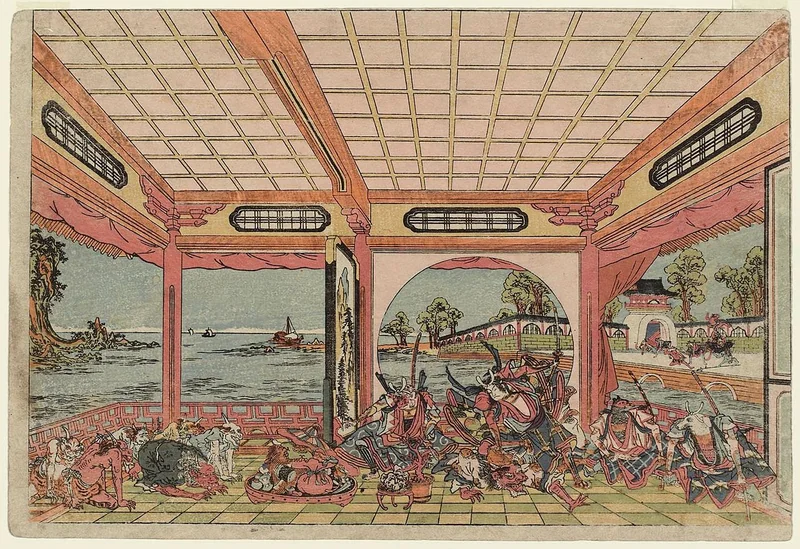
Momotarō (桃太郎, 'Peach Boy') is the hero of one of Japan's best-known folk tales. An old woman found a giant peach floating down a river; inside was a boy whom she and her husband raised as their son. When Momotarō came of age, he learned of the demons (oni) of the island of Onigashima who terrorised Japan by stealing treasure and people. He set out to defeat them, gathering three animal companions along the way — a dog, a monkey, and a pheasant — by offering them kibi-dango (millet dumplings). Together they stormed the demons' island fortress, defeated the demon king Ura, recovered the stolen treasures, and returned in triumph. The tale is attested in various manuscript and printed versions from at least the Muromachi period (1336–1573 CE); the earliest printed version dates from c. 1650 CE. The story appears in pre-modern Japanese collections such as Otogi Zōshi (c. 15th–17th century CE).
Quick facts
- Pantheon
- Japanese
- Figure type
- Hero
- Period
- Earliest printed version c. 1650 CE; oral tradition older; collected in Otogi Zōshi tradition (c. 15th–17th century CE)
- Primary sources
- Otogi Zōshi (c. 15th–17th century CE) — Japanese collection of medieval short tales; Printed ehon (picture-book) versions from the Edo period (1603–1868 CE)
- Related figures
- urashima-taro, kintoki, oni
Birth and companions
In the most common version of the tale (as recorded in Edo-period printed versions), an old couple lived childless; one day the old woman washing clothes in a river found an enormous peach floating toward her. They brought it home; when they tried to cut it open, a healthy boy burst out from inside, announcing that the gods had sent him to be their son. He was named Momotarō ('Peach Boy' or 'Peach Eldest Son'). When he came of age and heard about the demons of Onigashima, he requested kibi-dango (millet dumplings) from his mother and set off. On the road, a dog, a monkey, and a pheasant each in turn asked what he was eating; he offered them half a dumpling in exchange for becoming his retainer. The three animals represent a traditional Japanese combination of helpers — the loyal dog, the clever monkey, and the brave pheasant — whose combined abilities complement each other.
Conquest of Onigashima
Arriving at the island of Onigashima, Momotarō and his three companions stormed the demon fortress. The pheasant flew over the gate and distracted the demons; the monkey scaled the walls and opened the gates; the dog fought fiercely in the melee. Momotarō defeated the demon king Ura (or the chief oni) in single combat and compelled the demons to surrender all the stolen treasures and pledge never to terrorise Japan again. Momotarō and his companions returned home laden with treasure, bringing prosperity to the elderly foster parents who had raised him. The tale's structure — supernatural birth, exceptional virtue, symbolic animal allies, battle against evil — makes it a template of the Japanese hero-tale genre, comparable in function to European tales of the type 'The Monster's Bride' or Arthurian quests.
Sources & further reading (2)
- encyclopedia — accessed 2026-05-06
- primary-source — accessed 2026-05-06
Frequently asked questions
What do the three animals (dog, monkey, pheasant) symbolise?
The dog, monkey, and pheasant that accompany Momotarō are not arbitrary choices in the Japanese folkloric tradition. In the Japanese zodiac (eto), the dog (inu), monkey (saru), and pheasant (or rooster, tori) correspond to compass directions (west, northwest, and west-southwest) that collectively point away from the oni's direction — the northeast (kimon, 'demon gate'), the traditional direction from which malevolent forces were believed to come in Japanese geomancy. This directional symbolism suggests the trio represents forces that specifically ward off demons. In the tale, their complementary skills — the dog's loyalty and bite, the monkey's agility and cunning, the pheasant's flight and sharp beak — model cooperation as the practical foundation of the heroic quest.
How has the Momotarō story been used in modern Japan?
Momotarō has been one of the most politically and culturally significant figures in modern Japanese history, beyond its folkloric role. During the Meiji and Taishō periods (1868–1926 CE), the story was incorporated into school textbooks as a model of loyalty, filial piety, and national service. In the 1930s–1945 CE, Momotarō was consciously mobilised in imperial propaganda as a symbol of Japanese superiority and the nation's duty to civilise Asia — the demons of Onigashima were reinterpreted as Western colonial powers. The 1945 animated film Momotarō: Sacred Sailors (dir. Mitsuyo Seo) was the first feature-length Japanese animated film, produced as wartime propaganda. In postwar Japan, Momotarō returned to its role as a gentle children's folk hero; the story remains one of the most widely known Japanese tales internationally.