Monster
Minotaur
Monster of the Cretan Labyrinth, half-human and half-bull.
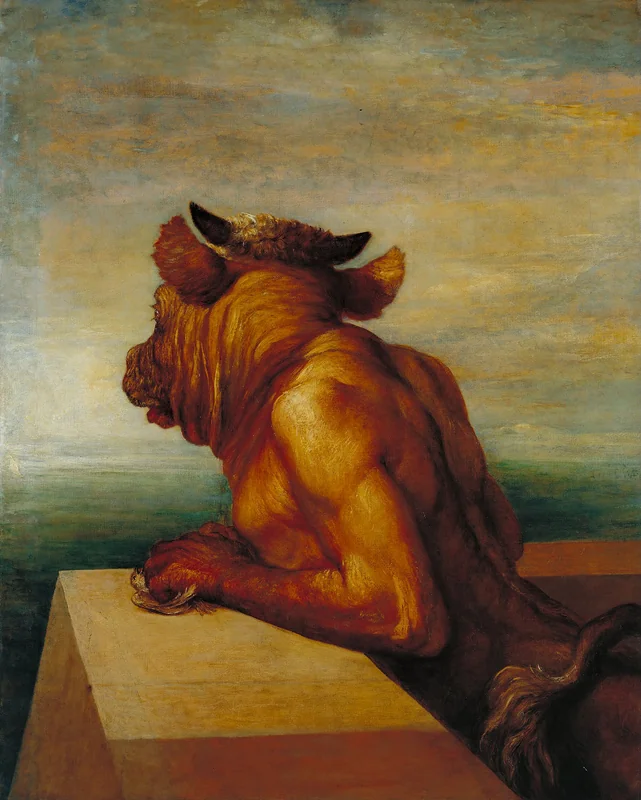
The Minotaur (Greek: Minotauros, 'Bull of Minos') is a monster from Greek mythology with the body of a man and the head of a bull, or, in some descriptions, the body of a bull and the head of a man. He was born to Pasiphae, wife of King Minos of Crete, after she mated with a bull sent by Poseidon. King Minos commissioned Daedalus to build the Labyrinth to contain the Minotaur. Athens was forced to send a tribute of young men and women to be fed to him every nine years until the hero Theseus killed him.
Quick facts
- Pantheon
- Greek
- Figure type
- Monster
- Period
- Tradition set in the Bronze Age; Minoan Crete c. 1600–1100 BCE
- Primary sources
- Apollodorus Bibliotheca 3.1.4; Apollodorus Epitome 1.7–9; Ovid Metamorphoses 8.152–182; Diodorus Siculus Library 4.61.4
- Related figures
- theseus, minos, pasiphae, daedalus, ariadne
Birth and the Labyrinth
Apollodorus (Bibliotheca 3.1.4) narrates that Poseidon sent a magnificent white bull from the sea as a gift to King Minos of Crete, intended for sacrifice. Minos kept the bull instead, substituting another. Poseidon punished him by causing his wife Pasiphae to fall in love with the bull. The craftsman Daedalus built a hollow wooden cow in which Pasiphae concealed herself; the result was the Minotaur, named Asterion. Minos commissioned Daedalus to construct the Labyrinth — a vast, inescapable maze — beneath his palace at Knossos to contain the monster.
Athenian tribute and the death of the Minotaur
Athens was required to pay Minos a tribute of seven young men and seven young women every nine years, to be fed to the Minotaur (Apollodorus Epitome 1.7). After two tributes, the Athenian hero Theseus volunteered to go as one of the tribute-youths. With the help of Minos's daughter Ariadne, who gave him a ball of thread (the 'clew of Ariadne'), Theseus entered the Labyrinth, killed the Minotaur, and led the other Athenians out by following the thread. The myth has been interpreted as reflecting the historical dominance of Minoan Crete over Mycenaean Greece.
Sources & further reading (2)
- primary-source — accessed 2026-05-06
- encyclopedia — accessed 2026-05-06
Frequently asked questions
What is the Labyrinth of Crete?
The Labyrinth was a vast underground maze built by the craftsman Daedalus on the orders of King Minos of Crete to contain the Minotaur (Apollodorus Bibliotheca 3.1.4). Ancient sources describe it as so complex that anyone who entered could not find their way out unaided. Modern archaeologists have connected the myth to the enormous multi-roomed palace complex at Knossos, excavated by Arthur Evans from 1900 onward. The Minoan palace's complexity, combined with the bull-leaping frescoes found there, may have inspired or preserved the myth.
What is the Minotaur's real name?
The Minotaur's personal name, as given by some ancient sources, is Asterion (or Asterius), meaning 'starry one' — the same name as the Cretan king who adopted Minos (Apollodorus Bibliotheca 3.1.3). The more common term Minotauros means 'Bull of Minos' in Greek and is a descriptive title rather than a proper name. The Minotaur's name Asterion appears in Apollodorus and in a scholion on Apollonius Rhodius's Argonautica.