Hero
Midas
Phrygian king of Greek mythology who received the gift of the golden touch.
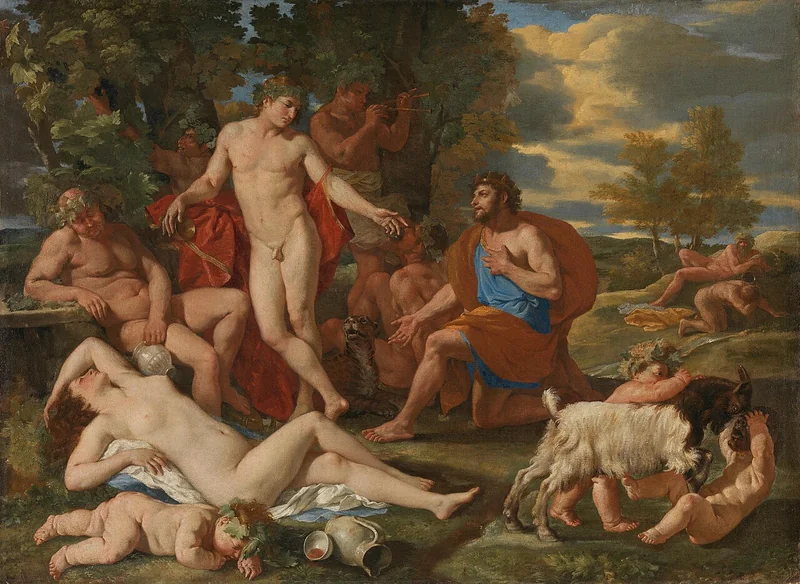
Midas is a king of Phrygia in Greek mythology best known for two myths: the golden touch granted by Dionysus, and the donkey's ears given by Apollo. In the first myth, Midas received from Dionysus the ability to turn everything he touched to gold; the gift quickly proved a curse when his food and drink also turned to gold. Dionysus instructed him to wash it away in the River Pactolus. In the second myth, Midas judged Apollo's music inferior to that of Pan and received donkey's ears as punishment. The myths are narrated by Ovid (Metamorphoses 11.85–193) and alluded to in earlier Greek sources.
Quick facts
- Pantheon
- Greek
- Figure type
- Hero
- Period
- A historical Midas (Mita of Mushki) ruled Phrygia c. 720–696 BCE; the mythological Midas is a legendary figure
- Primary sources
- Ovid Metamorphoses 11.85–145 (golden touch); Ovid Metamorphoses 11.146–193 (donkey's ears); Herodotus Histories 1.14 (historical Midas)
- Related figures
- dionysus, apollo, silenus, pan
The golden touch
Ovid's Metamorphoses (11.85–145) narrates that Midas found the satyr Silenus, companion of Dionysus, wandering in his kingdom and treated him hospitably for ten days before returning him to Dionysus. As a reward, Dionysus offered Midas any wish. Midas asked that everything he touched turn to gold. The wish was granted; at first it delighted him. Then he sat at his dinner table and found his food and wine turned to gold at his touch. He begged Dionysus to remove the gift. Dionysus directed him to wash in the River Pactolus at Sardis; the golden touch transferred to the river, which became famous in antiquity for its gold-bearing sands.
Donkey's ears
Ovid's Metamorphoses (11.146–193) narrates a second myth: Midas was present when the satyr Marsyas (or Pan in some versions) competed musically against Apollo. When all agreed Apollo was the victor, Midas alone dissented. Apollo punished him by transforming his ears into the ears of a donkey. Midas concealed the ears under his royal cap. Only his barber knew the secret; unable to keep it but afraid to speak it aloud, the barber dug a hole in the ground, whispered the secret into it, and filled it back in. Reeds grew there; when the wind blew through them, they whispered 'Midas has donkey's ears.'
Sources & further reading (2)
- primary-source — accessed 2026-05-06
- encyclopedia — accessed 2026-05-06
Frequently asked questions
What is the Midas touch?
The 'Midas touch' (or 'golden touch') refers to the mythological ability granted to King Midas by Dionysus to turn anything he touched to gold (Ovid Metamorphoses 11.85–145). In the myth, the gift proved a curse: his food, drink, and beloved daughter all turned to gold, leaving him unable to eat or drink. He begged Dionysus to remove the gift and was told to bathe in the River Pactolus. The phrase 'Midas touch' is used in modern English to describe a person who seems to be able to profit from or succeed at everything they undertake.
Was Midas a real historical king?
Yes. A historical king named Midas (known in Assyrian sources as Mita of Mushki) ruled the Phrygian kingdom in Anatolia (modern Turkey) around 720–696 BCE. He is mentioned in the inscriptions of the Assyrian king Sargon II and was known to the Greeks as a very wealthy king. Herodotus (Histories 1.14) records that the historical Midas sent a golden throne to the Oracle at Delphi. The mythological Midas with the golden touch appears to be a legendary elaboration of the real king's fame for wealth.