Monster
Medusa
Gorgon of Greek mythology whose gaze turned onlookers to stone.
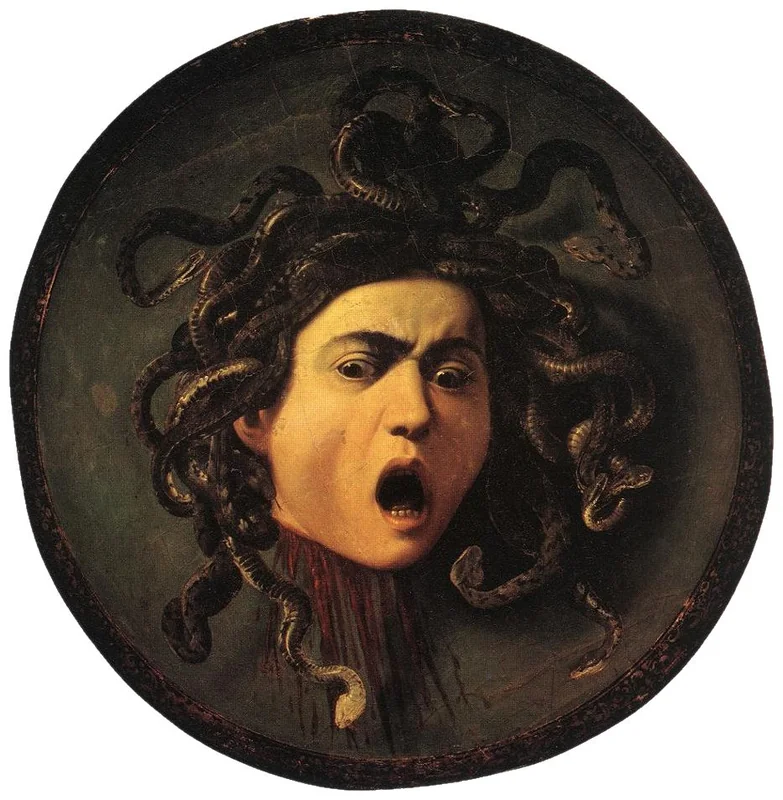
Medusa is the most famous of the three Gorgon sisters of Greek mythology, capable of turning any living creature who met her gaze to stone. She is the only mortal Gorgon — her sisters Stheno and Euryale were immortal. According to Hesiod's Theogony, the Gorgons were daughters of the sea-deities Phorcys and Ceto. Perseus beheaded Medusa with the aid of Athena and Hermes, using a reflective shield to avoid her petrifying gaze. From Medusa's severed neck sprang the winged horse Pegasus and the giant Chrysaor.
Quick facts
- Pantheon
- Greek
- Figure type
- Monster
- Period
- Attested from the 8th century BCE; Gorgon images on Greek pottery c. 700–650 BCE
- Primary sources
- Hesiod Theogony 270–286; Apollodorus Bibliotheca 2.4.2–3; Ovid Metamorphoses 4.770–803; Pindar Pythian Odes 10.44–48
- Related figures
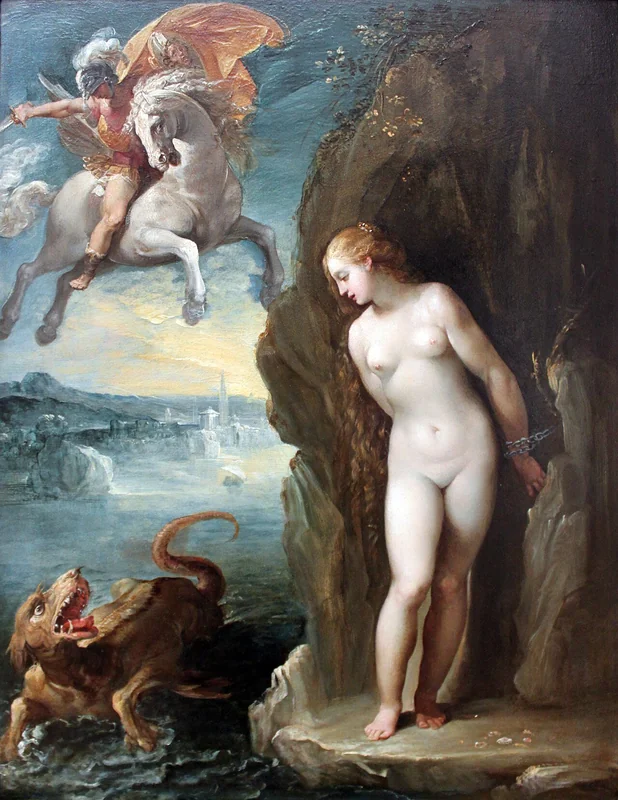
- perseus, athena, poseidon, pegasus, andromeda
The Gorgons
Hesiod's Theogony (270–286) places the Gorgons as daughters of the sea-deities Phorcys and Ceto, making them part of a family of primordial sea monsters. The three sisters are Stheno (Mighty), Euryale (Far-Roaming), and Medusa (Guardian). Only Medusa is mortal. The Gorgons dwell at the edge of the world, near the Gardens of the Hesperides and the Hyperboreans, according to early tradition. Medusa is distinguished from her immortal sisters in that she can be killed; her petrifying power, however, persists even after death — Perseus uses her severed head as a weapon.
Poseidon and the origin of Medusa's monstrous form
Ovid's Metamorphoses (4.790–803) — a Latin source drawing on earlier Greek tradition — records that Medusa was originally a mortal woman of great beauty, famous especially for her hair. Poseidon ravished her in a temple of Athena. Athena punished the violation of her sanctuary by transforming Medusa's beautiful hair into a mass of serpents and making her gaze petrifying. This Ovidian version is later than the canonical Hesiodic Gorgon as a primordial monster, but both traditions circulated in the ancient world.
Sources & further reading (2)
- primary-source — accessed 2026-05-06
- encyclopedia — accessed 2026-05-06
Frequently asked questions
How did Perseus kill Medusa without looking at her?
Perseus avoided Medusa's petrifying gaze by viewing her reflection in his polished bronze shield rather than looking at her directly (Apollodorus Bibliotheca 2.4.2–3). Athena guided his hand; he beheaded her while she slept. Perseus stored the head in a special bag called the kibisis, keeping it covered. He later used the head as a weapon, turning his enemies to stone by forcing them to look at it, before eventually giving it to Athena to mount on her aegis.
What emerged from Medusa's blood?
Hesiod's Theogony (280–281) records that when Perseus beheaded Medusa, from her severed neck sprang two beings: Pegasus, the winged horse, and Chrysaor, the giant who carried a golden sword. Both were children of Poseidon, who had lain with Medusa. Pegasus flew to Mount Helicon, where he struck the ground with his hoof and created the Hippocrene spring sacred to the Muses. He was later tamed by the hero Bellerophon.