God
Mago
The primordial great goddess of Korean mythology, the original creator from whose body the world was formed.
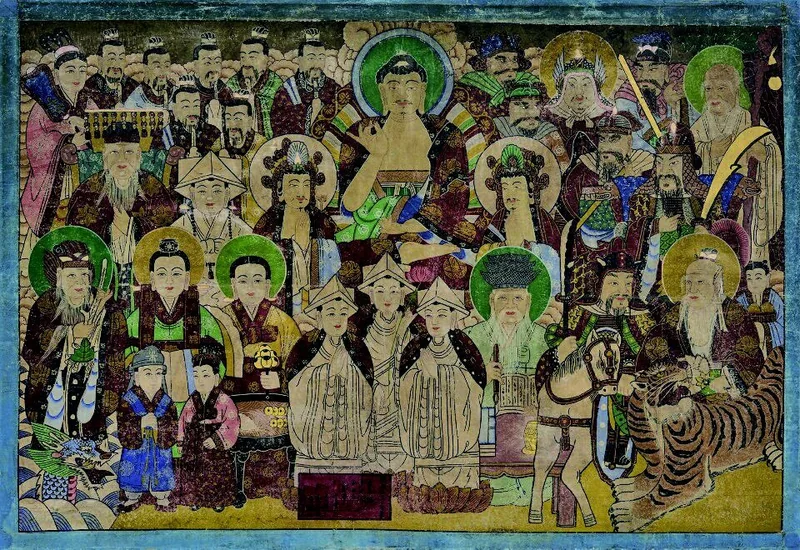
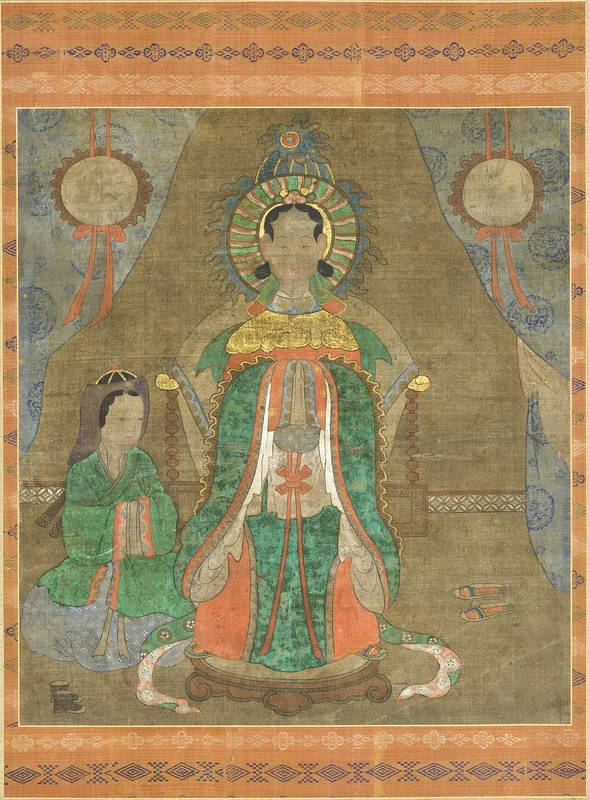
Mago (마고, 麻姑) is a primordial earth goddess and creator figure in Korean mythology, one of the oldest and most widely attested divine figures in the Korean tradition. She is a vast supernatural woman — sometimes described as enormous enough to fill the sky — whose mythology involves the creation of the world, the origin of humanity, and the first transgression that separated humans from paradise. The Budoji (符都誌, 'Record of the Wonderful City'), a text attributed to the Silla scholar Park Jega (or transmitted under disputed circumstances) and claimed to be the oldest Korean creation text, contains the most detailed Mago mythology. In folk tradition, Mago is associated with shamanic creation songs, mountains (she is sometimes identified with the grandmother spirit of the sacred mountains), and divine feminine creative power. She is also attested in Chinese Taoist tradition as Magu (麻姑, 'Hemp Lady'), a Taoist immortal associated with longevity.
Quick facts
- Pantheon
- Korean
- Figure type
- God
- Period
- Budoji attribution disputed; folk tradition ancient; Mago attested in various Korean and Chinese sources
- Primary sources
- Budoji (符都誌) — text attributed to Park Jega of Silla; dating and authenticity disputed; Korean shamanic creation narrative traditions (mul-mori gut, shamanic songs)
- Related figures
- dangun, hwanin, samsin, baridegi
Mago as creator goddess
In the Budoji tradition (a text of disputed date and transmission), Mago is the original self-existent being who preceded and generated the cosmos. From Mago came two daughters — Gung-hui and So-hui — and from them four further beings, and so on, generating the first humans. In this tradition, the original humans drank from the Heaven Lake (Mago's milk or the celestial spring) and were harmonious and sinless. The primordial fall from paradise occurs when one of the first humans, hungry, eats the berries of a vine (in some versions) or another forbidden food, causing the body to require earthly food instead of the celestial milk. The other humans follow, and paradise is lost. This Korean myth parallels the Garden of Eden structure (original paradise → transgression → expulsion to earthly necessity) and represents one of the few Korean cosmogonic myths with a fall narrative. The Budoji's dating is contested by scholars, with some placing the text's composition in the Joseon period (1392–1897 CE).
Mago in Korean folk tradition
Beyond the Budoji, Mago appears in Korean shamanic songs and regional folk traditions as a vast primordial grandmother figure associated with the earth and sacred mountains. In Jeju Island creation narratives (Cheonjiwahnggwa Dabyulaedo, the Jeju cosmogonic narrative), a primordial goddess-like figure separates heaven and earth in the beginning — a role that scholars have connected to the Mago figure. In mainland Korean shamanic tradition, the great mountains of Korea (Baekdusan, Hallasan, Jirisan) are sometimes presided over by mountain grandmother spirits (sanshin halmae) that share characteristics with the Mago archetype. The association between Mago and the Korean landscape — mountains, earth, caves — positions her as an indigenous earth-goddess figure pre-dating the Buddhist and Confucian overlays on Korean religion.
Sources & further reading (2)
- encyclopedia — accessed 2026-05-06
- primary-source — accessed 2026-05-06
Frequently asked questions
Is the Budoji a genuine ancient text?
The Budoji (符都誌, 'Record of the Wonderful City') is a highly contested text. It is claimed to have been written by Park Jega (or Jegae), a Silla-period figure, and preserved in secret transmission until its 'revelation' in the 20th century CE. Mainstream Korean historians and scholars treat the Budoji with significant scepticism, noting that it appears in no pre-modern catalogue or reference and that its content and style show characteristics inconsistent with Silla-period texts. The consensus scholarly view is that the Budoji was likely composed or substantially reworked in the modern period (late 19th or early 20th century CE) and should not be treated as an ancient source. However, the Mago figure herself may have ancient roots in Korean folk tradition independent of the Budoji, as shamanic creation songs and regional folk narratives contain goddess figures that parallel the Budoji's Mago without being textually dependent on it.
How is the Korean Mago related to the Chinese Magu?
The Chinese Magu (麻姑, 'Hemp Lady') is a Taoist immortal associated with longevity, the peach of immortality, and the eastern sea. She is attested in Chinese sources from at least the 3rd century CE (Ge Hong's Shenxian Zhuan, c. 320 CE). The Korean Mago (마고) and the Chinese Magu share the same Chinese characters and the same pronunciation in their respective languages. This suggests the Korean Mago may have connections to the Chinese Magu tradition introduced via Taoism. However, Korean Mago in the shamanic and Budoji tradition has a creator-goddess role not present in the Chinese Magu tradition, suggesting either that Korea developed the figure independently with a different mythological profile, or that the Korean tradition significantly expanded on the Chinese figure. The relationship between the two figures remains a subject of scholarly discussion.