Hero
Kim Alji
The golden-chest child of Korean mythology, ancestor of the Kim royal family of Silla.
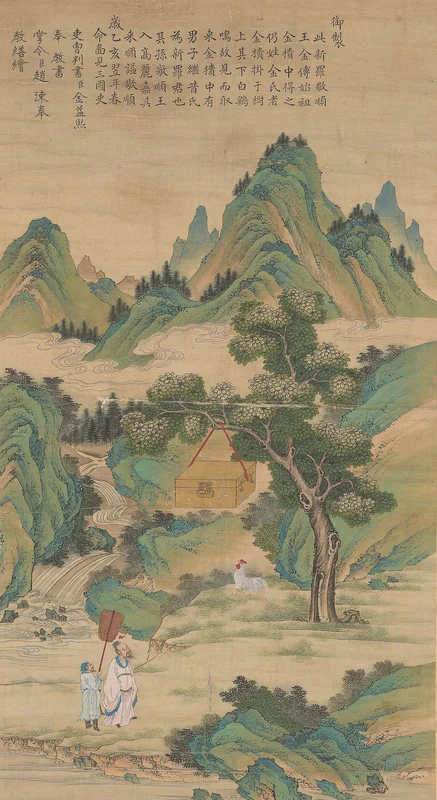
Kim Alji (김알지, 金閼智, 'Precious Gold') is the legendary ancestor of the Kim clan of Silla, from whom all Korean monarchs with the surname Kim (the most common Korean surname) ultimately trace their lineage. According to the Samguk Yusa (1281 CE), King Talhae of Silla heard a cockerel crow in the forest of Sirim (or Gyerim, 'Chicken Forest') and sent a minister to investigate. They found a golden chest hanging from the branch of a tree, with a white rooster crowing beneath it. Inside the chest was a radiant infant boy. The king adopted him and named him Alji (meaning 'child' in old Silla language). The forest was thereafter renamed Gyerim ('Chicken Forest') and Silla itself was sometimes called Gyerim. Alji chose not to ascend to the throne and his descendants eventually became one of Silla's ruling family lines. Recorded in the Samguk Yusa (1281 CE) and Samguk Sagi (1145 CE).
Quick facts
- Pantheon
- Korean
- Figure type
- Hero
- Period
- Legendary; traditional date 65 CE; recorded in Samguk Sagi (1145 CE) and Samguk Yusa (1281 CE)
- Primary sources
- Samguk Yusa (1281 CE), Book 1: 'Kim Alji, Silla' section, by Iryeon; Samguk Sagi (1145 CE), Book 1: Silla annals, by Kim Busik
- Related figures
- bak-hyeokgeose, suro, aryeong
Discovery in the golden chest
The Samguk Yusa (1281 CE, 'Kim Alji' section) narrates that in the 9th year of King Talhae's reign (traditionally 65 CE), a cockerel's crow was heard from the western forest of Sirim in the middle of the night. At dawn, the king sent the minister Hogong to investigate. In the forest, Hogong saw a bright golden light and found a purple cloud descending from heaven. Within it hung a golden chest (金函, golden box) from the branch of a tree. A white rooster crowed beneath the tree. Hogong returned and reported; the king himself went out to the forest. When the chest was opened, a beautiful infant boy was found inside, radiating light. The king was delighted and took him in as his son. The baby was named Alji ('child' in old Silla speech); because he came from a golden chest, his family name was given as Kim (金, gold).
Gyerim and the Kim clan legacy
The forest of Sirim where Kim Alji was found was renamed Gyerim (雞林, 'Chicken Forest') because of the white rooster that crowed at the discovery, and the Samguk Yusa (1281 CE) notes that Silla was sometimes called Gyerim as a result. Kim Alji himself did not become king — he declined succession and the throne passed back to the Bak lineage. However, his descendants eventually took the throne: the Samguk Sagi records that Kim Naemul (Kim Naemulwang, r. 356–402 CE) was the first Kim-clan king of Silla, establishing the Kim lineage as the dominant royal family for most of Silla's later history. All Korean people with the surname Kim (today approximately 21% of the South Korean population, roughly 10 million people) trace their family name to this mythological golden chest.
Sources & further reading (2)
- encyclopedia — accessed 2026-05-06
- primary-source — accessed 2026-05-06
Frequently asked questions
Why is the white rooster significant in the Kim Alji myth?
The white rooster (or cockerel) that crows at the discovery of Kim Alji's golden chest in the forest of Sirim (Samguk Yusa 1281 CE) connects the myth to two symbolic registers. First, the rooster's crow at dawn signals divine revelation — the cockerel announces the arrival of something extraordinary and sacred (its crow draws attention to the golden chest). Second, the rooster is associated in East Asian tradition with the sun and with warding off evil spirits (its crow dispels the darkness and malevolent forces of the night). The forest's subsequent renaming to Gyerim ('Chicken Forest') after the rooster permanently memorialises the creature in Silla's sacred geography. The white colour of the rooster adds purity symbolism: white animals in Korean and East Asian mythology are consistently markers of the divine or auspicious.
How is Kim Alji connected to modern Koreans with the surname Kim?
Kim (김, 金) is the most common surname in Korea, carried by approximately 21% of South Koreans (about 10.5 million people as of the 2015 census). The Samguk Yusa (1281 CE) and Samguk Sagi (1145 CE) both record that the family name Kim was given to Alji because he came from a golden chest (金函). All Korean Kims — regardless of which specific Kim clan branch they belong to, and there are over 290 registered Kim clan branches in Korea — trace the mythological origin of their surname to this founding moment. The actual historical origin of the Kim royal family of Silla is dated to the 4th century CE (King Naemul, r. 356–402 CE), but the mythological genealogy projects the family name back to 65 CE and the miraculous discovery in the forest.