Hero
Kaguya-hime
The Shining Princess of the Moon who descended to earth and returned to her celestial homeland.
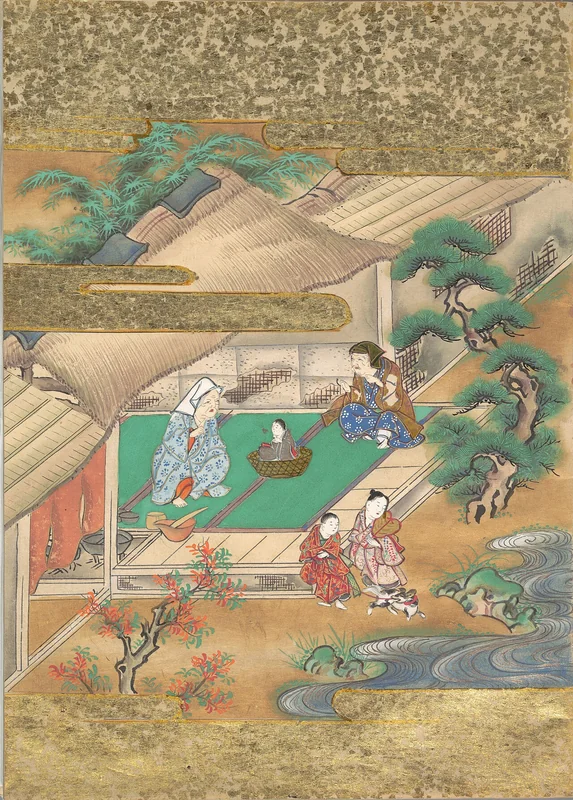
Kaguya-hime (輝夜姫, 'Shining Night Princess' or 'Princess of the Radiant Night') is the central figure of The Tale of the Bamboo Cutter (Taketori Monogatari, c. 10th century CE), considered Japan's oldest prose narrative. An old bamboo cutter discovered a tiny glowing girl inside a bamboo stalk; she grew into a woman of incomparable beauty. She rejected five noble suitors by setting each an impossible task, rejected the Emperor himself, and eventually revealed that she was a being from the Moon (Tsuki no Miyako, 'Capital of the Moon') who had been sent to earth as a punishment. When the celestial envoys came to retrieve her, she sent a letter and a robe of feathers to the Emperor — and ascended to the Moon, leaving her foster parents and the Emperor grief-stricken. Preserved in Taketori Monogatari (c. 10th century CE).
Quick facts
- Pantheon
- Japanese
- Figure type
- Hero
- Period
- Taketori Monogatari (The Tale of the Bamboo Cutter), c. 10th century CE
- Primary sources
- Taketori Monogatari (c. 10th century CE) — oldest surviving Japanese prose narrative; Referenced in Genji Monogatari (c. 1008 CE) as the ancestor of all tales
- Related figures
- tsukuyomi, fujiwara-no-mototsune, emperor
Discovery and five suitors
The Taketori Monogatari opens with Sanuki no Miyatsuko (the bamboo cutter) discovering a tiny girl inside a luminous bamboo stalk. She grows rapidly and becomes a woman of extraordinary beauty, radiating light. Five noble suitors seek her hand: she assigns each an impossible task. The first must bring the stone bowl of the Buddha from India (he returns with a fake). The second must fetch a jewelled branch from the island of Hōrai (he commissions a fake from craftsmen). The third must bring the robe of the fire-rat from China (his robe burns). The fourth must get a gem from a dragon's neck (he fails in a storm at sea). The fifth must bring the cowrie-shell of the swallows (he falls from a great height and nearly dies). All five fail, and Kaguya-hime remains unmarried. The Emperor himself comes and is equally rejected, though she accepts his correspondence.
Return to the Moon
As the night of the fifteenth day of the eighth month approaches, Kaguya-hime grows increasingly melancholy and reveals to her foster parents that she is a celestial being from the Moon, sent to earth as a consequence (the reason is left ambiguous — punishment or exile). The Emperor surrounds the house with warriors to prevent her ascent. The celestial envoys descend in a shining chariot; the warriors are blinded or paralysed. Kaguya-hime puts on the Feather Robe (hagoromo), which immediately causes all earthly emotion to fade from her. She sends a letter and a vial of the elixir of immortality to the Emperor. She writes that she would gladly stay if she could, then ascends to the Moon. The Emperor, grief-stricken, burns the elixir on the peak nearest the Moon — that mountain (Fuji) has smoked ever since.
Sources & further reading (2)
- primary-source — accessed 2026-05-06
- encyclopedia — accessed 2026-05-06
Frequently asked questions
What is the Taketori Monogatari and why is it important?
The Taketori Monogatari (竹取物語, 'The Tale of the Bamboo Cutter') is a Japanese prose narrative composed around the late 9th to early 10th century CE — the oldest surviving example of Japanese prose fiction (monogatari). Its author is unknown. The tale is referenced in the Genji Monogatari (c. 1008 CE) by Murasaki Shikibu as 'the ancestor of all tales' (monogatari no ide-kite oya naru taketori no okina). It combines folklore motifs (tiny being found in natural object, impossible tasks, celestial origin) with literary refinement, setting a template for Japanese narrative fiction. The tale's themes — the impossibility of possessing true beauty, the alien nature of perfection, the melancholy of departure — recur throughout classical Japanese literature.
Is the Feather Robe (hagoromo) the same in the Kaguya-hime story and in other Japanese myths?
The feather robe (hagoromo) that allows celestial beings to fly and that erases earthly feeling when worn appears in multiple Japanese literary and mythological contexts. In the Kaguya-hime story (Taketori Monogatari), it is the robe worn by the celestial envoys and given to Kaguya-hime upon her return. In the Noh play Hagoromo (attributed to Zeami Motokiyo, c. 15th century CE), a heavenly maiden loses her robe to a fisherman and must dance to recover it — a motif also found in Chinese and Korean swan-maiden traditions. The hagoromo motif is widespread across East and Southeast Asian mythology, representing the liminal object that allows movement between the human and celestial worlds. In the Kaguya-hime story, the robe functions as the agent of transformation that ends her earthly incarnation.