God
Izanami
The female creator deity of Japanese mythology, now ruler of the underworld Yomi.
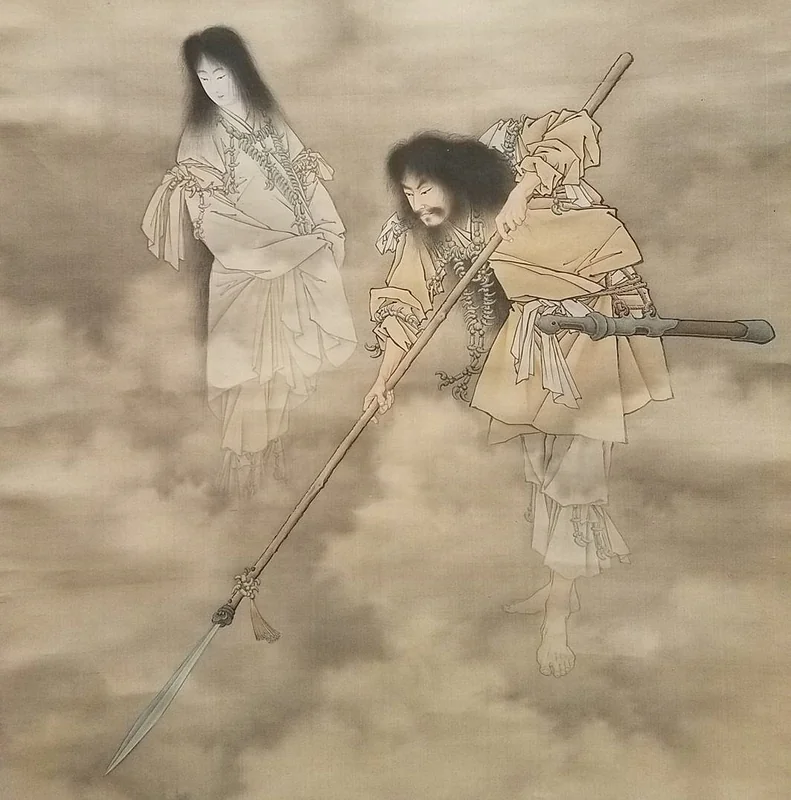
Izanami-no-Mikoto (伊邪那美命, 'She Who Invites') is the female creator deity of Japanese mythology, paired with Izanagi, her brother-husband. Together they created the islands of Japan and the first generation of gods. Izanami died from burns while giving birth to Kagutsuchi, the fire deity, and descended to Yomi, the underworld. When Izanagi followed and broke his promise not to look at her, she was shamed by his sight of her rotting form and became the queen of Yomi — a figure of death and pollution. Her vow to kill a thousand people daily (answered by Izanagi's vow to create fifteen hundred births) established the cycle of death and birth in the world. Described in the Kojiki (712 CE, trans. Chamberlain 1882) and Nihon Shoki (720 CE, trans. Aston 1896).
Quick facts
- Pantheon
- Japanese
- Figure type
- God
- Period
- Recorded in the Kojiki (712 CE) and Nihon Shoki (720 CE)
- Primary sources
- Kojiki (712 CE), trans. Chamberlain 1882: Book I, sections 5–10; Nihon Shoki (720 CE), trans. Aston 1896: Vol. I, pp. 14–25
- Related figures
- izanagi, amaterasu, susanoo, kagutsuchi, yomi
Death and descent to Yomi
The Kojiki (Book I, section 8, trans. Chamberlain 1882) narrates Izanami's death during the birth of the fire god Kagutsuchi: her genitals were burned by the fire of his birth, and she fell ill and died. From her vomit, excrement, and urine, additional deities were born even in her dying moments. She descended to Ne-no-Kuni, the root-country, also identified with Yomi — the underworld realm of the dead. When Izanagi descended to retrieve her, she called out to him: 'My husband and lord! Enter not! For I have already eaten of the cooking furnace of Yomi.' She went to negotiate with the deities of Yomi on his behalf, but asked him not to look at her. He broke his promise; she was revealed in her state of putrefaction, her body writhing with maggots and thunder deities. This scene — the forbidden gaze at the dead, and the resulting rupture — structures the myth's lesson about the separation between the living and the dead.
Queen of Yomi
After Izanagi's flight and the great boulder separation, Izanami became the ruler of Yomi and the embodiment of death (Kojiki Book I, section 10, trans. Chamberlain 1882). She shouted across the boulder: 'My dear husband and lord! If thou dost this, I will throttle to death a thousand of thy country's people in one day.' Izanagi answered: 'My dear spouse! If thou dost this, I will in one day cause to be born one thousand and five hundred people.' This exchange formally establishes the balance between death and life — mortality and fertility — as a cosmic compact. Izanami thus transforms from creator-goddess to death-goddess, ruling Yomi as Izanami-no-Ōkami (Great Goddess of Yomi), the source of all mortality.
Sources & further reading (2)
- primary-source — accessed 2026-05-06
- encyclopedia — accessed 2026-05-06
Frequently asked questions
Is Izanami equivalent to the Japanese concept of hell?
Yomi, the realm Izanami rules, is not a place of punishment like the Christian hell or Buddhist jigoku. It is described in the Kojiki (Book I, sections 9–10, trans. Chamberlain 1882) as a dark, polluted underworld — a realm of decay and death. All who die go there regardless of their moral conduct. Its darkness and uncleanness (represented by Izanami's rotting body) reflects Japanese concepts of kegare (ritual pollution) associated with death. Buddhist concepts of hell arrived in Japan alongside the introduction of Buddhism (6th century CE) and gradually merged with and overlaid the indigenous Yomi mythology. In the original Shinto tradition, Yomi is a realm of pollution and separation, not punishment.
What deities were born from Izanami's body?
The Kojiki (Book I, sections 5–8, trans. Chamberlain 1882) records that Izanami gave birth to many deities during her creative partnership with Izanagi. Among the principal ones: the kami of the islands of Japan, kami of the sea, mountains, rivers, trees, stones, wind, and fire. The fire deity Kagutsuchi (also called Homusubi) caused her death. Even as she lay dying, additional deities were generated from her body's emissions. After her death, the Nihon Shoki (trans. Aston 1896: Vol. I, pp. 23–24) records that from her decomposing body grew the food plants that would sustain humanity, paralleling the Norse myth of Ymir or the Mesopotamian Tiamat — the primordial creator whose death feeds the world.