God
Izanagi
The male creator deity of Japanese mythology who shaped the islands of Japan with his divine spouse.
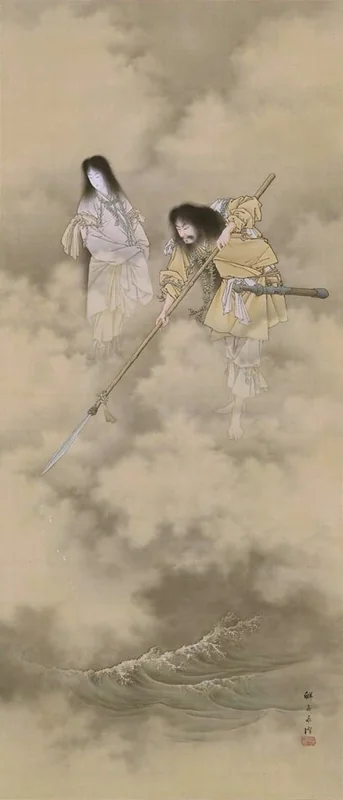
Izanagi-no-Mikoto (伊邪那岐命, 'He Who Invites') is the male creator deity of Japanese mythology, paired with his sister-wife Izanami. Together they stood on the floating bridge of heaven (Ama-no-Ukihashi) and stirred the primordial ocean with the Jewelled Spear of Heaven (Ame-no-Nuboko) to create the first island, Onokoro-jima. They descended to the island and through ritual union created the islands of Japan (the Ōyashiro) and the first generation of deities. After Izanami died giving birth to the fire god Kagutsuchi, Izanagi descended to the underworld Yomi to retrieve her. When he lit a torch and saw her rotting body, she pursued him furiously. He escaped by blocking the entrance to Yomi with a great boulder. Described in the Kojiki (712 CE, trans. Chamberlain 1882) and Nihon Shoki (720 CE, trans. Aston 1896).
Quick facts
- Pantheon
- Japanese
- Figure type
- God
- Period
- Recorded in the Kojiki (712 CE) and Nihon Shoki (720 CE)
- Primary sources
- Kojiki (712 CE), trans. Chamberlain 1882: Book I, sections 3–6; Nihon Shoki (720 CE), trans. Aston 1896: Vol. I, pp. 1–25
- Related figures
- izanami, amaterasu, susanoo, tsukuyomi, yomi
Creation of the Japanese islands
The Kojiki (Book I, sections 3–5, trans. Chamberlain 1882) opens the Japanese creation narrative with Izanagi and Izanami standing on the Ama-no-Ukihashi (Floating Bridge of Heaven) and receiving the command to 'make, consolidate, and give birth to this drifting land.' They dipped the Jewelled Spear of Heaven (Ame-no-Nuboko) into the primordial brine below and stirred it; when they lifted the spear, the brine that dripped from it coagulated to form the island Onokoro-jima. They descended to this island, erected a heavenly pillar, and performed the ritual of meeting and circling the pillar — with an initial misstep in which Izanami spoke first (producing malformed children); they corrected the ritual by having Izanagi speak first, and then produced the proper islands of Japan (Awaji, Shikoku, Kyushu, Honshu, etc.) and a great progeny of deities.
Descent to Yomi
When Izanami died in agony giving birth to Kagutsuchi (the fire deity), Izanagi descended to Yomi (the underworld) to retrieve her (Kojiki Book I, section 9, trans. Chamberlain 1882). Izanami called out to him not to look at her. Waiting too long, Izanagi broke off a comb-tooth and lit it as a torch — and saw Izanami's body writhing with maggots and eight kinds of thunder-deity. He fled in horror and disgust. Izanami, enraged at being seen in her shameful state, sent the shikome (hideous women) and thunder deities after him. Izanagi escaped by throwing his headdress (which became grapes), his comb (bamboo shoots), and peaches (which drove back the pursuers). He blocked the entrance to Yomi with the Great Boulder of Yomotsu Hirasaka, and the two divorced across the rock. Izanami swore to kill a thousand people daily; Izanagi countered he would see a thousand and five hundred born.
Sources & further reading (2)
- primary-source — accessed 2026-05-06
- encyclopedia — accessed 2026-05-06
Frequently asked questions
What happened when Izanagi returned from Yomi?
After escaping from Yomi (the underworld), Izanagi performed a purification ritual (misogi) in the river Tachibana in Hyuga Province (Kojiki Book I, section 11, trans. Chamberlain 1882). As he washed the pollution of death from his body, a great number of deities were born from each item of clothing he removed and from each body part he washed. The most significant births came from washing his face: from his left eye came Amaterasu (goddess of the sun), from his right eye came Tsukuyomi (god of the moon), and from his nose came Susanoo (god of storms). Izanagi then assigned each of these three great children their respective realms — heaven, night, and the sea — and departed, his earthly task complete.
What is the significance of the Jewelled Spear of Heaven?
The Ame-no-Nuboko ('Jewelled Spear of Heaven') given to Izanagi and Izanami by the heavenly deities is the instrument of creation in the Kojiki (Book I, section 4, trans. Chamberlain 1882). Its stirring of the primordial brine to create the first island is the foundational creative act of Japanese mythology. The spear functions analogously to creation instruments in other traditions — a cosmic ordering tool that transforms formless potential into solid reality. The image of a spear or vertical axis descending from heaven into the primordial sea is a creation motif found across several Asian mythological traditions. The spear is enshrined at Awaji Shrine on Awaji Island (traditionally identified as the first island created).