Hero
Io
Priestess of Hera transformed into a white cow by Zeus in Greek mythology.
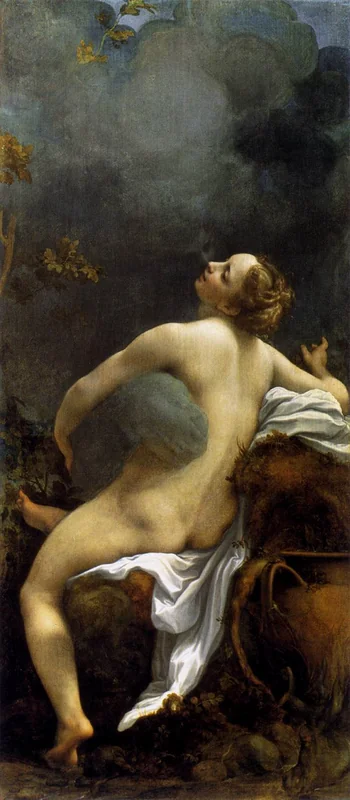
Io is a priestess of Hera in Greek mythology, daughter of the river-god Inachus, and a lover of Zeus. When Hera discovered the affair, Zeus transformed Io into a beautiful white cow to conceal her. Hera, not deceived, demanded the cow as a gift and set the hundred-eyed giant Argus Panoptes to watch over her. Hermes, sent by Zeus, slew Argus and freed Io, but Hera then sent a gadfly to torment her. Io wandered the earth in cow form, crossing vast distances. In Egypt, Zeus restored her human form; she bore him a son, Epaphus, and became identified by the Egyptians with the goddess Isis. The myth is attested from Aeschylus's Prometheus Bound (5th c. BCE) and Apollodorus.
Quick facts
- Pantheon
- Greek
- Figure type
- Hero
- Period
- Mythological figure; connected to Greek colonisation traditions of the eastern Mediterranean
- Primary sources
- Apollodorus Bibliotheca 2.1.3; Ovid Metamorphoses 1.568–746; Aeschylus Prometheus Bound 561–886
- Related figures
- zeus, hera, hermes, prometheus, argus
Transformation and wandering
Apollodorus (Bibliotheca 2.1.3) narrates that Zeus transformed Io into a white cow to hide her from Hera — but in another version (Ovid Metamorphoses 1.610–621) it was Hera's approach that prompted Zeus to make the transformation. Hera demanded the cow and placed her in the care of the hundred-eyed Argus Panoptes, who kept constant watch. Zeus sent Hermes, who first put Argus to sleep by playing music and telling stories, then killed him. Hera, enraged, sent a gadfly (oestros) to plague the transformed Io, who fled across the world — her wanderings traced the geography of the ancient Greek world. The Bosphorus (Ox-Ford) takes its name from Io's crossing.
Restoration and legacy
Io eventually reached Egypt, where Zeus restored her to human form by touching her (Apollodorus 2.1.3). She gave birth to Epaphus, identified with the Egyptian sacred bull Apis. Through her descendants, the myth connected the Greek world to Egypt and the Middle East: her great-granddaughter Ageror sired Cadmus (founder of Thebes), Europa (mother of Minos), Phoenix (ancestor of the Phoenicians), and Cilix (ancestor of the Cilicians). The Ionians, an important division of ancient Greeks, were said by some ancient sources to derive their name from Io.
Sources & further reading (2)
- primary-source — accessed 2026-05-06
- encyclopedia — accessed 2026-05-06
Frequently asked questions
Why is Io associated with the Bosphorus?
Io, wandering in the form of a cow under torment from Hera's gadfly, crossed the strait between Europe and Asia at the point now called the Bosphorus. The word Bosphorus means 'Ox-Ford' in Greek (bous = ox/cow, poros = ford/crossing). The strait was thus named after Io's crossing. Aeschylus's Prometheus Bound (730–735) and Ovid's Metamorphoses (1.727) both recount this detail. The myth provided an ancient mythological explanation for the geographical name of the strait connecting the Black Sea to the Sea of Marmara.
What is the Argus Panoptes myth?
Argus Panoptes ('All-seeing Argus') was a giant with a hundred eyes, set by Hera to guard Io in her cow form. He distributed his eyes in shifts so that some were always open, making it impossible to approach or free Io (Apollodorus 2.1.3). Zeus sent Hermes, who played the pipes of Pan and told Argus stories until all one hundred eyes fell asleep. Hermes then killed Argus with a stone (or sword in some versions). Hera placed Argus's eyes on the tail of the peacock, her sacred bird, as a memorial. Hermes's deed gave him the epithet Argeiphontes, 'Slayer of Argus.'