God
Inari
The Shinto deity of foxes, rice, agriculture, and prosperity, enshrined across Japan.
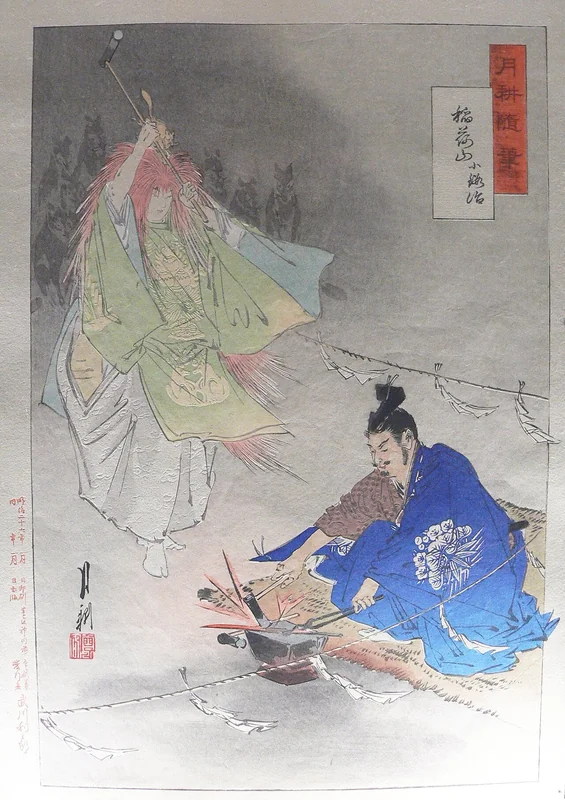
Inari Ōkami (稲荷大神, 'Great Kami of Rice') is one of the most widely venerated deities in Shinto, presiding over foxes, rice and agriculture, fertility, industry, worldly success, and swordsmanship. Inari is a fluid deity whose gender is variable in different traditions — sometimes male, sometimes female, sometimes a group of three deities. The fox (kitsune) is Inari's messenger and symbol; statues of foxes guard virtually every Inari shrine in Japan. The most important Inari shrine is Fushimi Inari Taisha in Kyoto, established in 711 CE. Inari's name likely derives from ine-nari ('rice growing'). Mentioned in the Nihon Shoki (720 CE, trans. Aston 1896) and the Man'yōshū (c. 759 CE, ed. various), with shrine history attested from the early 8th century CE.
Quick facts
- Pantheon
- Japanese
- Figure type
- God
- Period
- Shrine established 711 CE; deity attested in Nihon Shoki and 8th-century sources
- Primary sources
- Nihon Shoki (720 CE), trans. Aston 1896: references to rice deity; Yamashiro no Kuni Fudoki (c. 8th century CE) — Fushimi Inari founding legend
- Related figures
- amaterasu, okuninushi, kitsune
Nature and identity
Inari's identity in the classical and medieval Shinto tradition is unusually fluid. The deity may appear as an old man carrying rice, a young woman, or a fox — or as a trinity of three kami. This multiplicity reflects Inari's incorporation of several overlapping divine functions over centuries. The primary association with rice (ine) connects to the agricultural foundation of Japanese civilisation; rice not only fed the population but was the basis of taxation and political power. The fox (kitsune) became Inari's messenger — or in some traditions, Inari's manifestation — because foxes were observed near rice paddies (eating rodents that destroyed crops) and were associated with magical shape-shifting in Japanese folklore. By the medieval period, Inari had also become a patron of metalworking (swords) and urban commerce.
Fushimi Inari and the torii tradition
The Yamashiro no Kuni Fudoki (a regional gazetteer from the 8th century CE, partially preserved in later compilations) records the founding legend of Fushimi Inari Taisha in Kyoto. A man named Hata no Irogu was shooting at a mochi (rice cake) with an arrow for target practice; the mochi turned into a white bird and flew to the peak of Inariyama mountain, where it alighted. Rice grew there, and the man built a shrine. The practice of dedicating torii gates to Inari — with the donor's name inscribed on the back — became so popular that thousands of torii line the paths of Fushimi Inari Taisha, creating the famous orange tunnel effect. This practice is attested from at least the Edo period (1600–1868 CE) and continues today.
Sources & further reading (2)
- primary-source — accessed 2026-05-06
- encyclopedia — accessed 2026-05-06
Frequently asked questions
What is the relationship between Inari and the kitsune (fox)?
In Shinto tradition, the kitsune (fox) serves as Inari's messenger (使い, tsukai) rather than as the deity itself, though in popular practice the distinction is often blurred. Statues of foxes (often shown carrying symbolic items — a jewel, a key, a sheaf of rice, a scroll) stand at the entrances of Inari shrines throughout Japan. The kitsune's association with Inari draws on older Japanese beliefs in the fox as a supernatural creature capable of shape-shifting and magic, connected to rice paddy agriculture. In religious Taoism imported from China, the fox was also a figure of powerful, morally ambiguous magic. The white fox is particularly sacred to Inari. By the Edo period, a huge body of kitsune folklore had developed, with the fox appearing as a shape-shifter who could take human form and serve or deceive humans.
Why are there so many Inari shrines in Japan?
Inari is the most common Shinto deity by shrine count in Japan, with an estimated 32,000 Inari shrines (approximately one-third of all Shinto shrines). This ubiquity reflects the deity's broad appeal: as patron of rice, agriculture, and food production, Inari was essential to the survival of agricultural communities. As cities grew, Inari's domain expanded to cover commerce, industry, and prosperity more broadly. Merchants and craftsmen throughout the Edo period (1600–1868 CE) built Inari shrines in their workshops and counting houses. In the Meiji period (1868–1912 CE), Inari shrines became associated with prayer for business success. The deity's gender flexibility also made Inari accessible across different worship communities.