Creature
Imugi
The giant serpent of Korean mythology that yearns to become a dragon by catching a falling sky jewel.
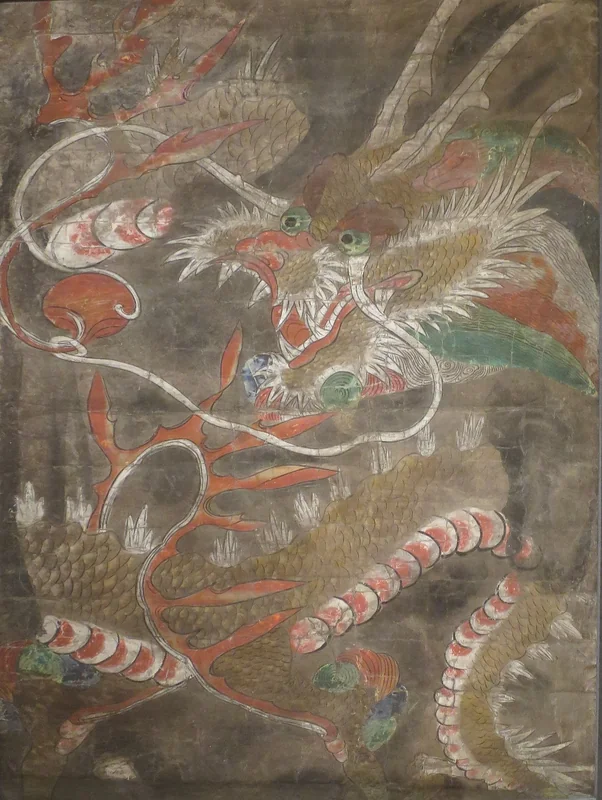
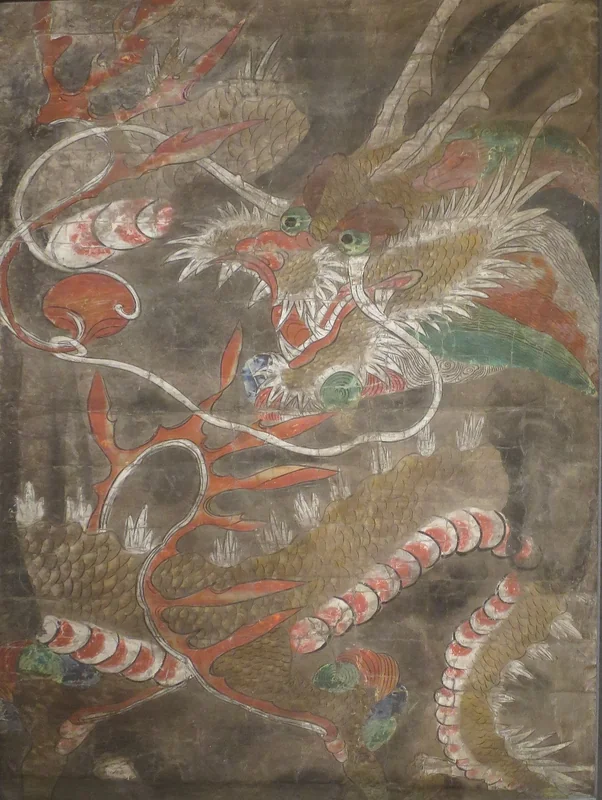
Imugi (이무기, 또는 이무기) is a great serpentine creature in Korean mythology — a proto-dragon or lesser serpent spirit that has not yet achieved full dragon status. In Korean folk belief, a snake must live for a thousand years to become an imugi, and an imugi must live for another thousand years and catch a haechi (a celestial jewel, 여의주, yeo-ui-ju) falling from the heavens before it can transform into a true dragon (용, yong). The imugi lives in water — rivers, lakes, the sea — and waits for its chance at the transformative jewel. Unlike the Japanese ryū or Chinese lóng (which are already fully divine creatures), the Korean imugi occupies an intermediate stage, yearning and waiting for ascension. The tradition is attested in Korean folk narrative collections from the Joseon period (1392–1897 CE) and documented in early 20th-century CE folklore scholarship.
Quick facts
- Pantheon
- Korean
- Figure type
- Creature
- Period
- Attested in Joseon-period (1392–1897 CE) folk narrative tradition
- Primary sources
- Joseon-period narrative folk literature — various oral and written collections; Early 20th-century CE Korean folklore documentation (Son Jin-tae, Choi Nam-seon)
- Related figures
- gumiho, dokkaebi, ryujin
The imugi's nature and yearning
In Korean folk cosmology, the progression from serpent to dragon is a staged transformation of spiritual power. A common snake lives its normal life; if it survives for one thousand years and gains sufficient spiritual energy (gi/ki), it becomes an imugi — a vast serpent, sometimes hundreds of metres long, living in water and capable of basic supernatural acts. The imugi is however incomplete: it cannot fly, cannot fully command weather, and cannot become the magnificent dragon (yong/ryong) without the yeo-ui-ju, a divine orb or jewel that falls from the sky. The jewel may be carried by a woman (sometimes a shaman or a person of exceptional virtue) or may fall during thunderstorms. If the imugi catches the jewel, it ascends into the sky and becomes a true dragon. If it misses — if a human takes the jewel first, or if it fails to reach it — the imugi must wait another thousand years.
Imugi in folk tales
Korean folk tales involving the imugi typically centre on the moment of the jewel's falling and human involvement in the imugi's fate. In a common tale type, a woman is fated (by a dream or a shaman's prophecy) to carry the yeo-ui-ju that will transform an imugi. She may be pursued by the imugi across years or in disguised human form. In some versions, the imugi that has waited faithfully is rewarded and ascends; in others, human interference (intentional or accidental) prevents the transformation and the imugi (sometimes enraged, sometimes despairing) causes floods or storms. The imugi is thus a figure of frustrated yearning — a creature at the threshold of divine status, whose fate depends on the actions of humans and the unpredictability of the sky. This narrative structure gives the imugi mythological pathos not present in fully realised dragon traditions.
Sources & further reading (2)
- encyclopedia — accessed 2026-05-06
- primary-source — accessed 2026-05-06
Frequently asked questions
What is the yeo-ui-ju and what power does it grant?
The yeo-ui-ju (여의주, 如意珠, 'wish-fulfilling jewel') is a radiant orb — typically depicted as a glowing sphere, sometimes flaming — that grants immense power to whoever possesses it. In Korean (and broader East Asian) dragon mythology, the dragon carries or seeks the yeo-ui-ju as the emblem of its full power; Chinese dragons are commonly depicted clutching a flaming pearl. In Korean folk belief, the yeo-ui-ju falls from the heavens during storms or is manifested by divine will; it is the transforming agent that converts an imugi into a true yong (dragon). The jewel's Sino-Korean name (如意珠) derives from the Sanskrit cintāmaṇi ('wish-fulfilling jewel') of Buddhist tradition, a divine gem that grants all desires, introduced into East Asian religion via Buddhism. In Korean folk narrative, the jewel is sometimes swallowed by the transforming creature, sometimes held in the mouth or claws.
How does the Korean yong (dragon) differ from Western dragons?
The Korean yong (용, cognate with Chinese lóng, Japanese ryū) belongs to the East Asian dragon tradition, which differs fundamentally from the Western European dragon. The East Asian dragon is typically a benevolent, intelligent, serpentine creature associated with water, rain, fertility, and celestial power — not the fire-breathing, treasure-hoarding monster of Western tradition. Korean dragons (yong) serve as palace guardians, controllers of weather and rain, divine ancestors, and symbols of royal authority. The Dragon King (Yong-wang or Naga-raja, borrowed from Sanskrit) rules underwater palaces analogous to Ryūjin's Ryūgū-jō in Japan. The path from snake → imugi → yong represents a Korean conception of spiritual advancement through patience and time — in which even a serpent can achieve divinity through perseverance.