Monster
Lernaean Hydra
Multi-headed serpent of Greek mythology slain by Heracles as his Second Labour.
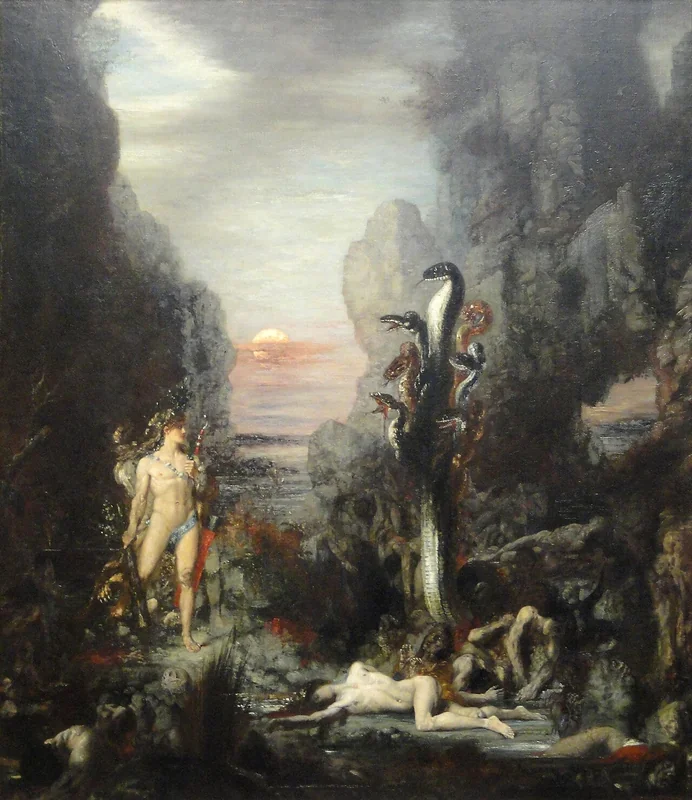
The Lernaean Hydra is a serpentine water monster in Greek mythology, offspring of Typhon and Echidna. It inhabited the swamps of Lerna in the Argolid, guarding an entrance to the underworld. The Hydra was notable for its multiple heads — ancient sources vary between seven and nine — and its regenerative ability: whenever one head was cut off, two grew in its place. It was slain by Heracles as his Second Labour, described in detail by Apollodorus (Bibliotheca 2.5.2). Heracles defeated it by cauterising each wound with fire after Iolaus burned the stumps.
Quick facts
- Pantheon
- Greek
- Figure type
- Monster
- Period
- Traditions set in the heroic age; Lernaean cult references c. 8th century BCE
- Primary sources
- Hesiod Theogony 313–318; Apollodorus Bibliotheca 2.5.2; Diodorus Siculus Library 4.11.5–6
- Related figures
- heracles, typhon, cerberus, chimera
- Constellation link
- Hydra Constellation (Hydra)
The Second Labour of Heracles
Apollodorus (Bibliotheca 2.5.2) narrates the slaying of the Hydra in detail. Heracles drove the Hydra from its lair by shooting flaming arrows into its lair in the swamps of Lerna. As he cut off each head, two new ones grew in its place. His nephew Iolaus devised the solution: as Heracles severed each head, Iolaus immediately cauterised the neck stump with a burning torch, preventing regeneration. The middle or central head was immortal; Heracles buried it still-living under a great rock. He then dipped his arrows in the Hydra's poisonous blood, which made them instantly fatal — a detail later relevant to several myths including the death of Heracles himself.
The Hydra in constellation tradition
The Hydra is commemorated as the constellation Hydra, the largest of the 88 IAU constellations, covering 1303 square degrees. In ancient tradition, the constellations Hydra, Corvus (the Crow), and Crater (the Cup) were grouped together: the crow stands on the water serpent, next to the cup, as narrated by Eratosthenes (Catasterismi 41) — a mythological tableau in the sky. Ptolemy included Hydra in his catalogue of 48 constellations (Almagest, c. 150 CE). The three constellations span a long section of the southern spring sky.
Sources & further reading (2)
- primary-source — accessed 2026-05-06
- encyclopedia — accessed 2026-05-06
Frequently asked questions
How many heads did the Lernaean Hydra have?
Ancient sources differ on the exact number. Hesiod (Theogony 313) does not specify a number but calls it 'the fierce Hydra of Lerna'. Simonides (frg. 569) gives nine heads. Diodorus Siculus (Library 4.11.5) says nine. Apollodorus (Bibliotheca 2.5.2) does not give a specific original number but says that when one head was severed, two grew in its place. Later tradition, as in Hyginus (Fabulae 30), says it had seven heads. The number nine became the most widely cited figure in post-classical tradition.
Why was fighting the Hydra counted as a Labour, despite Iolaus helping?
Eurystheus refused to count the Hydra as a legitimate Labour because Heracles had received help from his companion Iolaus, who burned the neck stumps to prevent head regeneration. Apollodorus (Bibliotheca 2.5.2) records that Eurystheus declared it invalid on these grounds, and Heracles was required to complete a replacement Labour (the Stymphalian Birds) to make up the number. This explains why the canonical Twelve Labours require thirteen or more individual tasks in some accounts.