God
Hwanwoong
The Son of Heaven who descended to earth to civilise humanity and father the first Korean king.
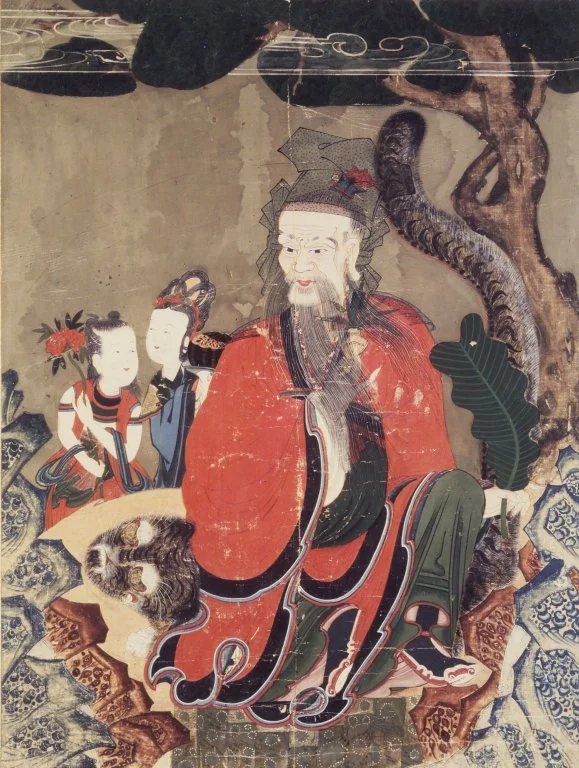
Hwanwoong (환웅, 桓雄, 'Magnificent Hero' or 'Glorious Hero') is the son of the Heavenly Lord Hwanin and father of Dangun, the legendary founder of Korea. He received permission from Hwanin to descend from heaven to the human world with three thousand followers and the three heavenly seals of governance (wind, rain, and clouds). He descended to Mount Taebaek (identified with Baekdusan) and established the city of Sinsi ('Divine City'), bringing civilisation — agriculture, medicine, morality, and the arts — to humanity. He temporarily took human form to marry Ungnyeo (the transformed bear-woman) and fathered Dangun. Hwanwoong's myth is the intermediate link in the divine genealogy: Hwanin (heaven) → Hwanwoong (mediator) → Dangun (earth). Recorded in the Samguk Yusa (1281 CE) by Iryeon.
Quick facts
- Pantheon
- Korean
- Figure type
- God
- Period
- Recorded in the Samguk Yusa (1281 CE); traditional date of descent 2333 BCE
- Primary sources
- Samguk Yusa (1281 CE), Book 1: 'Gojoseon' section, by Iryeon; Jewang Ungi (1287 CE) by Yi Seunghyu
- Related figures
- hwanin, dangun, ungnyeo
Descent and divine city
The Samguk Yusa (1281 CE, Book 1, 'Gojoseon') describes Hwanwoong frequently gazing down at the human world and desiring to govern it. His father Hwanin surveyed the three great mountains and determined that Mount Taebaek was the most suitable for human benefit. He gave Hwanwoong three heavenly seals (cheon-buin, 天符印) and sent him with three thousand followers. Hwanwoong descended to the peak of Taebaek under a great sandalwood tree and declared it the divine city (Sinsi). He appointed ministers of Wind (Pungbaek), Rain (Ubaek), and Cloud (Unsa), and governed over 360 human affairs — including grain, disease, justice, morality, and life and death. Hwanwoong's governance introduces civilisation: the human world is not abandoned to chaos but actively administered by a divine presence.
Transformation and fatherhood
When Ungnyeo, transformed from a bear through her endurance of the mugwort-and-garlic trial, prayed under the sandalwood tree for a child, Hwanwoong is described in the Samguk Yusa (1281 CE) as temporarily transforming into human form (hwawa) to marry her. Their son was Dangun Wanggeom. Hwanwoong's willingness to take human form — the divine condescending to the earthly to produce a bridge figure — parallels the divine genealogies of other Asian foundation myths and the Greek tradition of gods fathering heroes with mortal or semi-mortal women. Hwanwoong's role as the central intermediary in the three-generational divine genealogy (Hwanin → Hwanwoong → Dangun) makes him the active civilising deity who both brings divine order to earth and produces the earthly ruler.
Sources & further reading (2)
- encyclopedia — accessed 2026-05-06
- primary-source — accessed 2026-05-06
Frequently asked questions
What are the three heavenly seals (cheon-buin) Hwanwoong received?
The Samguk Yusa (1281 CE) mentions that Hwanin gave Hwanwoong three cheon-buin (天符印, 'heavenly seal-signs') when he descended, but does not specify what they were. The Jewang Ungi (1287 CE) by Yi Seunghyu describes them as a bronze mirror, a bronze sword, and a bronze bell — objects associated with authority and ritual in Korean Bronze Age culture. Scholars have interpreted the three objects as representing the three ministers Hwanwoong brought with him (Wind, Rain, Cloud) or as symbols of the three aspects of divine governance (justice, agricultural fertility, and ritual). Bronze mirrors, swords, and bells (and comma-shaped jewels, or gokgok) are indeed found in Korean Bronze and Iron Age burial archaeology (approximately 1000–300 BCE), suggesting the myth may encode cultural memory of Bronze Age aristocratic material culture.
What does the sandalwood tree (sindansu) symbolise in the Dangun myth?
The sandalwood tree (신단수, sindansu, also sometimes translated 'divine birch' or 'sacred tree') at the summit of Mount Taebaek is the cosmic axis around which Hwanwoong establishes Sinsi in the Samguk Yusa (1281 CE). The name Dangun itself contains the element 'dan' (단/檀), which refers to the sandalwood tree, and Dangun is called the 'Sandalwood Lord.' The cosmic tree at the mountain-summit is a widespread motif in Siberian, Altaic, and East Asian shamanic cosmologies — the World Tree as the axis connecting heaven and earth, around which shamans ascend and descend. Hwanwoong's descent to the sandalwood tree on the mountain summit follows this structure exactly: heaven → sacred tree at mountain peak → earthly world. Baekdusan (Mount Baekdu/Changbai), the highest peak on the Korean peninsula, has been identified as this sacred mountain in Korean tradition.