God
Hwanin
The Heavenly Lord of Korean mythology, the supreme deity who sent his son to civilise the earth.
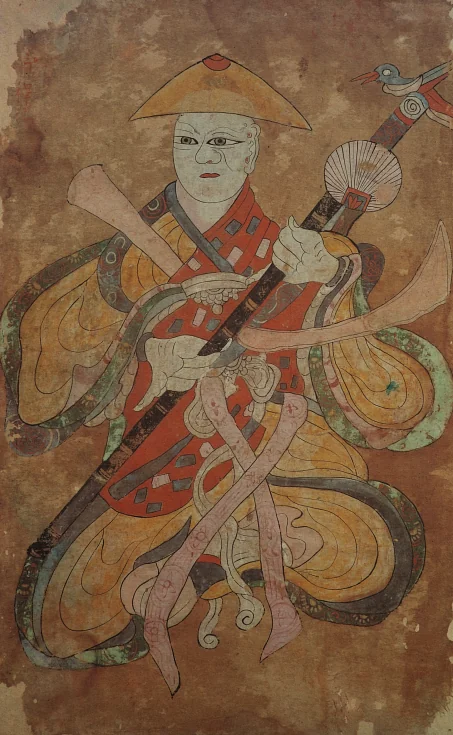
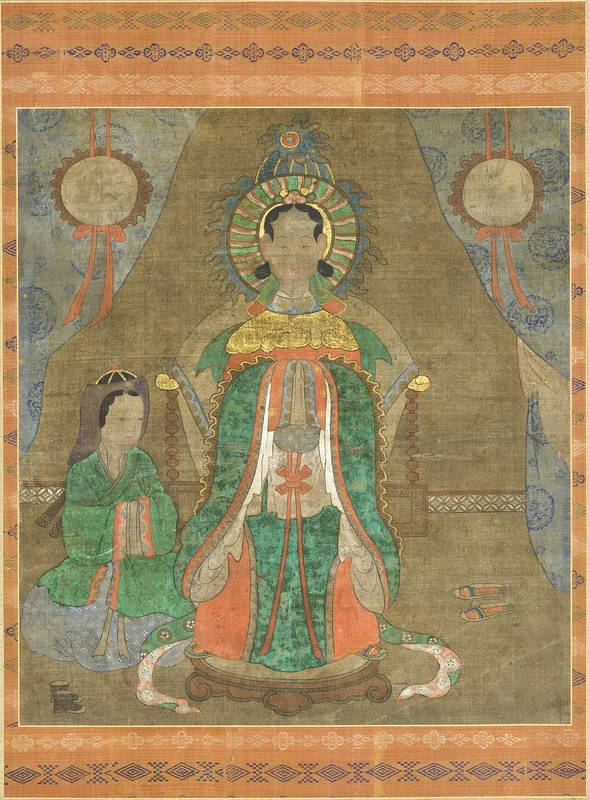
Hwanin (환인, 桓因, 'Heavenly Lord' or 'Lord of All') is the supreme deity in Korean founding mythology, the Heavenly Lord who rules the celestial realm and is the grandfather of Dangun, Korea's legendary first king. He is identified in the Samguk Yusa (1281 CE) with the Buddhist concept of Indra (Hwanin is the Korean reading of the Chinese transliteration of Sanskrit 'Indra' — 帝釋, Jesŏk). Hwanin permitted his son Hwanwoong to descend to earth with three thousand followers to govern humanity for the benefit of all. Hwanin himself does not descend — he rules from heaven, surveys the world, and grants permission. He represents divine authority at its most abstract and absolute. Recorded in the Samguk Yusa (1281 CE) and Jewang Ungi (1287 CE).
Quick facts
- Pantheon
- Korean
- Figure type
- God
- Period
- Recorded in the Samguk Yusa (1281 CE); syncretised with Buddhist Indra
- Primary sources
- Samguk Yusa (1281 CE), Book 1: 'Gojoseon' section, by Iryeon; Jewang Ungi (1287 CE) by Yi Seunghyu
- Related figures
- hwanwoong, dangun
Identity and heavenly rule
The Samguk Yusa (1281 CE, 'Gojoseon' section) introduces Hwanin as the Lord of Heaven (Cheonje, 天帝) who governs from above. The text explicitly glosses his name as 'Jesŏk' (帝釋), the Korean reading of the Buddhist deity Indra/Śakra, lord of the gods in Buddhist cosmology — a clear example of the Buddhist-indigenous syncretism that characterises the Samguk Yusa's presentation of Korean myth. Hwanin is described as having surveyed the earth from heaven and selected Mount Taebaek as the most suitable place for human benefit. His role in the narrative is to authorise rather than act: he gives Hwanwoong the three heavenly seals and permission to descend. This makes him a supreme deity defined by will and authority rather than by intervention.
Role in the divine genealogy
In the three-generational structure of the Korean creation myth — Hwanin (heaven) → Hwanwoong (mediation) → Dangun (earth) — Hwanin represents pure celestial authority, never directly touching the human world. This structure is typical of many founding mythologies in which the supreme deity is too holy or removed to directly intervene in earthly affairs, delegating the creative and civilising work to a divine intermediary. The pattern appears in Mesopotamian, Chinese (the Jade Emperor's sons), and Japanese (Takamagahara's assembly authorising Ninigi's descent) mythology. Hwanin's identification with Buddhist Indra in the Samguk Yusa reflects the 13th-century CE Buddhist scholarly perspective of the monk Iryeon, who compiled the text.
Sources & further reading (2)
- encyclopedia — accessed 2026-05-06
- primary-source — accessed 2026-05-06
Frequently asked questions
Is Hwanin the same as the Buddhist deity Indra?
The Samguk Yusa (1281 CE) explicitly glosses Hwanin as 'Jesŏk' (帝釋), the Korean Buddhist term for Indra/Śakra, lord of the Trāyastriṃśa heaven in Buddhist cosmology. This identification was made by the monk Iryeon, who compiled the Samguk Yusa from older sources and filtered them through a Buddhist scholarly lens. Whether the original pre-Buddhist Korean tradition identified its Heavenly Lord with a specific deity by that name is unclear from surviving sources. The syncretism between indigenous Korean shamanic/animist concepts of a High God (Haneullim or Cheonji) and the Buddhist Indra was a natural theological move in the 13th century CE, when Buddhism had been the dominant Korean state religion for over 700 years. Modern Korean shamanic (musok) tradition retains the concept of Haneullim as the supreme Heaven God, distinct from the Buddhist Indra.
How does Hwanin compare to creator gods in other Korean traditions?
Korean indigenous religious tradition (shamanism/musok) preserves a variety of heavenly deity concepts that overlap with Hwanin. The deity Haneullim (하늘님, 'Sky Lord') or Cheonsin (天神, 'Heavenly Deity') in shaman ritual traditions represents the supreme sky god who governs from above. Regional creation myths collected by folklorists in the late 19th and early 20th centuries (Akamatsu Jōjō and Akiba Takashi, 1938 — the primary scholarly sources on Korean shamanic mythology, though post-1925) include narrative variants of the creation in which the Heavenly King (Cheonjiwang or Cheonnim) plays the role assigned to Hwanin in the Samguk Yusa. The Jeju Island creation myth cycle features Cheonjiwang (Heavenly King) as the supreme deity who contests with an earthly figure over governance of the world — a parallel to the Hwanin → Hwanwoong delegation.