Hero
Heracles
Greatest hero of Greek mythology, famous for his Twelve Labours.
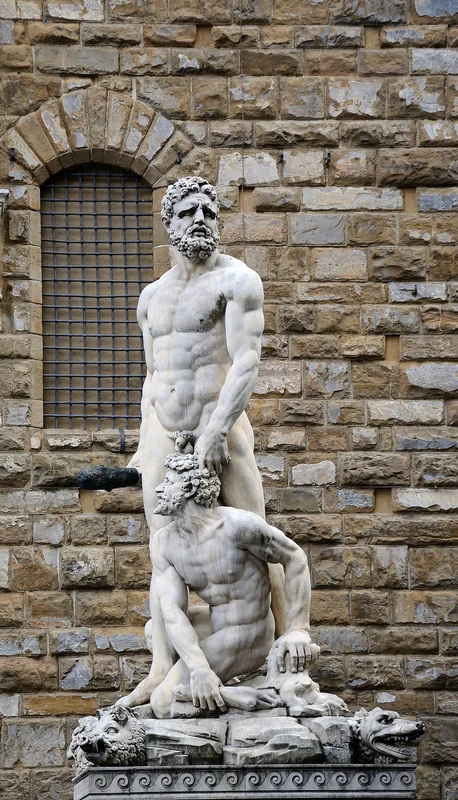
Heracles (Hercules in Latin) is the greatest hero of ancient Greek mythology, celebrated for his extraordinary strength and the Twelve Labours he performed as penance. Son of Zeus and the mortal Alcmena, his divine parentage was resented by Hera from birth. The Twelve Labours, detailed by Apollodorus in the Bibliotheca, include killing the Nemean Lion, slaying the Lernaean Hydra, and capturing Cerberus in the underworld. After death, Heracles was deified and joined the Olympians on Mount Olympus.
Quick facts
- Pantheon
- Greek
- Figure type
- Hero
- Period
- Mythological hero; traditions set in the generation before the Trojan War
- Primary sources
- Apollodorus Bibliotheca 2.4.8–2.7.8; Hesiod Theogony 943–944; Homer Iliad 18.117–119; Pindar Nemean Odes 1
- Related figures
- zeus, hera, theseus, jason, cerberus, hydra, medusa
- Constellation link
- Hercules Constellation (Hercules)
The Twelve Labours
The Twelve Labours of Heracles are set out in detail by Apollodorus (Bibliotheca 2.5.1–12). They were imposed by King Eurystheus of Tiryns as penance for Heracles killing his own children in a fit of madness sent by Hera. The labours are: (1) slay the Nemean Lion; (2) slay the Lernaean Hydra; (3) capture the Ceryneian Hind; (4) capture the Erymanthian Boar; (5) clean the Augean Stables; (6) drive away the Stymphalian Birds; (7) capture the Cretan Bull; (8) steal the Mares of Diomedes; (9) obtain the girdle of Hippolyta; (10) capture the cattle of Geryon; (11) steal the apples of the Hesperides; (12) bring Cerberus from the underworld. On completing all twelve, Heracles was absolved.
Apotheosis
After completing the Twelve Labours and many other deeds, Heracles met his death through the unwitting actions of his wife Deianira. She sent him a robe soaked in what she believed was a love potion from the centaur Nessus; it was in fact the poisoned blood of the Lernaean Hydra. In agony from the poison, Heracles built a funeral pyre on Mount Oeta and lay down on it. The flames consumed his mortal nature; Zeus carried his divine portion to Olympus, where he was granted immortality and married the goddess Hebe. The constellation Hercules was identified as his memorial (Eratosthenes Catasterismi 4).
Sources & further reading (2)
- primary-source — accessed 2026-05-06
- encyclopedia — accessed 2026-05-06
Frequently asked questions
What are the Twelve Labours of Heracles?
The Twelve Labours are a canonical series of tasks imposed on Heracles by King Eurystheus, as detailed by Apollodorus (Bibliotheca 2.5.1–12): (1) Nemean Lion, (2) Lernaean Hydra, (3) Ceryneian Hind, (4) Erymanthian Boar, (5) Augean Stables, (6) Stymphalian Birds, (7) Cretan Bull, (8) Mares of Diomedes, (9) Girdle of Hippolyta, (10) Cattle of Geryon, (11) Apples of the Hesperides, (12) Cerberus from the underworld. The number twelve became canonical; earlier versions of the myth list fewer tasks.
What is the constellation Hercules?
The constellation Hercules is one of the 88 modern IAU constellations, covering 1225 square degrees in the northern sky. It is among the 48 constellations catalogued by Ptolemy (Almagest, c. 150 CE). It represents Heracles in his iconic pose — kneeling, with one foot on the head of the dragon Draco — as described by Eratosthenes (Catasterismi 4) and Aratus (Phaenomena 63–70). The constellation is best seen in summer in the northern hemisphere.