God
Hephaestus
God of fire, smithcraft, and the forge in Greek mythology.
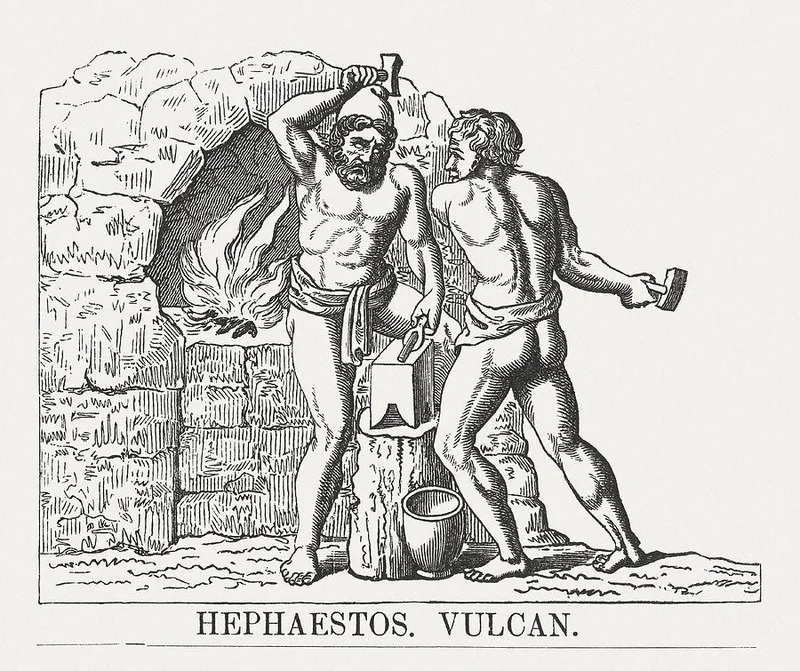
Hephaestus is the Olympian god of fire, metalworking, stone masonry, and the forge in Greek mythology. He is the divine craftsman, blacksmith to the gods, and manufacturer of their weapons, armour, and magical objects. Son of Hera (and Zeus in some accounts), he is the only Olympian to be physically imperfect, depicted as lame. He crafted the armour of Achilles (Iliad 18.468–617), the net that trapped Ares and Aphrodite, the palaces of Olympus, and numerous other divine artefacts. His Roman equivalent is Vulcan.
Quick facts
- Pantheon
- Greek
- Figure type
- God
- Period
- Attested from the 8th century BCE; Linear B form not confirmed but pre-Homeric worship likely
- Primary sources
- Hesiod Theogony 927–929; Homer Iliad 18.368–617; Homer Odyssey 8.266–366; Homeric Hymn 20 (To Hephaestus)
- Related figures
- zeus, hera, aphrodite, ares, athena, achilles
Divine craftsman
Hephaestus is described in Homer's Iliad as the divine smith who built the palaces of the gods on Olympus and crafted their weapons and magical objects. His most celebrated work is the armour of Achilles, forged at the request of Thetis in Iliad 18.468–617: Hephaestus fashioned a shield decorated with elaborate scenes of human life, including a city at peace and a city at war. He also made the invisible bronze net that entrapped Ares and Aphrodite (Odyssey 8.274–278) and the golden servant-girls who assist him in his forge (Iliad 18.417–420).
Lameness and ejection from Olympus
Two conflicting myths account for Hephaestus's lameness. In Hesiod's Iliad (1.590–594), Hephaestus was thrown from Olympus by Zeus during a quarrel between the divine couple, falling for a whole day and landing on the island of Lemnos. In the alternative version (Iliad 18.394–397), Hera herself threw the infant Hephaestus from Olympus because he was born lame, and he was rescued by the sea-nymph Thetis. These myths together associate Hephaestus with volcanic islands (Lemnos, Lipari) and establish him as an outsider among the Olympians despite his indispensable craftsmanship.
Sources & further reading (2)
- primary-source — accessed 2026-05-06
- encyclopedia — accessed 2026-05-06
Frequently asked questions
What did Hephaestus create in Greek mythology?
Hephaestus was the divine craftsman whose works are described throughout the Iliad and other ancient sources. Notable creations include: the armour of Achilles (Iliad 18), the thunderbolts of Zeus, Hermes's winged sandals, the chariot of Helios, the palace of the gods on Olympus, the golden servant-maidens that assist him, and the net that trapped Ares and Aphrodite (Odyssey 8.274). He is also associated with the creation of Pandora, whom Hesiod describes as modelled from clay on Hephaestus's workshop floor (Theogony 570–572).
Why is Hephaestus associated with volcanoes?
Ancient Greeks and Romans associated Hephaestus (Vulcan) with volcanic activity because they understood volcanic islands as the workshop of the divine smith. The myths of his ejection from Olympus to the island of Lemnos (Iliad 1.594) and his association with the volcanic Lipari Islands reinforced this connection. The Romans especially connected Vulcan's forge with Mount Etna in Sicily and the volcanic Aeolian Islands. The word 'volcano' derives ultimately from Vulcan's name.