Hero
Heo Hwang-ok
The legendary foreign princess who sailed from a distant kingdom to become queen of Gaya.
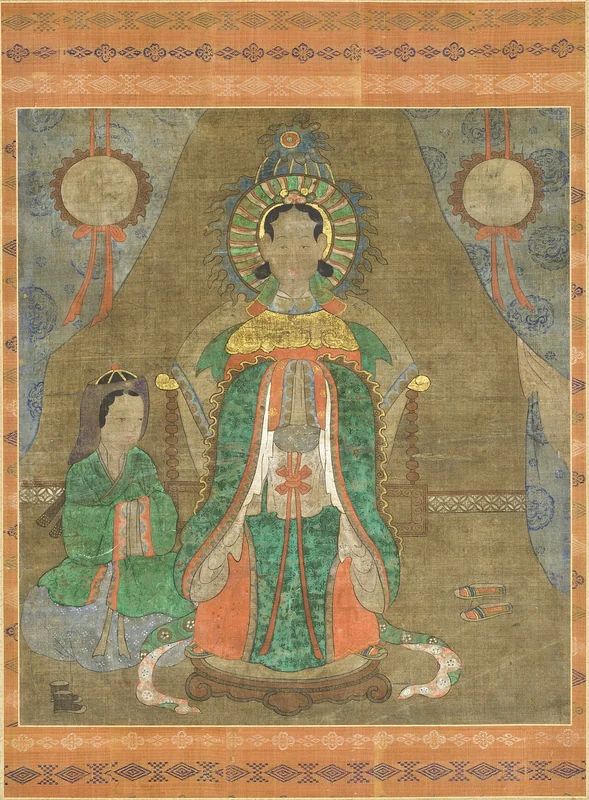
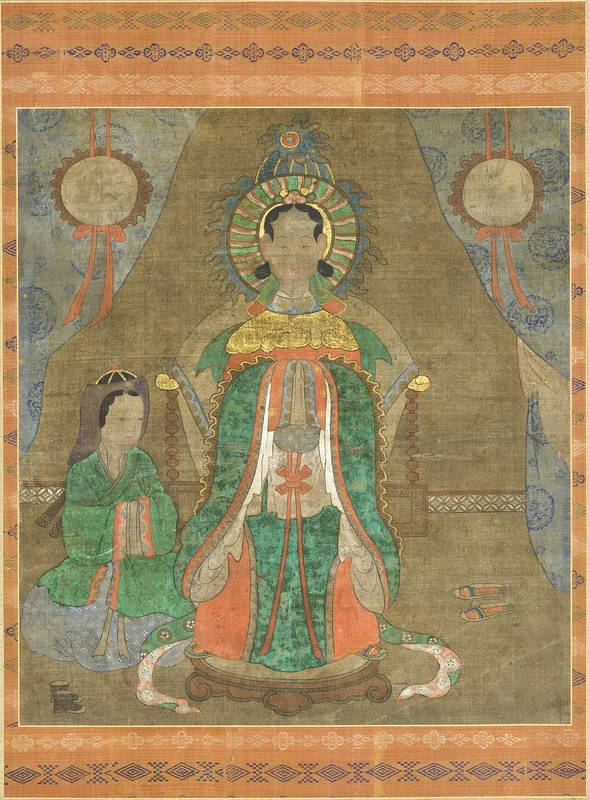
Heo Hwang-ok (허황옥, 許黃玉, 'Yellow Jade of the Heo family') is the legendary founding queen of Geumgwan Gaya, wife of King Suro, whose story is recorded in the Samguk Yusa (1281 CE). According to the narrative, she was a princess of the kingdom of Ayuta (阿踰陀國) — a distant realm from which she came by boat on the orders of a divine dream-command. She arrived at the Gaya coast carrying silk, jade, gold, and red-purple stones. King Suro went out to receive her in person rather than allow any lesser official to do so, and they married. She bore ten sons; two took her family name Heo, establishing the Heo lineage in Korea. She died at the age of 157 (in the legendary account) and was buried with Suro. The question of Ayuta's identity — possibly Ayodhya in northern India — has made Heo Hwang-ok a figure of significant cultural and diplomatic significance between Korea and India.
Quick facts
- Pantheon
- Korean
- Figure type
- Hero
- Period
- Legendary; traditional date 42–189 CE (reign of Suro); recorded in Samguk Yusa (1281 CE)
- Primary sources
- Samguk Yusa (1281 CE), Book 2: 'Garak Guk gi' (Record of the Garak Kingdom), by Iryeon
- Related figures
- suro, dangun, aryeong
The journey from Ayuta
The Samguk Yusa (1281 CE, 'Garak Guk gi') narrates that Heo Hwang-ok was a princess of Ayuta (sometimes rendered as Ayodha or Ayodhya). Her father the king received a divine message in a dream commanding him to send his daughter to be the queen of the Gaya king Suro. She set sail on a red-painted ship with a scarlet flag, carrying gifts of silk, jade, and gold. When she arrived on the Gaya coast, she initially attempted to land but saw a mountain (Mujisa Mountain) that seemed inauspicious; she withdrew and offered silken trousers to the mountain spirit, then re-approached. A servant was sent ahead to announce her arrival; Suro himself came down to receive her — a mark of exceptional respect for a foreign arrival. The Samguk Yusa records that she explained she was obeying a divine command and had never met Suro before, yet did not feel she was meeting a stranger. They married the same day.
Legacy and Heo clan
The Samguk Yusa (1281 CE) records that Heo Hwang-ok bore King Suro ten sons. Two of the sons took their mother's family name Heo (許) — establishing the Gimhae Heo clan (김해 허씨) in Korea. The other sons took the Kim (金) family name of their father Suro. The Gimhae Kim clan (the descendants of Suro who took his name) is today one of the largest Korean surname groups. Heo Hwang-ok died at the legendary age of 157 CE and was buried in a royal tumulus near Suro's tomb in Gimhae, South Gyeongsang Province. The Suro Royal Tomb complex in Gimhae (a designated Korean historical site) contains the traditional burial mounds of both Suro and Heo Hwang-ok. The Heo clan and the Gimhae Kim clan observe a shared ancestral rite as descendants of the founding royal couple of Gaya.
Sources & further reading (2)
- encyclopedia — accessed 2026-05-06
- primary-source — accessed 2026-05-06
Frequently asked questions
Is there evidence that Heo Hwang-ok really came from India?
The identification of Ayuta (阿踰陀國 in the Samguk Yusa 1281 CE) with Ayodhya in northern India is a proposition supported by some Korean and Indian scholars and celebrated in cultural diplomacy, but it is disputed in academic historiography. The name 'Ayuta' is a Chinese transliteration of Sanskrit 'Ayodhyā' — the city sacred in Ramayana tradition as Rama's birthplace. Proponents note the red stones (possibly agate) brought by Heo Hwang-ok as potentially consistent with Indian materials, and maritime trade routes between India and Korea were plausible in the early CE period. Sceptics argue that 'Ayuta' may be a generic literary name for a distant exotic kingdom rather than a specific geographical identification, and that the Samguk Yusa was compiled in 1281 CE, over a thousand years after the legendary events. The Ayodhya Municipal Corporation erected a memorial to Heo Hwang-ok in 2000 CE, and South Korea–India cultural exchanges have celebrated the tradition.
What does Heo Hwang-ok's story reveal about early Korean attitudes to foreigners?
The Samguk Yusa (1281 CE) account of Heo Hwang-ok's arrival and marriage to Suro presents a remarkably positive view of a foreign woman entering and becoming the founding queen of a Korean kingdom. Suro personally goes to receive her — not sending a subordinate — and they marry the same day on the basis of mutual divine appointment rather than political arrangement. Her foreign origin is presented as part of her legitimacy rather than a problem: she comes with divine mandate and personal virtue. Her two sons perpetuating her foreign family name in Korea further institutionalises her foreign identity rather than erasing it. This stands in contrast to many founding myths in which the female founding figure is indigenous or transformed to become indigenous. Scholars have used the Heo Hwang-ok tradition to argue for early Korean openness to maritime cultural exchange and for the multicultural composition of early Gaya society.