God
Haemosu
The sun deity and heavenly prince of Korean mythology, father of Jumong the founder of Goguryeo.
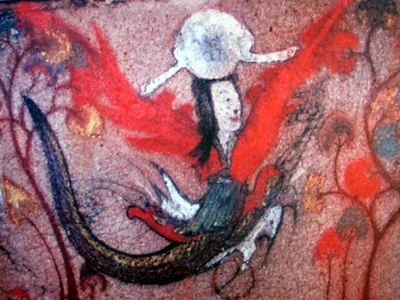
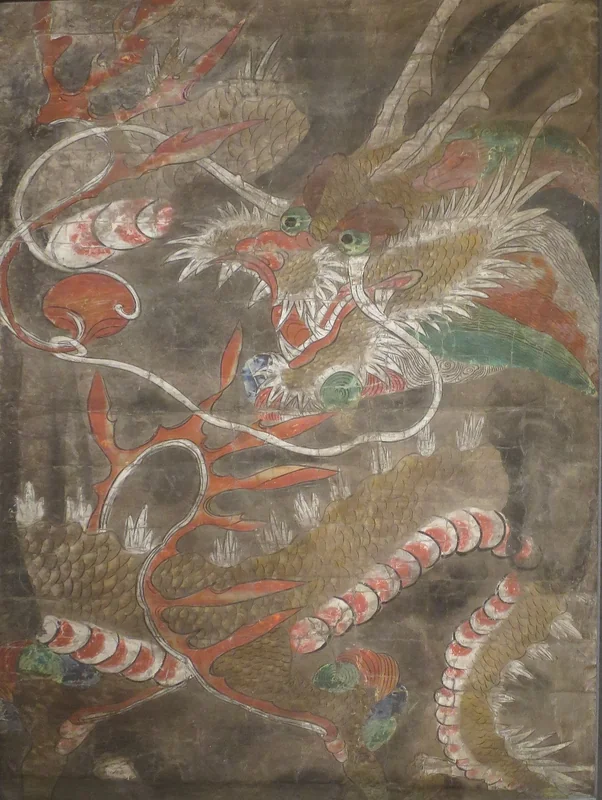
Haemosu (해모수, 解慕漱) is the sun deity and heavenly prince in Korean mythology, primarily known as the father of Jumong, the legendary founder of Goguryeo. He descended from heaven in a chariot drawn by five dragons, wearing a hat of crow feathers (a solar symbol) and riding the sun's rays. He seduced or abducted the river goddess Yuhwa, daughter of Habaek, and then abandoned her — an act for which Habaek confronted him, leading to a contest of transformation (a widespread shamanic/mythological motif). After the contest, Habaek acknowledged Haemosu's divine status and the union was formalised. Haemosu then left Yuhwa, who was later imprisoned by King Geumwa and gave birth to Jumong from an egg by miraculous sunlight impregnation. Haemosu appears in the Samguk Sagi (1145 CE) and is elaborated in the Dongmyeong-wang Pyeon poem by Yi Gyubo (1168–1241 CE).
Quick facts
- Pantheon
- Korean
- Figure type
- God
- Period
- Recorded in Samguk Sagi (1145 CE); elaborated in Dongmyeong-wang Pyeon by Yi Gyubo (c. 1193 CE)
- Primary sources
- Samguk Sagi (1145 CE), Book 13: Goguryeo annals, by Kim Busik; Dongmyeong-wang Pyeon (c. 1193 CE) by Yi Gyubo
- Related figures
- jumong, yuhwa, habaek
Descent and encounter with Yuhwa
The Samguk Sagi (1145 CE, Book 13) and the Dongmyeong-wang Pyeon (c. 1193 CE by Yi Gyubo) narrate that Haemosu descended from heaven each morning in a chariot of five dragons and returned each night. He wore a hat made of crow feathers (a solar symbol, as crows — particularly the three-legged sun-crow (삼족오, samjogo) — are associated with the sun in East Asian mythology). He encountered the three daughters of Habaek (the river god) at the Yalu River, brought them into a pleasure palace he conjured, and made Yuhwa his wife. When Habaek heard, he was furious at the seduction without proper marriage procedure and confronted Haemosu. The two deities engaged in a contest of transformation — Haemosu transformed into a carp, then Habaek into an otter; Haemosu became a deer, Habaek a wolf; Haemosu became a pheasant, Habaek a hawk. The contest ended with Habaek's recognition of Haemosu's divine power.
Solar symbolism
Haemosu's solar character is established through consistent imagery in the sources. His crow-feather hat invokes the samjogo (三足烏, three-legged sun-crow), the celestial bird that inhabits the sun in East Asian mythology (Chinese, Korean, Japanese traditions all preserve this figure, related to the Chinese sun-crow mythology recorded in sources as early as the Han dynasty). His daily descent in a dragon chariot mirrors the sun's daily journey. His son Jumong is born when sunlight penetrates and impregnates Yuhwa while she is imprisoned — a direct transfer of solar fertilising power through light. Jumong's archery skill may also connect to the solar archery tradition: in Chinese mythology, the hero Yi shot down nine of the ten suns; the great archer as a solar-connected figure appears across East Asian traditions.
Sources & further reading (2)
- encyclopedia — accessed 2026-05-06
- primary-source — accessed 2026-05-06
Frequently asked questions
What is the transformation contest between Haemosu and Habaek?
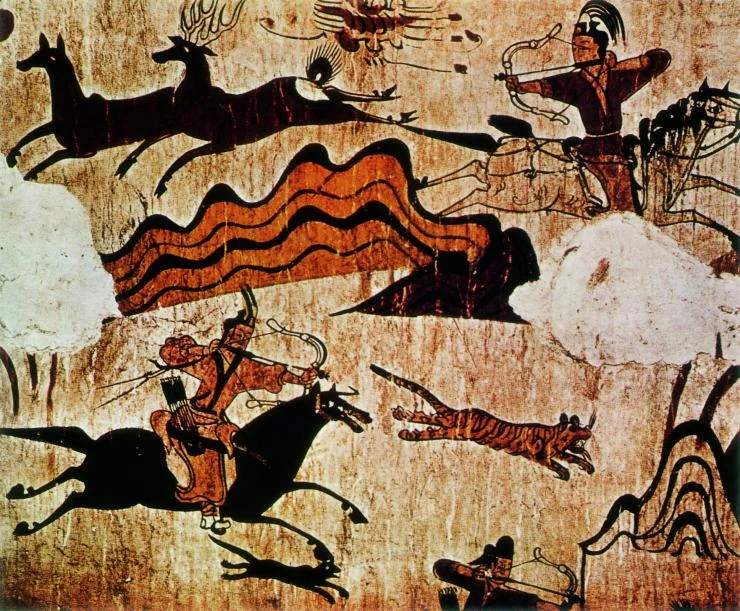
The Dongmyeong-wang Pyeon (c. 1193 CE by Yi Gyubo) describes in detail the transformation (metamorphosis) contest between Haemosu and Habaek. This contest — in which two supernatural beings repeatedly transform into different animals to test their power — is a widespread motif in world mythology (found in Celtic traditions, Finnish Kalevala, numerous shamanic traditions). In the Korean version, the contest is a formal demonstration of divine competence: Haemosu and Habaek cycle through matched animal pairs (predator/prey transformations), with Haemosu ultimately prevailing. The contest ends when Habaek concedes Haemosu's superior divine status and legitimises the union with his daughter Yuhwa, then sends the couple off in a chariot — but Haemosu ascends to heaven alone, abandoning Yuhwa. This abandonment sets in motion the birth of Jumong through subsequent miraculous impregnation by sunlight.
Is Haemosu the same as the Chinese sun deity?
Haemosu is a specifically Korean deity with characteristics that overlap with but are distinct from Chinese solar deities. His crow-feather hat invokes the three-legged crow (samjogo in Korean; sanzuwu in Chinese) that lives in the sun — a motif shared across East Asian solar mythology, attested in Chinese texts from the Han dynasty (206 BCE – 220 CE) onwards. His chariot drawn by five dragons parallels the solar chariot imagery found across Eurasian mythology. However, the specific Haemosu mythology — the seduction of Yuhwa, the transformation contest with Habaek, the fathering of Jumong — is particular to the Korean Goguryeo founding tradition and is not found in Chinese sources. He is a Korean cultural elaboration of the solar deity archetype rather than a direct import.