God
Hades
God and realm of the dead in Greek mythology, lord of the underworld.
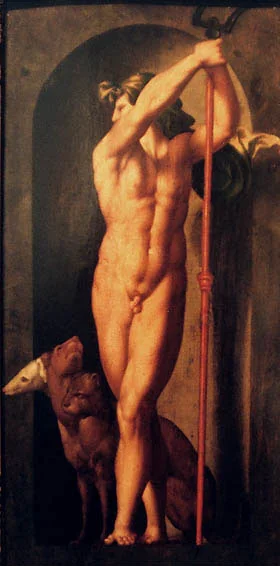
Hades is both the god of the dead and the name of the underworld kingdom he rules in Greek mythology. Son of the Titans Cronus and Rhea, he received dominion over the underworld when the three brothers divided the cosmos. Unlike his brother Zeus, who governs the living world, Hades presides over all who have died. His queen is Persephone, whom he abducted from the upper world. The underworld he rules contains named regions including Tartarus (for the worst sinners), Elysium (for heroes), and the Asphodel Meadows (for ordinary souls). His Roman equivalent is Pluto or Dis Pater.
Quick facts
- Pantheon
- Greek
- Figure type
- God
- Period
- Attested from at least the 8th century BCE; Linear B form A-i-da-jo possibly at Pylos
- Primary sources
- Hesiod Theogony 453–456; Homer Iliad 15.187–193; Homeric Hymn 2 (To Demeter) 1–90; Apollodorus Bibliotheca 1.1.5–7
- Related figures
- zeus, poseidon, persephone, cerberus, heracles, orpheus
The underworld kingdom
In Greek cosmology, the underworld (also called Hades after its ruler) is situated beneath the earth, accessible via certain cave entrances — notably at Taenarum in Laconia and at Lake Avernus in Italy. The underworld is bounded by several rivers: Styx (by which the gods swore unbreakable oaths), Acheron (the river of woe), Lethe (the river of forgetfulness), Phlegethon (the river of fire), and Cocytus (the river of lamentation). Charon the ferryman transports shades across the Acheron, for which the dead were traditionally buried with a coin (an obol) to pay the fare. The three judges of the dead — Minos, Aeacus, and Rhadamanthus — assess the souls.
Hades and Persephone
Hades seized Persephone, daughter of Demeter, as she gathered flowers in a meadow, dragging her underground to be his queen (Homeric Hymn to Demeter, c. 650 BCE). Demeter's grief caused the earth to become barren. Zeus intervened; Persephone was allowed to return to the upper world for part of each year. Because she had eaten pomegranate seeds in the underworld, she was bound to return to Hades for roughly one-third of the year. The myth establishes the divine governance of the underworld as a marriage between the lord of death and the daughter of the harvest goddess.
Sources & further reading (2)
- primary-source — accessed 2026-05-06
- encyclopedia — accessed 2026-05-06
Frequently asked questions
Is Hades evil in Greek mythology?
In Greek mythology, Hades is not portrayed as evil but as a powerful, stern, and unwavering ruler who maintains cosmic order by ensuring the dead remain in his realm. Unlike the Christian devil with whom he is sometimes compared, Hades does not tempt the living into sin or cause suffering — he simply governs the dead impartially. Ancient Greeks feared the underworld (and consequently avoided uttering Hades's name) but did not consider him malevolent. The Homeric Iliad (9.158–159) calls him 'the most hated by mortals of all the gods.'
What are the regions of the Greek underworld?
Ancient sources describe several distinct regions within Hades's underworld. Tartarus is the deepest pit, where the Titans are imprisoned (Hesiod Theogony 720–728) and where extreme sinners like Tantalus, Sisyphus, and Ixion undergo eternal punishment (Homer Odyssey 11.576–600). Elysium (or the Elysian Fields) is a paradise for heroes and the exceptionally virtuous (Homer Odyssey 4.563–568). The Asphodel Meadows are where ordinary souls dwell, neither happy nor miserable. These regions are described in Homer's Odyssey Book 11 (the Nekyia) and in Plato's dialogues.