God
Hachiman
The Shinto god of war and archery, patron of the samurai and divine protector of Japan.
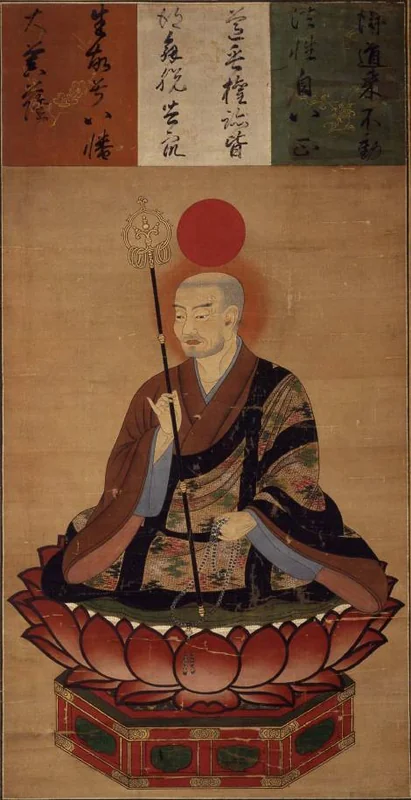
Hachiman (八幡神, 'God of the Eight Banners') is the Shinto deity of war, archery, and divine protection of Japan, syncretised early with the bodhisattva Daibosatsu (a Buddhist saint). He is closely associated with Emperor Ōjin (r. 270–310 CE in legendary chronology), who was deified as Hachiman after death — or in some accounts, Hachiman appeared as the divine manifestation of Emperor Ōjin. The warrior class of Japan, particularly the samurai, venerated him as their patron. The Usa Jingū shrine in Ōita Prefecture (Kyushu) is Hachiman's principal sanctuary, established c. 725 CE. The Tsurugaoka Hachiman-gū in Kamakura was built by the Minamoto clan in 1191 CE as the spiritual centre of the Kamakura shogunate. Hachiman's manifestation as oracle is attested in chronicles from the 8th century CE.
Quick facts
- Pantheon
- Japanese
- Figure type
- God
- Period
- Deification associated with Emperor Ōjin (legendary 3rd–4th century CE); Usa shrine established c. 725 CE
- Primary sources
- Nihon Shoki (720 CE), trans. Aston 1896: Emperor Ōjin chapters; Shoku Nihongi (797 CE): oracle of Hachiman, trans. various
- Related figures
- amaterasu, ojin, empress-jingu
Origin and deification
Hachiman's origin is intertwined with the figure of Emperor Ōjin (legendary reign 270–310 CE), described in the Nihon Shoki (trans. Aston 1896) as a powerful emperor associated with continental relations and the arrival of Confucian learning. Ōjin was deified after death at Usa in northern Kyushu — a region culturally and geographically close to the Korean peninsula — where his spirit became the oracle deity known as Hachiman. By 725 CE, the Usa Hachiman shrine was formally established. In 749 CE, according to the Shoku Nihongi (797 CE), the Hachiman oracle at Usa sent a divine message to the imperial court at Nara, declaring support for the building of the Tōdai-ji bronze Buddha — the first recorded instance of a Shinto deity formally endorsing a Buddhist project. This marked a key moment in the early syncretism of Shinto and Buddhism (shinbutsu-shūgō).
Warrior patron and archery
Hachiman's association with warfare became paramount in the Heian period (794–1185 CE) when warrior families (bushi) began to rise in power. The Minamoto clan in particular claimed Hachiman as their divine protector; Minamoto no Yoritomo built the Tsurugaoka Hachiman-gū in Kamakura in 1191 CE as the central shrine of his new shogunate. The deity's identification with archery reflects the central role of mounted archery (yabusame) in Japanese warrior culture. Yabusame ritual — mounted archers shooting at targets while riding — was performed at Hachiman shrines as a form of divine petitioning and military training in religious form. Hachiman's eight banners (hachi-man means 'eight ten-thousand' but popularly glossed as 'eight banners') became symbols of military authority.
Sources & further reading (2)
- primary-source — accessed 2026-05-06
- encyclopedia — accessed 2026-05-06
Frequently asked questions
Is Hachiman a Shinto or Buddhist deity?
Hachiman is one of the most prominent examples of shinbutsu-shūgō (the syncretism of Shinto kami and Buddhist divinities) in Japanese religious history. From early in his cult's development, Hachiman was identified as a bodhisattva — Hachiman Daibosatsu — and received Buddhist priests, rituals, and iconographic elements alongside Shinto worship. The Usa Jingū oracle of 749 CE endorsing the Buddhist Tōdai-ji project cemented this dual identity. Hachiman shrines throughout Japan have historically housed both Shinto priests and Buddhist monks. The Meiji government's forced separation of Shinto and Buddhism (shinbutsu-bunri, 1868) disrupted this tradition, but many Hachiman sites retain the layered heritage of centuries of syncretism.
What is yabusame and its connection to Hachiman?
Yabusame (流鏑馬) is the Japanese ritual of mounted archery in which riders shoot at wooden targets at a gallop from a running horse. It is performed as a religious ceremony at several major Shinto shrines, most famously at Tsurugaoka Hachiman-gū in Kamakura and at Shimogamo Shrine in Kyoto. The ritual petitions Hachiman for military prowess, divine protection, and a good harvest. Yabusame developed in the Heian period and was institutionalised by the Kamakura shogunate (1185–1333 CE) as a formal military-religious practice. In the Shoku Nihongi (797 CE), accounts of archery associated with Hachiman shrines suggest early connections between the deity and martial training. Contemporary yabusame continues as a living ceremonial tradition at major festivals.