God
Dionysus
God of wine, festivity, theatre, and ritual madness in Greek mythology.
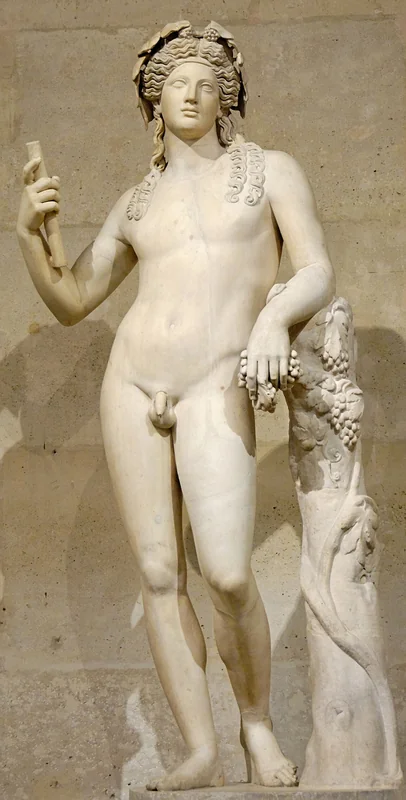
Dionysus is the Olympian god of wine, viticulture, festivity, theatre, and religious ecstasy in Greek mythology. Son of Zeus and the mortal Semele, he is unique among the Olympians as the son of a mortal woman. When Semele was destroyed by Zeus's lightning, Zeus sewed the unborn Dionysus into his thigh until ready for birth. Dionysus later descended to the underworld to retrieve his mother. He introduced viticulture to humanity and established his cult throughout Greece and beyond. His Roman equivalent is Bacchus.
Quick facts
- Pantheon
- Greek
- Figure type
- God
- Period
- Attested from the 8th century BCE; Linear B tablet di-wo-nu-so-jo at Pylos c. 1200 BCE
- Primary sources
- Hesiod Theogony 940–942; Homeric Hymn 7 (To Dionysus); Apollodorus Bibliotheca 3.4.3; Homer Iliad 6.130–137
- Related figures
- zeus, semele, ariadne, hermes, apollo
Twice-born god
The myth of Dionysus's unusual birth is central to his mythology. His mother Semele, a daughter of Cadmus of Thebes, was a mortal lover of Zeus. Hera, jealous, tricked Semele into asking Zeus to reveal himself in his full divine form. When Zeus appeared in his true glory as god of thunder, the radiance destroyed Semele. Zeus rescued the unborn Dionysus, sewing him into his own thigh until the gestation period was complete. Dionysus thus had two births: one from his mother Semele, and one from his father Zeus. This dual birth earned him the epithet 'twice-born' (Eurip. Bacchae 288–297, Apollodorus 3.4.3).
God of theatre
The origin of Greek theatre is traced to the festivals of Dionysus. The Great Dionysia festival at Athens, held in spring, was the occasion for the performance of tragedies and comedies. Ancient sources agree that tragedy (from tragodia, 'goat-song') developed from choral dithyrambs sung in honour of Dionysus (Aristotle Poetics 4.14). The Theatre of Dionysus on the southern slope of the Acropolis was the venue for original performances of plays by Aeschylus, Sophocles, Euripides, and Aristophanes. Theatre masks, associated with Dionysus, symbolise his domain of dramatic transformation.
Sources & further reading (2)
- primary-source — accessed 2026-05-06
- encyclopedia — accessed 2026-05-06
Frequently asked questions
Why is Dionysus called the 'twice-born'?
Dionysus is called the 'twice-born' because of his unusual dual birth. His mortal mother Semele was destroyed by the radiance of Zeus, who rescued the unborn infant and sewed him into his own thigh. Dionysus completed his development there and was 'born' a second time from Zeus's thigh. This is narrated in Apollodorus's Bibliotheca (3.4.3) and alluded to in Euripides's Bacchae and Hesiod's Theogony (940–942).
What is the Dionysian cult?
The cult of Dionysus encompassed rituals centred on wine, communal festivity, and religious ecstasy. The principal festivals in Athens were the Lenaia (winter) and the Greater Dionysia (spring). Dionysiac worship also included the Maenads (Bacchants), female devotees who were believed to enter states of divine frenzy (Euripides Bacchae 135–169). Mystery cults associated with Dionysus, including the Orphic mysteries, promised their initiates a better fate after death. These rites spread across the Greek world and, as the Bacchic cult, into Rome.