God
Demeter
Goddess of the harvest, grain, and the fertility of the earth.
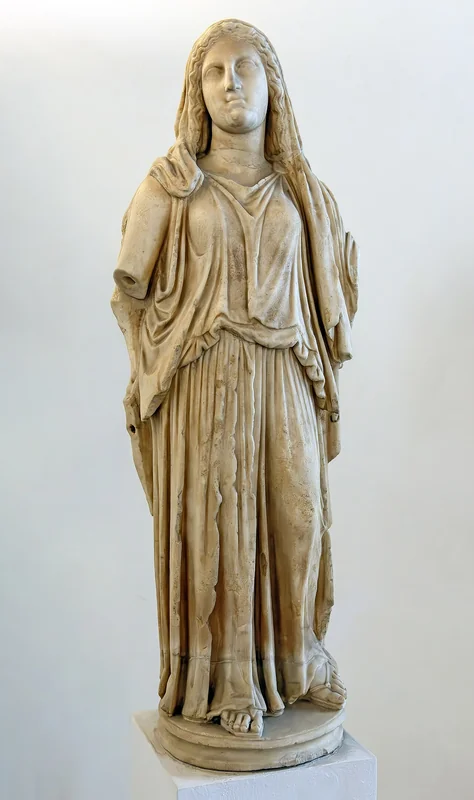
Demeter is the Olympian goddess of the harvest, grain, and agriculture in Greek mythology. Daughter of Cronus and Rhea, she is the sister of Zeus, Poseidon, Hades, Hera, and Hestia. Demeter is best known for the myth of her daughter Persephone's abduction by Hades, which the Homeric Hymn to Demeter (c. 650 BCE) records as the mythological origin of the seasons. The Eleusinian Mysteries, ancient Greece's most important religious rites, were conducted in her honour at Eleusis.
Quick facts
- Pantheon
- Greek
- Figure type
- God
- Period
- Attested from the 8th century BCE; possibly related to earlier Minoan grain deities
- Primary sources
- Homeric Hymn 2 (To Demeter) 1–495; Hesiod Theogony 453–456; Apollodorus Bibliotheca 1.5.1–3
- Related figures
- zeus, hera, persephone, hades, triptolemus
The myth of Persephone
The Homeric Hymn to Demeter (c. 650 BCE) narrates the abduction of Demeter's daughter Persephone by Hades, god of the underworld. Demeter searched the earth in grief for nine days before Helios revealed what had happened. She withdrew her gifts from the land, causing crops to fail and threatening all life. Zeus intervened and compelled Hades to return Persephone; however, because Persephone had eaten pomegranate seeds in the underworld, she was required to spend a portion of each year there. This myth explains the alternation of the fertile seasons, when Demeter rejoices, and winter, when she mourns.
The Eleusinian Mysteries
Demeter's most important cult centre was at Eleusis, near Athens, where the Eleusinian Mysteries were conducted annually from at least the 8th century BCE until the 4th century CE. The rites re-enacted the myth of Persephone's return and promised initiates a more blessed existence in the afterlife. Participants included famous historical figures such as Plato, Cicero, and the emperor Marcus Aurelius. The exact rites were kept secret; ancient sources describe only that initiates 'saw' something transformative (Pindar Frg. 137 Snell).
Sources & further reading (2)
- primary-source — accessed 2026-05-06
- encyclopedia — accessed 2026-05-06
Frequently asked questions
What is the origin of the seasons according to Greek mythology?
The Homeric Hymn to Demeter (c. 650 BCE) provides the mythological explanation. When Demeter's daughter Persephone was abducted by Hades, Demeter's grief prevented crops from growing. After Zeus arranged a compromise, Persephone spends roughly one-third of the year in the underworld (autumn and winter) and the remainder on earth (spring and summer). When Persephone returns, Demeter rejoices and the earth becomes fertile again.
What were the Eleusinian Mysteries?
The Eleusinian Mysteries were ancient Greek religious rites held annually at Eleusis, dedicated to Demeter and her daughter Persephone. They were the most important mystery religion of ancient Greece, conducted from at least the 8th century BCE until the late 4th century CE. Initiates were sworn to secrecy about the rites themselves, which involved fasting, processions, and a culminating ceremony believed to promise a blessed afterlife.