Hero
Dangun
The legendary founder of Gojoseon, the first Korean kingdom, born of a bear-woman and a divine father.
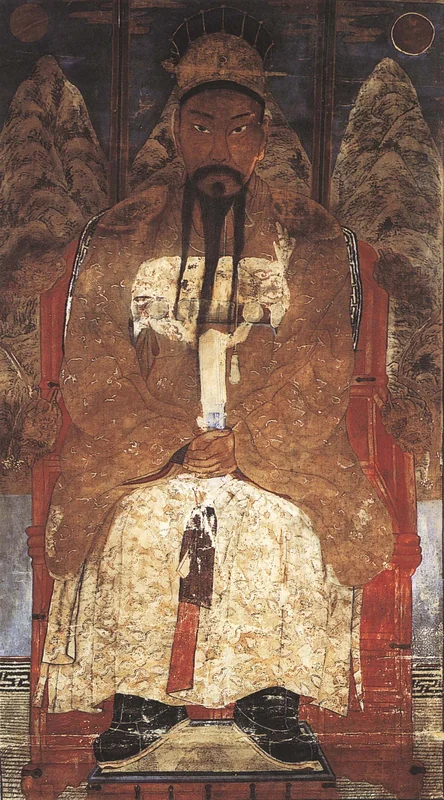
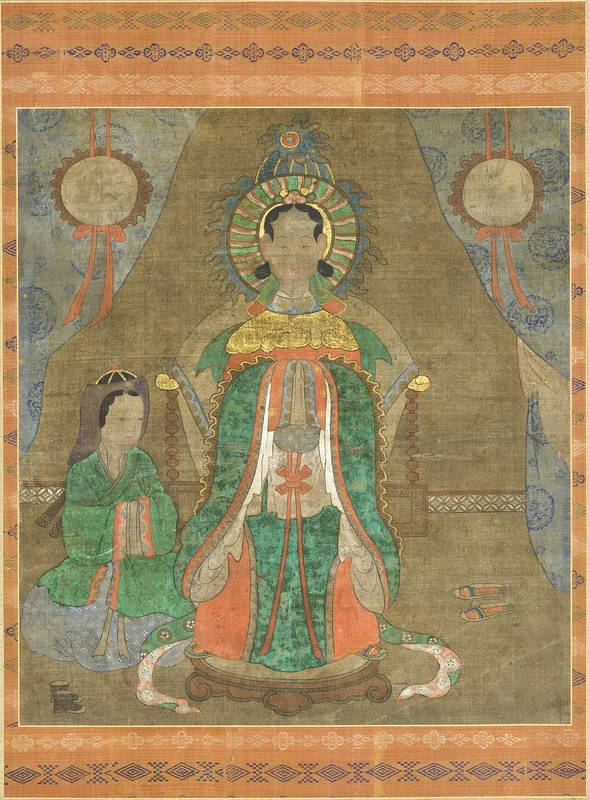
Dangun Wanggeom (단군왕검, 'Sandalwood Lord King') is the legendary founder and first ruler of Gojoseon (Old Joseon), the first Korean state, according to the founding mythology of Korea. He was the son of Hwanwoong (son of the Heavenly Lord Hwanin) and Ungnyeo, a bear-woman who had been transformed into human form after enduring the trials set by Hwanwoong. Dangun founded Gojoseon in 2333 BCE (by the traditional calculation) at the city of Asadal, near present-day Pyongyang. After ruling for 1,500 years, he withdrew to Mount Taebaek and became a mountain spirit (sansin). His founding myth is recorded in the Samguk Yusa (1281 CE) by the monk Iryeon and the Jewang Ungi (1287 CE) by Yi Seunghyu.
Quick facts
- Pantheon
- Korean
- Figure type
- Hero
- Period
- Legendary founding date: 2333 BCE; myth recorded in Samguk Yusa (1281 CE) and Jewang Ungi (1287 CE)
- Primary sources
- Samguk Yusa (1281 CE), Book 1: 'Gojoseon' section, by Iryeon; Jewang Ungi (1287 CE) by Yi Seunghyu
- Related figures
- hwanwoong, hwanin, ungnyeo
Birth and founding of Gojoseon
The Samguk Yusa (1281 CE, Book 1, 'Gojoseon' section) records the founding myth. The Heavenly Lord Hwanin permitted his son Hwanwoong to descend to the human world with three thousand followers and the three heavenly seals of governance. Hwanwoong descended to Mount Taebaek (Baekdu Mountain) and established a sacred city called Sinsi ('Divine City'). A bear and a tiger living nearby prayed to become human. Hwanwoong gave them a bundle of mugwort and twenty cloves of garlic and commanded them to remain in a cave for one hundred days, avoiding sunlight. The tiger gave up; the bear endured and was transformed into a woman — Ungnyeo. She longed for a child; Hwanwoong temporarily took human form and married her. Their son was Dangun Wanggeom. Dangun established the capital at Asadal, founded the kingdom of Gojoseon (in the 50th year of the reign of the Chinese emperor Yao, traditionally 2333 BCE), and ruled for 1,500 years.
Retreat and divine legacy
According to the Samguk Yusa (1281 CE), after ruling Gojoseon for 1,500 years and transferring the kingdom to the Zhou dynasty's enfeoffed figure Gija (a historical or semi-historical Chinese figure sent to rule the Korean peninsula), Dangun withdrew to Asadal and became a mountain spirit (sansin). The Jewang Ungi (1287 CE) by Yi Seunghyu gives a slightly different account of the timeline. Dangun's identity as a mountain spirit after his long earthly reign connects him to the widespread East Asian tradition of the mountain god, and to the importance of mountains as sacred spaces in Korean religion. Mount Baekdu (Baekdusan, on the present-day Korea–China border) is identified as Hwanwoong's descent point and remains the most sacred mountain in Korean cultural tradition.
Sources & further reading (2)
- encyclopedia — accessed 2026-05-06
- primary-source — accessed 2026-05-06
Frequently asked questions
Is Dangun considered a real historical figure in Korea?
Dangun occupies a complex position in Korean historical and cultural memory. In the Samguk Yusa (1281 CE), Iryeon presents the story as mythology alongside other legendary material. Modern historiography treats Dangun as a mythological figure representing the founding narrative of Korean civilization. However, the legendary date of 2333 BCE for the founding of Gojoseon is treated as the starting year in the Dangun Era (단기, tangi) calendar system, which was widely used in Korea until 1961 CE and continues in some official Korean contexts. National Foundation Day (Gaecheonjeol, 개천절) is celebrated on October 3rd in South Korea as the anniversary of Dangun's establishment of Gojoseon. Dangun represents Korean cultural and ethnic identity rather than a verifiable historical figure.
What is the significance of the bear and tiger in the Dangun myth?
The Samguk Yusa (1281 CE) presents the bear and the tiger as petitioners for humanity who must pass a trial of self-discipline. The contrast between the patient bear (successful) and the impatient tiger (failed) has been interpreted by Korean scholars in several ways. One reading sees the bear as representing an early Korean tribal group that practiced bear totemism (the bear is a significant totemic animal across Siberian and East Asian cultures), successfully absorbed into the Hwanwoong-led people through cultural assimilation (the trial of garlic and mugwort). The tiger represents a different tribal group that could not be integrated. Another reading treats the myth as a moral narrative about endurance and patience as prerequisites for civilized life. The bear's transformation into Ungnyeo, who then becomes the mother of Korea's founder, makes the bear the maternal ancestor of the Korean people.