Titan
Cronus
Ruler of the Titans and father of the Olympian gods in Greek mythology.
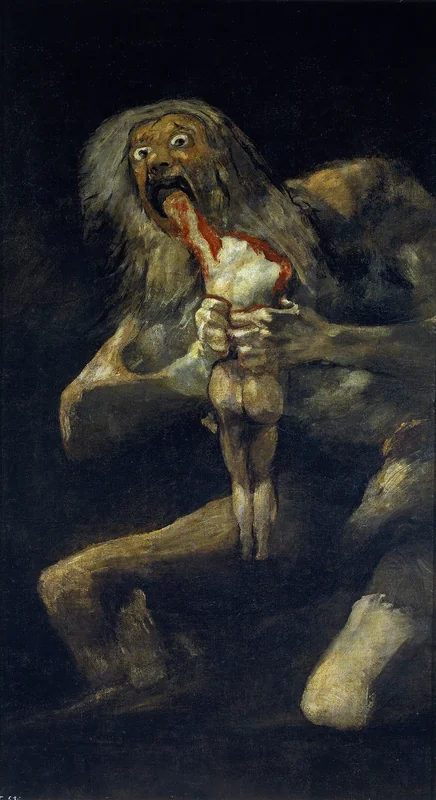
Cronus is the youngest and most powerful of the first generation of Titans in Greek mythology, son of Ouranos (Sky) and Gaia (Earth). He overthrew his father Ouranos by castrating him with an adamantine sickle given by Gaia. Cronus then ruled as king of the cosmos during the Golden Age. Warned by prophecy that his own offspring would overthrow him, he swallowed each of his children at birth — Hestia, Demeter, Hera, Hades, and Poseidon — until his wife Rhea hid the youngest, Zeus, and substituted a stone. Zeus grew up, returned, forced Cronus to disgorge his siblings, and overthrew him in the Titanomachy. His Roman equivalent is Saturn.
Quick facts
- Pantheon
- Greek
- Figure type
- Titan
- Period
- Attested from Hesiod (c. 700 BCE); the Golden Age ruled by Cronus placed before historical time
- Primary sources
- Hesiod Theogony 137–138, 168–182, 453–506; Hesiod Works and Days 109–120 (Golden Age); Apollodorus Bibliotheca 1.1.2–5
- Related figures
- zeus, hera, poseidon, demeter, hades, prometheus, atlas
Overthrow of Ouranos
Hesiod's Theogony (168–182) narrates that Gaia, suffering from the children whom Ouranos refused to allow out of her body, fashioned an adamantine sickle and asked her sons for help. Only Cronus agreed. When Ouranos came to lie with Gaia, Cronus struck with the sickle and severed Ouranos's genitals, casting them into the sea. From the foam arose Aphrodite; from the blood that fell on earth arose the Erinyes (Furies), Giants, and the Meliae (ash-tree nymphs). With Ouranos overthrown, Cronus became ruler of the cosmos and married his sister Rhea.
The Golden Age
Hesiod's Works and Days (109–120) describes the generation of humans living under Cronus's rule as the Golden Race — beings who 'lived like gods, free from sorrow and pain, who did not grow old in labour and grief. Their fields bore crops spontaneously, and they lived in abundance.' This era became the mythological archetype of a lost paradise, the Golden Age, contrasted with subsequent ages of silver, bronze, heroes, and iron (the present, fallen age). The Greek and Roman tradition of a once-perfect past, associated with the rule of Cronus/Saturn, influenced a long line of Western literature.
Sources & further reading (2)
- primary-source — accessed 2026-05-06
- encyclopedia — accessed 2026-05-06
Frequently asked questions
Why did Cronus swallow his children?
Cronus swallowed each of his children at birth because Ouranos and Gaia had warned him by prophecy that he would be overthrown by his own offspring, just as he himself had overthrown Ouranos (Hesiod Theogony 453–467). By swallowing Hestia, Demeter, Hera, Hades, and Poseidon, Cronus attempted to break the cycle of generational overthrow. His wife Rhea eventually outwitted him by substituting a stone wrapped in swaddling cloths for the youngest child, Zeus, who was hidden in Crete.
What is the Titanomachy?
The Titanomachy is the ten-year war between the Olympian gods, led by Zeus, and the Titans, led by Cronus, described by Hesiod in the Theogony (617–735). Zeus released the Cyclopes from Tartarus; they forged his thunderbolt in gratitude. He also released the Hecatoncheires (Hundred-Handers), whose storm of rocks overwhelmed the Titans. The Titans were defeated and imprisoned in Tartarus, guarded by the Hecatoncheires. The victory of the Olympians over the Titans represents, in Hesiod's narrative, the establishment of the current cosmic order under Zeus.