Monster
Chimera
Fire-breathing monster of Greek mythology with lion, goat, and serpent parts.
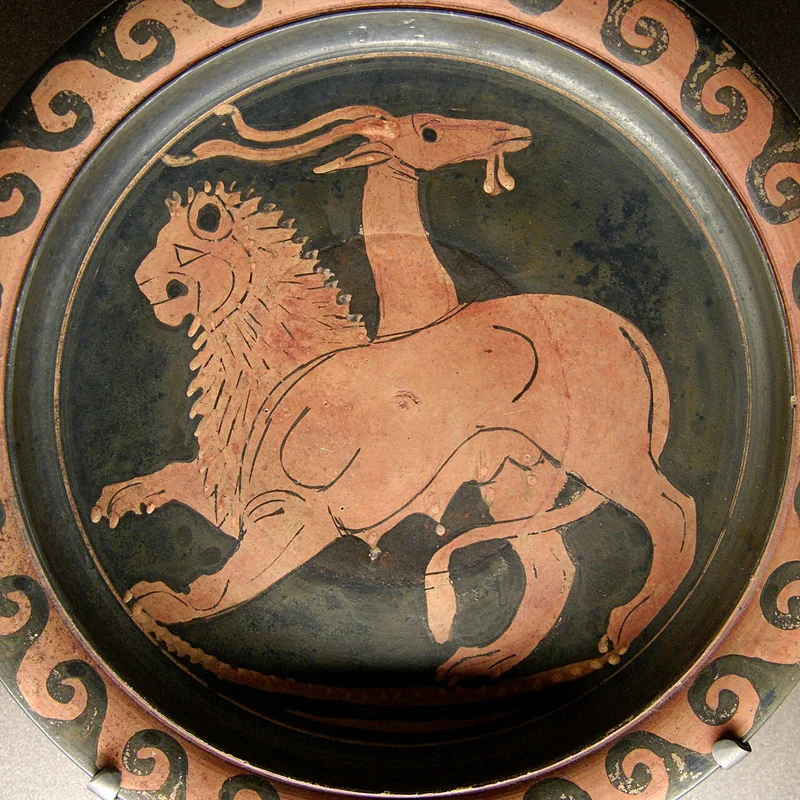
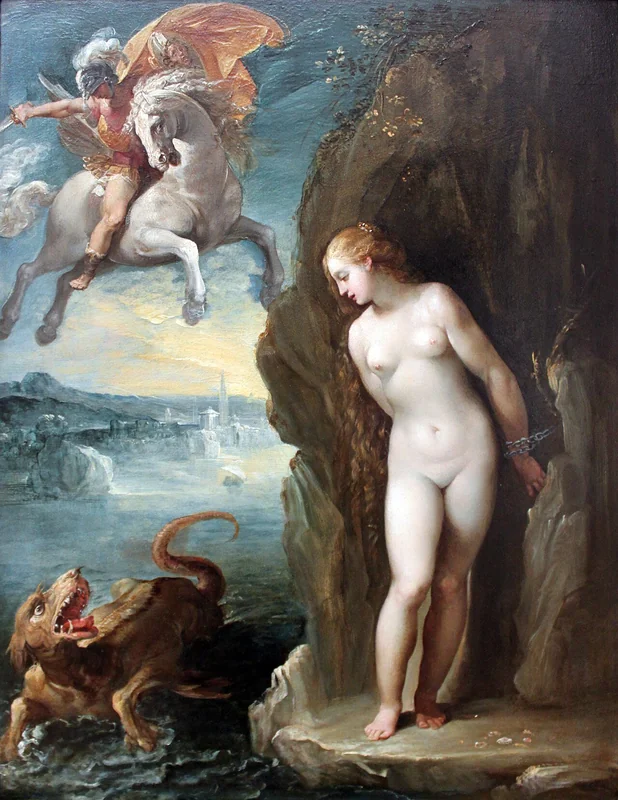
The Chimera is a fire-breathing monster of Greek mythology with the head of a lion, the body of a goat (or a goat's head rising from its back), and a serpent or dragon for a tail. She is a daughter of Typhon and Echidna, and her siblings include Cerberus, the Lernaean Hydra, the Sphinx, and the Nemean Lion. The Chimera ravaged Lycia until slain by the hero Bellerophon, who attacked her from the air on the winged horse Pegasus. She is among the earliest monsters described in Greek literature, appearing in Homer's Iliad (6.179–182).
Quick facts
- Pantheon
- Greek
- Figure type
- Monster
- Period
- Attested from Homer's Iliad (c. 750 BCE); iconography from c. 600 BCE
- Primary sources
- Homer Iliad 6.179–182; Hesiod Theogony 319–325; Apollodorus Bibliotheca 2.3.1; Pindar Olympian Odes 13.84–87
- Related figures
- bellerophon, typhon, cerberus, hydra, sphinx
Description and genealogy
Homer's Iliad (6.179–182) provides the earliest description: 'She was of divine descent, not human — lion in front, serpent behind, goat in the middle, breathing terrible fire.' Hesiod's Theogony (319–325) gives the genealogy: Chimera is daughter of Typhon and Echidna, sister of Cerberus, the Lernaean Hydra, the Nemean Lion, the Sphinx, and Orthus. Apollodorus (Bibliotheca 2.3.1) repeats the three-body description. The composite nature of the Chimera made her name synonymous in ancient Greek thought with an impossible or absurd combination.
Bellerophon and the Chimaera of Arezzo
Bellerophon killed the Chimera by riding Pegasus above the monster and out of reach of her fire (Homer Iliad 6.183). Apollodorus (Bibliotheca 2.3.1) adds that Bellerophon tipped his lance with lead; the Chimera's own fire breath melted the lead onto her throat, choking her. An Etruscan bronze statue of a chimera, the 'Chimaera of Arezzo,' was discovered in 1553 and is now in the National Archaeological Museum of Florence. Dating to c. 400 BCE, it is one of the finest surviving ancient depictions of a Chimera.
Sources & further reading (2)
- primary-source — accessed 2026-05-06
- encyclopedia — accessed 2026-05-06
Frequently asked questions
What does the word 'chimera' mean today?
The word 'chimera' (from the Greek Chimaira) has entered modern scientific and everyday language as a term for any impossible combination or fantastical creation. In biology, a genetic chimera is an organism composed of cells from two or more genetically distinct zygotes. In molecular biology, a chimeric gene is a fusion of two separate genes. In everyday usage, a 'chimera' refers to an illusory hope or impossible dream — derived from the monster's inherently contradictory hybrid nature.
What is the Chimaera of Arezzo?
The Chimaera of Arezzo is an Etruscan bronze sculpture of the mythological Chimera, discovered in Arezzo (ancient Arretium), Tuscany, in 1553. Dating to c. 400 BCE, it depicts the creature with a lion's body, a goat's head rising from its back (with a serpent biting it), and a serpent tail. It was presented to Cosimo I de' Medici and is now in the National Archaeological Museum of Florence. The inscription on its right foreleg reads 'Tinscvil,' believed to be an Etruscan dedicatory inscription. It is one of the masterpieces of ancient Etruscan metalwork.