Monster
Cerberus
Three-headed dog guarding the entrance to the underworld in Greek mythology.
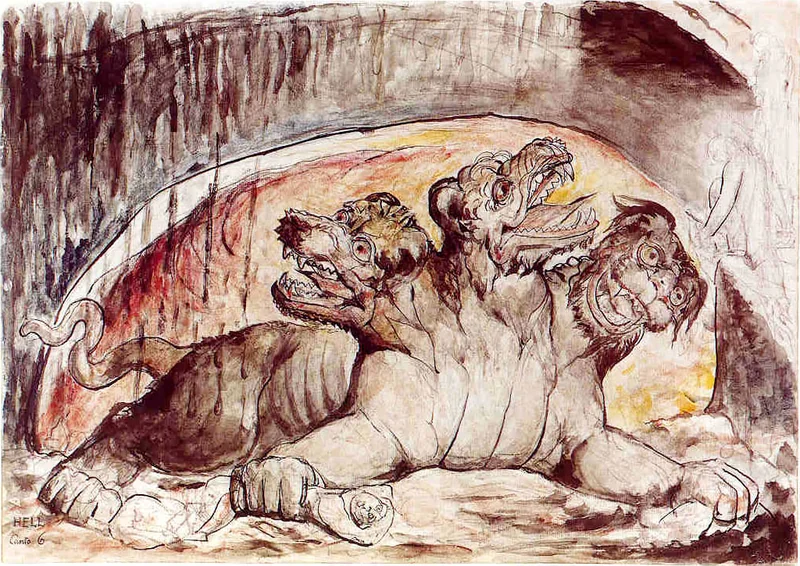
Cerberus is the monstrous multi-headed dog that guards the entrance to the underworld (Hades) in Greek mythology, preventing the living from entering and the dead from leaving. Offspring of the monsters Typhon and Echidna, he is described by Hesiod as having fifty heads (Theogony 311–312), though the canonical image settled on three heads by classical times. He appears in the Twelfth Labour of Heracles — the hero's descent into the underworld to capture and return Cerberus — and in the journeys of Orpheus and Aeneas.
Quick facts
- Pantheon
- Greek
- Figure type
- Monster
- Period
- Attested from the 8th century BCE in Hesiod; consistent presence throughout antiquity
- Primary sources
- Hesiod Theogony 310–312; Apollodorus Bibliotheca 2.5.12; Homer Iliad 8.368–369; Virgil Aeneid 6.417–425
- Related figures
- hades, heracles, orpheus, typhon, hydra, chimera
Guardian of the underworld
Cerberus is stationed at the gates of Hades to prevent both the living from entering and the shades of the dead from leaving. Ancient sources describe him as having multiple heads — Hesiod (Theogony 311) gives fifty, though the iconographic convention settled on three. He also has a serpent for a tail and serpent heads along his back in some descriptions. The shades of the newly dead appeased Cerberus by offering him a honey-cake (a meli, a 'honey-cake') — a funerary custom reflected in Greek burial practices of placing honey-cakes with the dead.
Twelfth Labour: Heracles and Cerberus
Heracles's Twelfth and final Labour was to bring Cerberus alive from the underworld (Apollodorus Bibliotheca 2.5.12). Heracles descended to Hades and asked Persephone's permission to take Cerberus. She granted it, on condition that Heracles overpower the dog without weapons. Heracles grasped Cerberus by the throat, protected by his lion-skin armour, and wrestled him into submission. He carried the dog to King Eurystheus, who was so terrified that he hid in a large storage jar. Heracles then returned Cerberus to the underworld. Where Cerberus's saliva fell to earth during the journey, the plant aconite (monkshood) sprang up.
Sources & further reading (2)
- primary-source — accessed 2026-05-06
- encyclopedia — accessed 2026-05-06
Frequently asked questions
How many heads does Cerberus have?
The canonical image of Cerberus in classical Greek and Roman art gives him three heads, though ancient literary sources vary. Hesiod's Theogony (311–312) gives him fifty heads. Pindar (frg. 249 Snell) gives one hundred heads. Virgil's Aeneid (6.417) gives three. The three-headed form dominates in ancient art and became standard in the popular imagination. In some descriptions (e.g. Apollodorus Bibliotheca 2.5.12) he also has a serpent for a tail and serpent heads along his body.
How did Orpheus pass Cerberus?
When Orpheus descended to the underworld to retrieve his wife Eurydice, he charmed Cerberus with his lyre-playing, as described in Virgil's Georgics (4.481–484) and Ovid's Metamorphoses (10.40–44) — both Latin sources drawing on earlier Greek tradition. The music was so beautiful that the three-headed dog sat still, entranced, allowing Orpheus to pass unharmed. This motif contrasts with the approach of Heracles (who overpowered Cerberus) and the Sibyl's honey-cake offering in Virgil's Aeneid (6.418–424).