Hero
Bellerophon
Greek hero who tamed Pegasus and slew the Chimera.
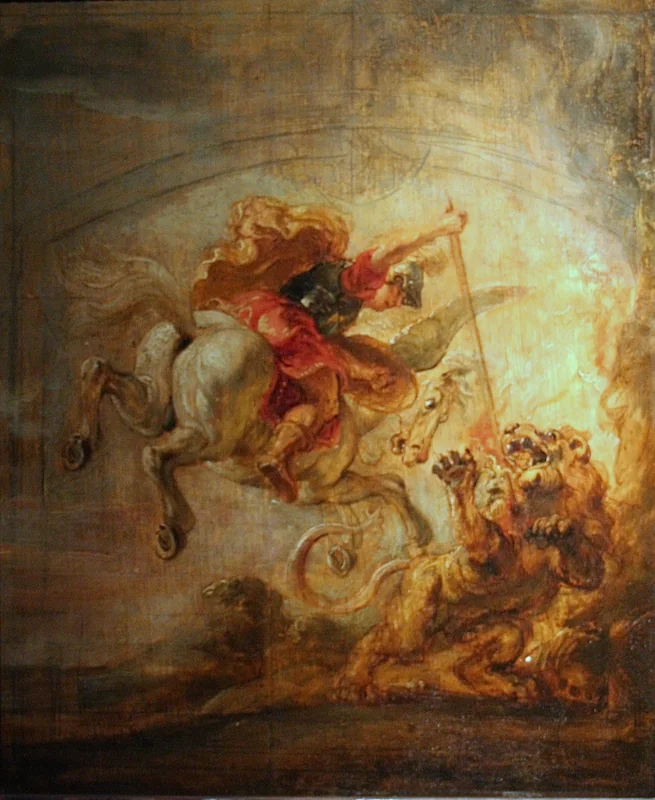
Bellerophon is a hero of ancient Greek mythology, prince of Corinth and son of Poseidon (or Glaucus in some accounts). He is celebrated for taming the winged horse Pegasus with the help of the goddess Athena and for slaying the fire-breathing Chimera of Lycia. His story is narrated in Homer's Iliad (6.155–202) — one of the oldest extended heroic narratives in the epic — and more fully by Apollodorus (Bibliotheca 2.3.1–2). His downfall came when he attempted to fly to Olympus on Pegasus, an act of presumption (hybris) that offended the gods.
Quick facts
- Pantheon
- Greek
- Figure type
- Hero
- Period
- Mythological hero; tradition places him two generations before the Trojan War
- Primary sources
- Homer Iliad 6.155–202; Apollodorus Bibliotheca 2.3.1–2; Pindar Olympian Odes 13.60–92; Hesiod Theogony 319–325
- Related figures
- pegasus, chimera, poseidon, athena
- Constellation link
- Pegasus Constellation (Pegasus)
Pegasus and the Chimera
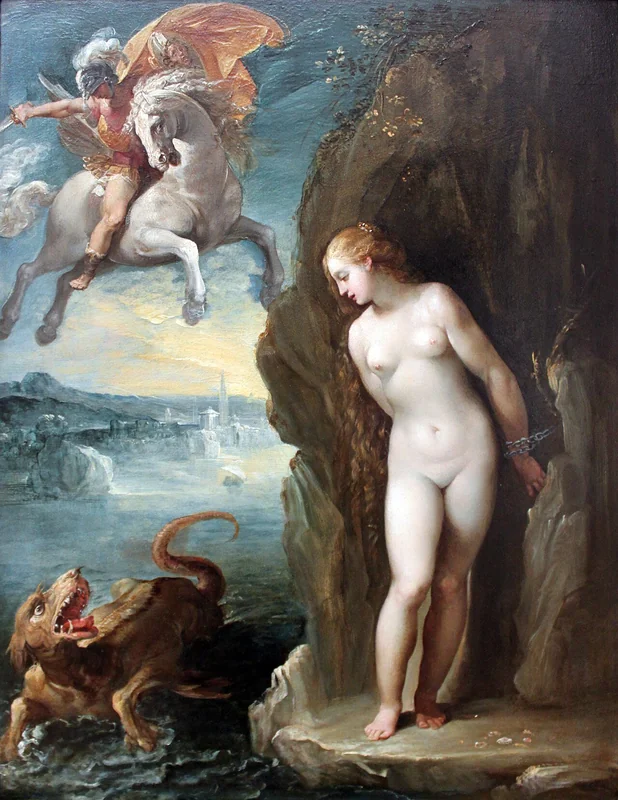
The Iliad's account (6.155–202) narrates that Bellerophon was sent to Lycia by King Proetus of Tiryns with a sealed letter instructing the Lycian king to kill him. Instead, the Lycian king Iobates sent him on a series of dangerous missions, beginning with slaying the Chimera — a fire-breathing monster described by Homer as part lion, part goat, and part serpent (Iliad 6.179–182). Bellerophon killed the Chimera 'relying on the gods' (Iliad 6.183). Pindar's Olympian Ode 13 adds the detail that Bellerophon tamed Pegasus at the spring Peirene with a golden bridle given by Athena in a dream.
Hubris and downfall
After his series of heroic feats in Lycia, Bellerophon's pride led to his ruin. He attempted to fly on Pegasus to the summit of Mount Olympus and join the company of the immortals — an act of hubris (presumptuous pride before the gods). Zeus sent a gadfly that stung Pegasus; the horse threw Bellerophon, who fell to the Aleian plain (Homer Iliad 6.200–202). There he wandered alone, 'devouring his own soul,' until his death. Pegasus continued alone to Olympus where Zeus used him to carry his thunderbolts. The myth serves as a canonical example of hybris and its punishment in Greek thought.
Sources & further reading (2)
- primary-source — accessed 2026-05-06
- encyclopedia — accessed 2026-05-06
Frequently asked questions
Who is Pegasus in relation to Bellerophon?
Pegasus is the famous winged horse of Greek mythology, born from the blood of Medusa when Perseus beheaded her (Hesiod Theogony 280–281). Bellerophon tamed Pegasus using a golden bridle given to him by Athena (Pindar Olympian Odes 13.63–69), enabling him to fly and perform his heroic feats, most famously slaying the Chimera of Lycia. Bellerophon's attempt to fly to Olympus on Pegasus ended in his fall; the horse lived on Olympus carrying Zeus's thunderbolts.
What is hybris in Greek mythology?
Hybris (often spelled hubris) refers in Greek thought to excessive pride, presumption, or outrage against the natural order — specifically, a mortal's presumption to the status or prerogatives of the gods. In mythology, hybris regularly brings divine punishment (nemesis). Bellerophon's attempt to fly to Olympus on Pegasus, Icarus flying too close to the sun (Apollodorus 2.6.3), and Salmoneus imitating Zeus's thunder (Apollodorus 1.9.7) are canonical mythological examples of hybris and its consequences.