Titan
Atlas
Titan condemned to hold up the heavens on his shoulders in Greek mythology.
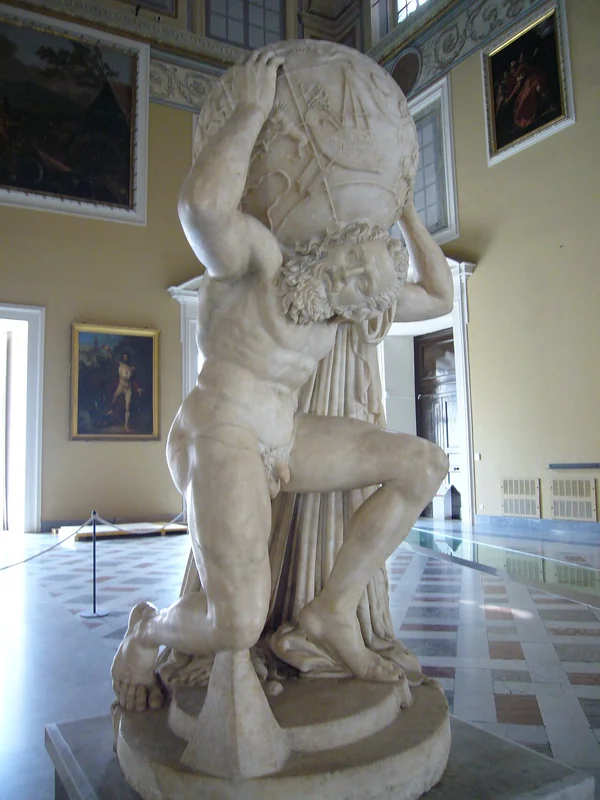
Atlas is a Titan in Greek mythology, son of Iapetus and the Oceanid Clymene (or Asia), brother of Prometheus. As punishment for his role in the Titanomachy — the war of the Titans against the Olympians — Zeus condemned Atlas to stand at the western edge of the earth and hold up the heavens on his shoulders for eternity. He appears in the myths of both Heracles and Perseus, each of whom briefly takes the burden from him. He is associated with the Atlas Mountains in North Africa and the Atlantic Ocean, which take their names from him.
Quick facts
- Pantheon
- Greek
- Figure type
- Titan
- Period
- Attested from Hesiod (c. 700 BCE)
- Primary sources
- Hesiod Theogony 507–520; Apollodorus Bibliotheca 2.5.11; Apollodorus Bibliotheca 2.4.3; Homer Odyssey 1.52–54
- Related figures
- prometheus, heracles, perseus, zeus, pleione
Punishment and the heavens
Hesiod's Theogony (517–520) states that Atlas 'holds up the broad heaven with his head and tireless hands, standing at the edge of the earth, in front of the clear-voiced Hesperides; for this is the lot that wise Zeus assigned him.' Homer's Odyssey (1.52–54) calls him 'the wicked one' who 'knows the depths of the whole sea and holds the tall pillars that keep earth and sky apart.' The dual tradition — Atlas holds the sky, or Atlas holds the pillars separating sky from earth — reflects two slightly different ancient conceptions of the myth.
Atlas and Heracles
During the Eleventh Labour, Heracles was sent to fetch the golden apples of the Hesperides from the garden at the western edge of the world (Apollodorus Bibliotheca 2.5.11). He persuaded Atlas, who was the father of the Hesperides, to fetch the apples for him if Heracles would hold the heavens for a while. Atlas agreed, retrieved the apples, but then refused to take the burden back. Heracles tricked him by asking Atlas to hold the sky briefly so he could adjust his shoulder-pad; Atlas complied and Heracles walked away with the apples.
Sources & further reading (2)
- primary-source — accessed 2026-05-06
- encyclopedia — accessed 2026-05-06
Frequently asked questions
Why was Atlas punished to hold the heavens?
According to ancient sources, Atlas was punished by Zeus for fighting on the side of the Titans in the Titanomachy — the war between the Titans and the Olympian gods (Hesiod Theogony 517–520). While most Titans were imprisoned in Tartarus, Atlas received the particular punishment of standing at the western edge of the earth and holding up the heavens on his shoulders. The myth may preserve an ancient Greek cosmological notion that the heavens must be physically supported to prevent them from collapsing onto the earth.
What is the Farnese Atlas?
The Farnese Atlas is an ancient Roman marble sculpture (c. 2nd century CE, probably a copy of an earlier Hellenistic original) depicting Atlas kneeling and holding a celestial globe on his shoulders. It is now in the National Archaeological Museum of Naples. The celestial sphere on the statue shows an ancient star map with the constellations depicted as mythological figures. The globe is based on a star catalogue possibly derived from Hipparchus (c. 130 BCE) and is the oldest surviving three-dimensional representation of the ancient Greek constellation figures.