God
Athena
Goddess of wisdom, warfare strategy, and crafts in Greek mythology.
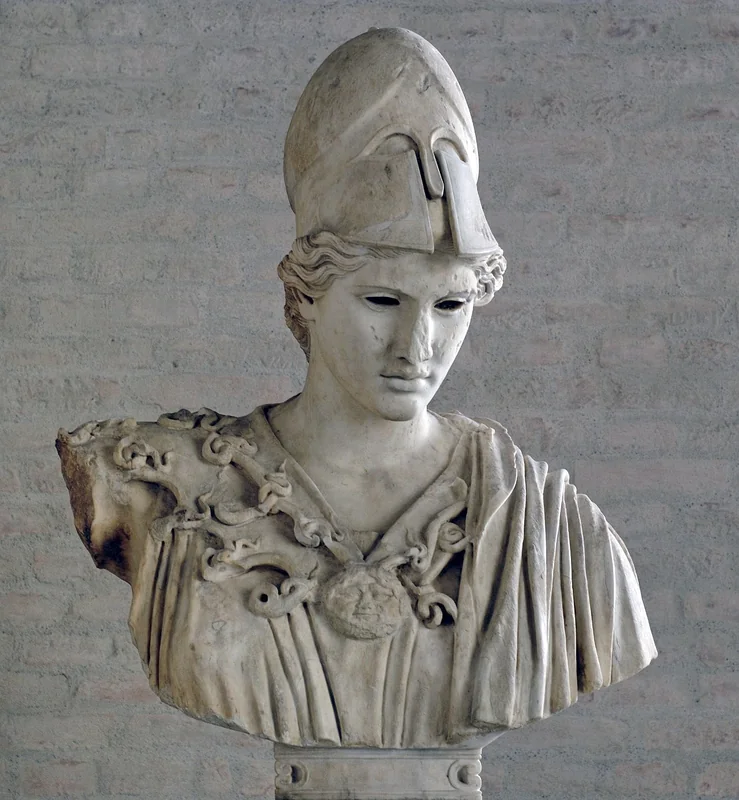
Athena is the Olympian goddess of wisdom, strategic warfare, and crafts in Greek mythology. Born fully armed from the head of Zeus after he swallowed her mother Metis, she is one of the twelve Olympians. As the patron deity of Athens, she gave the city her name after winning a contest against Poseidon. Athena bears the epithet Pallas and is consistently portrayed in ancient sources as a virgin goddess — one of the three divine virgins alongside Artemis and Hestia.
Quick facts
- Pantheon
- Greek
- Figure type
- God
- Period
- Attested from the 8th century BCE; Linear B tablet A-ta-na-po-ti-ni-ja ('Athena the Mistress') at Knossos c. 1400 BCE
- Primary sources
- Hesiod Theogony 886–900; Homeric Hymn 28 (To Athena); Apollodorus Bibliotheca 1.3.6; Homer Iliad 5.719–842
- Related figures
- zeus, hephaestus, poseidon, heracles, odysseus, perseus
Birth from Zeus
Athena's unusual birth is narrated in Hesiod's Theogony (886–900). Zeus swallowed the Titaness Metis after an oracle warned that her offspring would surpass the father in power. Later, afflicted by a terrible headache, Zeus summoned Hephaestus (or Prometheus, in some versions) to split his skull open. From the wound sprang Athena, fully grown and clad in armour, uttering a great war-cry. The myth associates Athena uniquely with Zeus's divine intellect and reflects her role as the goddess of strategic wisdom.
Patron of Athens
Athena's contest with Poseidon for patronage of Athens is recorded by Apollodorus (Bibliotheca 3.14.1) and alluded to by Herodotus (8.55). Each deity offered the Athenians a gift: Poseidon struck the Acropolis rock and produced a saltwater spring; Athena produced an olive tree. The Athenians — or the gods themselves — judged the olive tree the more valuable gift. The city was named Athens after Athena, and the Parthenon on the Acropolis was built as her primary sanctuary. The great chryselephantine statue of Athena Parthenos by Pheidias (c. 438 BCE) stood inside the Parthenon.
Sources & further reading (2)
- primary-source — accessed 2026-05-06
- encyclopedia — accessed 2026-05-06
Frequently asked questions
How was Athena born?
According to Hesiod's Theogony (886–900), Zeus swallowed the goddess Metis after learning from an oracle that her child would surpass the father. When a severe headache afflicted Zeus, Hephaestus (or Prometheus) split his skull open with an axe, and Athena sprang out fully armed. This myth sets Athena apart from all other Olympians as the only deity born directly from the head of the sky-father.
What is the Parthenon?
The Parthenon is the main temple to Athena on the Acropolis of Athens, built between 447 and 432 BCE under the direction of the sculptor Pheidias and the architects Ictinus and Callicrates. It housed the monumental chryselephantine (gold and ivory) statue of Athena Parthenos. The temple is considered the finest example of Doric architecture; its sculptural programme depicted mythological subjects including the birth of Athena and the Gigantomachy.