Sedum rupestre
Sedum rupestre Care Guide
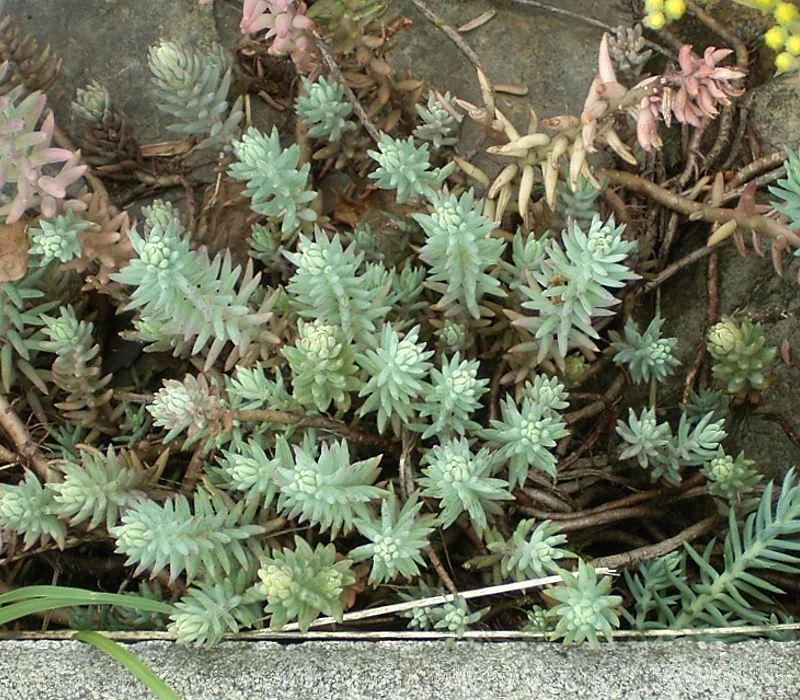 Featured photosedum-rupestre.jpg
Sedum rupestre, commonly called reflexed stonecrop or rock stonecrop, is a European alpine succulent with slender, needle-like, glaucous-green leaves arranged densely on branching stems. It forms low, mat-like clumps that cascade attractively over the sides of containers and walls. Exceptionally hardy and adaptable, it tolerates cold, drought, and poor soils. The cultivar 'Angelina' with golden-yellow foliage is one of the most popular ornamental sedums worldwide.
Care facts at a glance
- Light
- Bright indirect
- Water
- Water sparingly when the soil is completely dry; very infrequently in winter.
- Humidity
- 30–60 %
- Temperature
- -15–35 °C
- Soil
- Very gritty, free-draining mix; tolerates poor, sandy soils well.
- Origin
- Rocky slopes and alpine meadows of central and western Europe.
- Mature size
- 10 to 20 cm tall; spreads to 50 cm wide.
Overview
Sedum rupestre is native to central and western European mountain ranges including the Alps and Pyrenees. Its reflexed (backward-curved) leaves are the origin of one of its common names. The golden cultivar 'Angelina', selected for its vivid chartreuse to orange foliage, has become globally popular in container and rock garden design. Unlike most succulents from tropical or Mediterranean climates, S. rupestre is fully hardy to well below 0 °C.
Care Priorities
- Full sun or very bright indirect light brings out the best foliage colour, especially in the 'Angelina' cultivar.
- Excellent drainage is essential — this species abhors wet roots.
- Very little supplemental watering is needed in cool or temperate climates.
- Trim back annually after flowering to maintain a tidy, dense clump.
Common Problems
Pale, washed-out foliage in the golden cultivar indicates insufficient light — move to a sunnier position. Root rot can occur in poorly draining pots during winter wet; improve drainage and elevate pots if growing outdoors. Aphids may cluster on new soft growth in spring; treat with a dilute soap spray or beneficial insects.
Sources & further reading (2)
- botanical-garden — accessed 2026-05-08
- encyclopedia — accessed 2026-05-08
Frequently asked questions
Is the 'Angelina' cultivar the same species?
Yes — 'Angelina' is a cultivar of S. rupestre selected for its golden-yellow to orange foliage. The care requirements are identical.
Can S. rupestre survive winter outdoors in temperate climates?
Yes — it is one of the hardiest sedums, tolerating temperatures as low as -15 °C. It may look bedraggled in deep winter but recovers vigorously in spring.
Does it flower?
Yes — it produces flat-topped clusters of bright-yellow star-shaped flowers in summer. Deadheading is not necessary but keeps the plant looking tidy.