Philodendron erubescens 'White Princess'
Philodendron 'White Princess' Care Guide
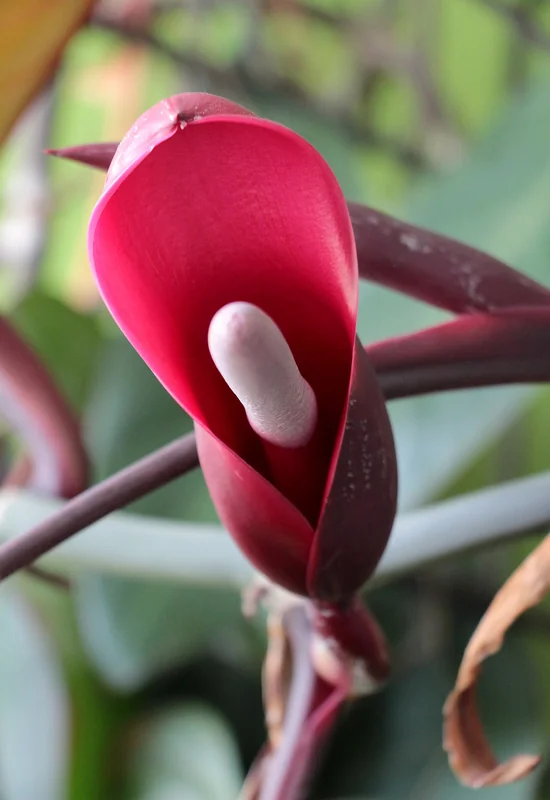 Featured photophilodendron-white-princess.jpg
Philodendron 'White Princess' is a striking variegated cultivar, most likely derived from Philodendron erubescens, featuring elongated dark-green leaves with white sector and streak variegation and characteristically pink to red-flushed petioles that distinguish it from related cultivars. It is a slow-growing, self-heading to semi-vining aroid that has become a collector favourite alongside 'White Knight' and 'White Wizard', each bearing white variegation but differing in petiole and spathe colouration.
Care facts at a glance
- Light
- Bright indirect
- Water
- Water when the top 3 to 4 cm of substrate has dried; every 7 to 10 days in the growing season.
- Humidity
- 60–80 %
- Temperature
- 18–30 °C
- Soil
- Well-draining aroid mix: bark, perlite, and potting compost.
- Origin
- Cultivar of Philodendron erubescens, originally from the tropical forests of Colombia and the Caribbean.
- Mature size
- Self-heading to vining; 60 to 120 cm tall; leaves 20 to 35 cm long.
Overview
Philodendron 'White Princess' is a chimeric cultivar in which some sectors of leaf cells lack chlorophyll, producing the white variegation against the dark green background. The pink to red petiole colouration — caused by anthocyanin pigmentation — is the primary distinguishing feature that separates it from 'White Knight' (brown-purple petioles) and 'White Wizard' (green petioles). The variegation pattern varies per leaf — some leaves may be nearly all-white, others predominantly green with fine streaks. All-white or near-white leaves are beautiful but represent non-photosynthetic tissue that the plant cannot sustain long-term; a balance of green and white leaves keeps the plant healthy.
Care Priorities
- Bright indirect light is essential; too little light causes the plant to push all-green leaves to compensate for low photosynthetic efficiency — fewer white sectors are produced.
- Maintain high humidity to prevent browning of the delicate white leaf tissue, which is less durable than green tissue.
- Monitor for all-green reverted growth and cut it back to a variegated node to prevent green shoots from outcompeting the variegated growth.
- Slow growth means infrequent repotting; repot only when roots emerge from drainage holes.
Common Problems
Thrips are particularly damaging on White Princess as the feeding damage (silvery streaks) is very visible on the white leaf sectors; treat with systemic insecticide at the first sign. Browning of the white sectors at the margins indicates low humidity or water quality issues; switch to distilled water and increase ambient humidity. Reversion to all-green growth can occur when the plant is stressed by low light or over-fertilisation with nitrogen — correct conditions and remove any all-green shoots. Root rot from overwatering is more likely in this slow-growing cultivar as it uses water slowly; ensure thorough drying between waterings.
Sources & further reading (2)
- botanical-garden — accessed 2026-05-08
- encyclopedia — accessed 2026-05-08
Frequently asked questions
How is White Princess different from White Knight?
The primary difference is petiole colour — White Princess has pink to red petioles, while White Knight has dark brown to purplish-brown petioles. Both have white variegated leaves on P. erubescens. White Wizard has green petioles.
Is the variegation stable?
Generally stable, but as a chimeric mutation it can produce more or less variegated leaves depending on conditions. It does not revert entirely but can push predominantly green leaves in low light or high-nitrogen conditions.
Can I propagate a cutting that is mostly white?
A cutting with some green tissue will root, but a node with an all-white leaf will struggle — white tissue cannot photosynthesise and the cutting has insufficient energy reserves. Choose cuttings with a green and white balanced leaf for best propagation results.