Nautilocalyx forgettii
Nautilocalyx forgettii Care Guide
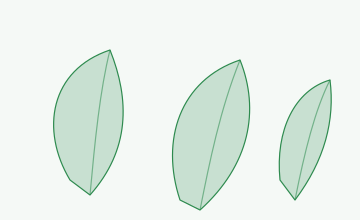 Featured photonautilocalyx-forgettii.jpg
Nautilocalyx forgettii is a rare collector's gesneriad from Peru, prized for its extraordinary foliage — large, heavily bullate (blistered) dark-green leaves with a pronounced iridescent silver-bronze metallic shimmer on the upper surface and deep red to maroon veining and undersides. The yellow tubular flowers are secondary to the spectacular leaf display. A demanding species requiring high humidity and warmth, it is one of the most visually arresting foliage houseplants available and is a highlight in any gesneriad collection.
Care facts at a glance
- Light
- Low light
- Water
- Keep consistently moist; water every 5 to 7 days. Never allow the medium to dry out.
- Humidity
- 65–90 %
- Temperature
- 18–30 °C
- Soil
- Rich, moisture-retentive, free-draining mix: peat-free compost with fine perlite and coir.
- Origin
- Humid lowland rainforests of Peru.
- Mature size
- Compact upright plant; 20–35 cm tall. Leaves 8–15 cm long.
Overview
Nautilocalyx forgettii Sprague was described in 1912, named for Georges Forget, a Belgian orchid grower who first cultivated material from Peru. The genus Nautilocalyx is a neotropical gesneriad closely related to Episcia and Columnea. N. forgettii is rare in cultivation but prized wherever it appears; the iridescent silver metallic sheen on the bullate (deeply puckered) leaf surface is produced by iridoplasts — structurally modified chloroplasts — combined with the surface sculpting that creates multiple light-reflection angles. It is one of the few species where iridescence is combined with deep surface texture to create an almost three-dimensional shimmer effect.
Care Priorities
- Terrarium culture is strongly recommended in temperate climates; the required 65–90% humidity is very difficult to maintain in open household air.
- Water at soil level only; the textured, hairy leaf surface traps moisture and develops Botrytis rapidly if wetted.
- Consistent warmth (above 18 °C year-round) is critical; this Peruvian lowland species has no cold tolerance.
- Moderate, indirect light — the iridescent effect is best visible in diffuse, directional light rather than direct sun.
- Handle minimally; the bullate leaf surface is easily physically damaged.
Common Problems
Iridescent sheen fading or appearing dull usually indicates insufficient light intensity or excessive direct sun that bleaches the leaf; move to a position with bright, diffuse indirect light. Botrytis on the textured leaf surface in wet, stagnant conditions is the primary disease risk; ensure airflow and avoid leaf contact with water. Root rot from waterlogged medium in a pot without sufficient drainage; use a well-draining mix and ensure drainage holes are clear. Fungus gnats indicate persistently wet medium surface; allow the surface to dry slightly between waterings while keeping the root zone consistently moist.
Sources & further reading (2)
- botanical-garden — accessed 2026-05-27
- encyclopedia — accessed 2026-05-27
Frequently asked questions
Is it suitable for a terrarium?
Yes — an enclosed terrarium is the ideal environment. The consistent high humidity (65–90%), warm stable temperature, and diffuse lighting of a well-designed plant terrarium meet this species' requirements precisely. It grows slowly and maintains a compact size suitable for most terrariums. Ensure good airflow to prevent Botrytis.
Where can I find it?
N. forgettii is rarely available from general plant retailers; it is primarily found through specialist gesneriad societies (such as the American Gloxinia and Gesneriad Society), rare plant fairs, and specialist online retailers. Collectors' swaps and gesneriad society seed and cutting exchanges are a reliable source.
What do the flowers look like?
The flowers are tubular, pale-yellow, approximately 2–3 cm long, and appear from the leaf axils. They are modest compared to the extraordinary foliage. Most growers value N. forgettii entirely for its leaves and regard the flowers as an occasional bonus.